
[논문 리뷰] Quantum Computing-Enhanced Algorithm Unveils Novel Inhibitors for KRAS
양자-고전 하이브리드 생성 모델(QCBM-LSTM)을 양자 하드웨어/설계로 학습하여 KRAS 억제제를 설계; 두 화합물이 실험적 활성을 보였으며, 그 중 하나는 pan-KRAS 억제제를 포함한다.
The discovery of small molecules with therapeutic potential is a long-standing challenge in chemistry and biology. Researchers have increasingly leveraged novel computational techniques to streamline the drug development process to increase hit rates and reduce the costs associated with bringing a drug to market. To this end, we introduce a quantum-classical generative model that seamlessly integrates the computational power of quantum algorithms trained on a 16-qubit IBM quantum computer with the established reliability of classical methods for designing small molecules. Our hybrid generative model was applied to designing new KRAS inhibitors, a crucial target in cancer therapy. We synthesized 15 promising molecules during our investigation and subjected them to experimental testing to assess their ability to engage with the target. Notably, among these candidates, two molecules, ISM061-018-2 and ISM061-22, each featuring unique scaffolds, stood out by demonstrating effective engagement with KRAS. ISM061-018-2 was identified as a broad-spectrum KRAS inhibitor, exhibiting a binding affinity to KRAS-G12D at $1.4 μM$. Concurrently, ISM061-22 exhibited specific mutant selectivity, displaying heightened activity against KRAS G12R and Q61H mutants. To our knowledge, this work shows for the first time the use of a quantum-generative model to yield experimentally confirmed biological hits, showcasing the practical potential of quantum-assisted drug discovery to produce viable therapeutics. Moreover, our findings reveal that the efficacy of distribution learning correlates with the number of qubits utilized, underlining the scalability potential of quantum computing resources. Overall, we anticipate our results to be a stepping stone towards developing more advanced quantum generative models in drug discovery.
연구 동기 및 목표
- 양자 강화 생성 모델링을 활용해 소분자 설계를 가속화하는 목적과 시연.
- 리간드 설계를 위한 QCBM 프라이어와 LSTM 제너레이터를 통합한 하이브리드 양자-고전 프레임워크를 개발한다.
- 크고 다양한 KRAS 억제제 데이터셋을 큐레이션하고 합성 가능하며 약물처럼 보이는 분자를 생성하도록 모델을 훈련한다.
- 최고 후보를 실험적으로 합성하고 KRAS 표적에 대한 예측을 검증하기 위해 평가한다.
제안 방법
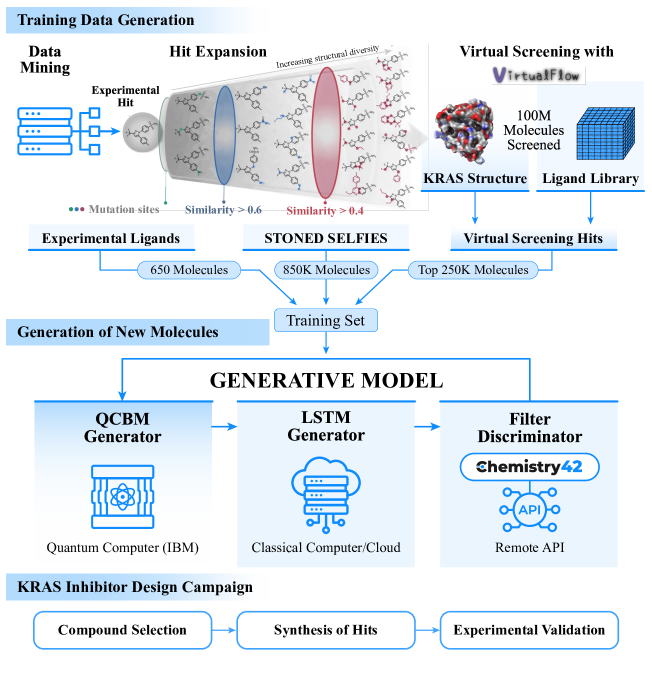
- 약 ~650개의 알려진 KRAS 억제제에서 데이터를 구성하고 STONED-SELFIES 및 가상 스크리닝(REAL 라이브러리)을 통해 약 100만 분자로 확장한다.
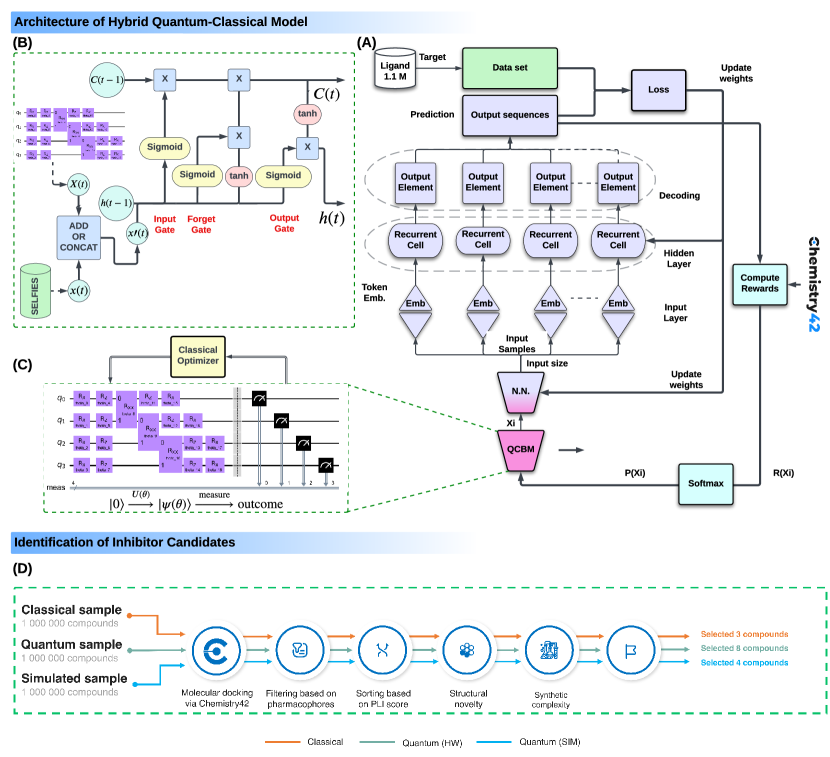
- Priori로 16-퀀비트 QCBM을 사용하고 LSTM 기반의 고전 모델을 보상 신호로 Chemistry42를 활용하는 하이브리드 제너레이터를 구현한다.
- 하드웨어에서 샘플링된 양자 프라이어로 모델을 반복적으로 학습시키고, 양자 및 분자 정보를 LSTM 입력으로 병합한다.
- Tartarus 로컬 필터 및 Chemistry42 점수로 생성된 분자를 평가하고, 실험 시험에 사용할 유망 후보군 15개를 합성한다.
- SPR 및 MaMTH-DS 분석을 통해 결합 및 기능 활성화를 실험적으로 검증하고, KRAS 돌연변이 간 구조-활성 관계를 분석한다.
실험 결과
연구 질문
- RQ1양자 프라이어를 통합하는 것이 고전적 기준선과 비교해 생성된 KRAS 억제제의 품질과 다양성을 개선하는가?
- RQ2양자 프라이어의 퀀비트 수가 분포 학습 및 분자 품질에 어떤 영향을 미치는가?
- RQ3양자 강화 생성 모델이 실험적으로 검증된 KRAS 억제제를 도출할 수 있는가?
- RQ4양자 생성 후보와 고전적 방법의 도킹 점수, 합성 가능성, 표적 결합에서 어떤 차이가 있는가?
주요 결과
- 두 합성 화합물인 ISM061-018-2 및 ISM061-22가 KRAS와의 실험적 교감을 보였다.
- ISM061-018-2는 KRAS-G12D에 대해 1.4 μM 친화도로 결합하고 pan-KRAS 억제제로 작용한다.
- ISM061-22는 돌연변이 선택적 활성으로, 특히 KRAS G12R 및 Q61H 돌연변이에 대해 강하게 작용하며 G12D 결합은 제한적이다.
- 양자 프라이어가 Tartarus 벤치마크에서 분포 학습 및 분자 품질을 개선했다.
- 성공률은 양자 프라이어에 사용된 퀀비트 수와 거의 선형적으로 상관관계가 있다.
- 본 연구는 의약품 발견에서 양자 알고리즘에 기인한 실험적으로 확인된 최초의 히트를 보고한다.
더 나은 연구,지금 바로 시작하세요
논문 읽기부터 검토까지, 연구 시간을 획기적으로 줄여보세요.
카드 등록 없음 · 무료 플랜 제공
이 리뷰는 AI가 만들고, 인간 에디터가 검토했습니다.