
[논문 리뷰] QUEST-DMC superfluid $^3$He detector for sub-GeV dark matter
이 논문은 나노기계 진동자 기반 볼로미터를 사용하여 초유체 $^3$He를 이용해 1 eV 이하의 핵반발 에너지 감도를 확보함으로써, 1 GeV/$c^2$ 이하의 어둠성 물질을 쿼라스입자 탐지 방식으로 탐지하는 새로운 어둠성 물질 탐지기 QUEST-DMC를 제안한다. 이는 경량 어둠성 물질의 스핀 독립 및 스핀 의존 상호작용에 대해 경쟁 가능한 감도를 확보하며, 다중 와이어 NEMS와 고도화된 온도 측정 기술을 통해 향후 향상 가능성을 지닌다.
The focus of dark matter searches to date has been on Weakly Interacting Massive Particles (WIMPs) in the GeV/$c^2$-TeV/$c^2$ mass range. The direct, indirect and collider searches in this mass range have been extensive but ultimately unsuccessful, providing a strong motivation for widening the search outside this range. Here we describe a new concept for a dark matter experiment, employing superfluid $^3$He as a detector for dark matter that is close to the mass of the proton, of order 1 GeV/$c^2$. The QUEST-DMC detector concept is based on quasiparticle detection in a bolometer cell by a nanomechanical resonator. In this paper we develop the energy measurement methodology and detector response model, simulate candidate dark matter signals and expected background interactions, and calculate the sensitivity of such a detector. We project that such a detector can reach sub-eV nuclear recoil energy threshold, opening up new windows on the parameter space of both spin-dependent and spin-independent interactions of light dark matter candidates.
연구 동기 및 목표
- 1 GeV/$c^2$ 이하 어둠성 물질에 대한 새로운 탐지 개념을 개발하며, 특히 스핀 독립 및 스핀 의존 상호작용에 중점을 둔다.
- 기존의 WIMP 중심 실험에서 미처 탐지하지 못한 경량 어둠성 물질 후보에 대한 감도 격차를 해소한다.
- 초유체 $^3$He의 고유한 특성—저온 안정성과 높은 쿼라스입자 감도—를 활용하여 초저에너지 임계값 탐지 기술을 구현한다.
- 신호 및 배경 상호작용의 탐지기 반응을 시뮬레이션하고 모델링하여, 1 eV 이하의 감도를 예측한다.
- 미래의 실험적 실현 및 초유체 전이 현상에 대한 기본 연구를 위한 기반을 마련한다.
제안 방법

- 탐지기는 약 1 cm$^3$ 크기의 초유체 $^3$He 볼로미터 셀을 사용하며, 이는 100 $\mu$K 정도로 냉각된 딜루션 냉각기와 coppeR 자성 냉각 스테이지에 의해 냉각된다.
- 어둠성 물질-$^3$He 산란 사건에서 발생하는 쿼라스입자 자극에 의해 발생하는 열 에너지를 나노기계 진동자(NEMS)인 마이크로미터 이하 직경의 나노와이어로 탐지한다.
- 쿼라스입자 생성의 고해상도 에너지 측정을 위해 이러한 온도에서 처음으로 SQUID 기반 읽기 방식을 구현한다.
- 핵반발에서의 에너지 투입은 쿼라스입자 생성과 열화에 대한 영향을 고려한 세밀한 탐지기 반응 함수를 사용해 모델링된다.
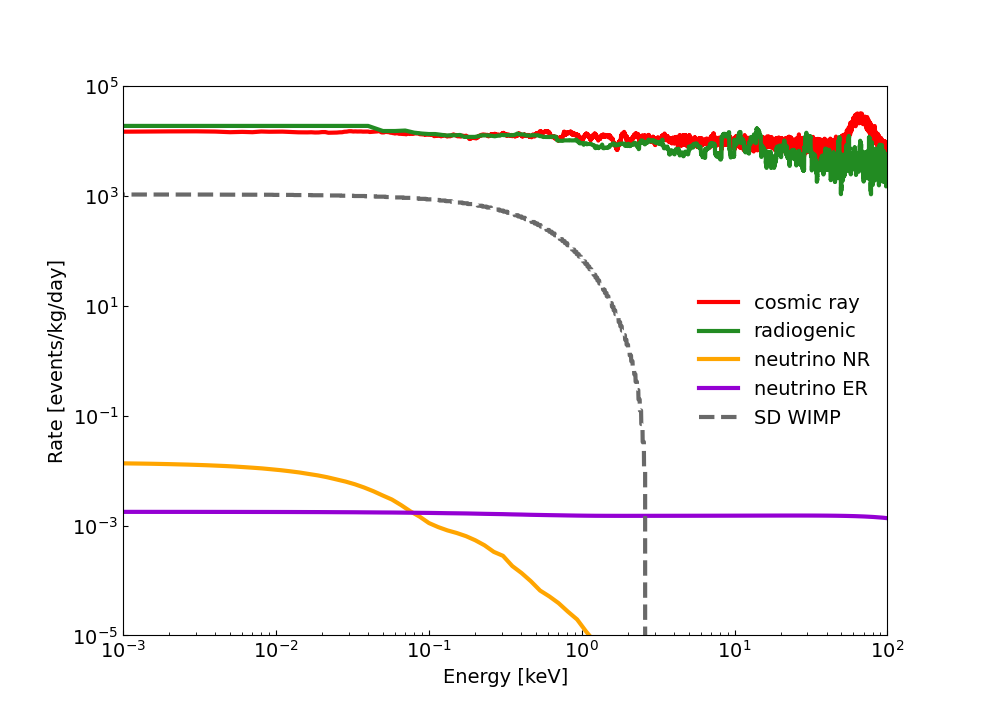
- 몬테카를로 시뮬레이션을 통해 후보 어둠성 물질 신호 및 배경 상호작용(전자 반발 및 우주선 포함)을 모델링한다.
- 에너지 임계값, 신호 효율성, 배경 제거 기반의 전체 시뮬레이션 프레임워크를 사용하여 감도를 예측한다.
실험 결과
연구 질문
- RQ1나노기계 진동자를 탑재한 초유체 $^3$He 기반 볼로미터가 핵반발에 대해 1 eV 이하의 에너지 해상도를 확보할 수 있는가?
- RQ2이러한 탐지기가 1 GeV/$c^2$ 이하 어둠성 물질의 스핀 독립 및 스핀 의존 상호작용에 대해 예상되는 감도는 어떠한가?
- RQ3쿼라스입자 쇼트 노이즈와 진동자 설계는 에너지 임계값과 감도에 어떤 영향을 미치는가?
- RQ41 eV 이하 영역에서의 주요 배경 원인은 무엇이며, 이를 어떻게 제거할 수 있는가?
- RQ5이 탐지기 개념은 균일한 1차 상전이와 같은 기본 초유체 현상을 탐지하는 데 확장 가능할 수 있는가?
주요 결과
- QUEST-DMC 탐지기 개념은 1 eV 이하의 핵반발 에너지 임계값을 예측하여, 경량 어둠성 물질의 매개변수 공간에서 이전에 탐색되지 않은 영역에 접근할 수 있다.
- 이 탐지기는 $^3$He 핵과의 스핀 독립 및 스핀 의존 상호작용에 민감하여, 기존의 희귀가스 기반 실험들과의 보완적 접근을 가능하게 한다.
- 감도 예측 결과에 따르면, 특히 현재 실험에서 덜 탐색된 스핀 의존 상호작용에 대해 1 GeV/$c^2$ 이하 질량 범위에서 경쟁 가능한 감도를 확보한다.
- 여러 개의 독립적인 나노와이어 진동자를 사용할 경우 에너지 해상도가 $\sqrt{N}$ 배 향상되어 감도가 크게 향상될 수 있다.
- 막대에 부착된 진동자나 비국소적 열역학 측정 기술(예: 멀티온 BEC 붕괴)과 같은 대안 전략을 통해 노이즈를 추가로 감소시키고 1 eV 이하로 감도를 연장할 수 있다.
- 시뮬레이션 프레임워크는 에너지 임계값 설정과 이벤트 구조 분석을 통한 배경 억제가 가능함을 보여주며, 발견 가능성을 위한 실현 가능한 길을 제시한다.
더 나은 연구,지금 바로 시작하세요
논문 읽기부터 검토까지, 연구 시간을 획기적으로 줄여보세요.
카드 등록 없음 · 무료 플랜 제공
이 리뷰는 AI가 만들고, 인간 에디터가 검토했습니다.