
[논문 리뷰] RANS-PINN based Simulation Surrogates for Predicting Turbulent Flows
본 논문은 2방정식 k-ε 난류 모델을 사용하여 난류 흐름을 시뮬레이션하는 물리 정보를 갖춘 신경망 프레임워크인 RANS-PINN을 제안하며, 단계적 학습 체계와 미지 Reynolds 수에 대한 매개변수 확장을 포함한다.
Physics-informed neural networks (PINNs) provide a framework to build surrogate models for dynamical systems governed by differential equations. During the learning process, PINNs incorporate a physics-based regularization term within the loss function to enhance generalization performance. Since simulating dynamics controlled by partial differential equations (PDEs) can be computationally expensive, PINNs have gained popularity in learning parametric surrogates for fluid flow problems governed by Navier-Stokes equations. In this work, we introduce RANS-PINN, a modified PINN framework, to predict flow fields (i.e., velocity and pressure) in high Reynolds number turbulent flow regimes. To account for the additional complexity introduced by turbulence, RANS-PINN employs a 2-equation eddy viscosity model based on a Reynolds-averaged Navier-Stokes (RANS) formulation. Furthermore, we adopt a novel training approach that ensures effective initialization and balance among the various components of the loss function. The effectiveness of the RANS-PINN framework is then demonstrated using a parametric PINN.
연구 동기 및 목표
- DNS/LES가 너무 비용이 많이 들어가는 난류 흐름에 대한 빠른 대리 모델링의 필요성을 제시한다.
- PINN 프레임워크에 두 방정식 RANS 난류 모델(k-epsilon)을 통합한다.
- 난류를 위한 데이터 손실과 물리 손실을 안정화하는 견고한 학습 체계를 개발한다.
- 여러 기하에서 대리 모델의 능력을 입증하고 Reynolds 수에 대한 매개변수화 PINN으로 확장한다.
제안 방법
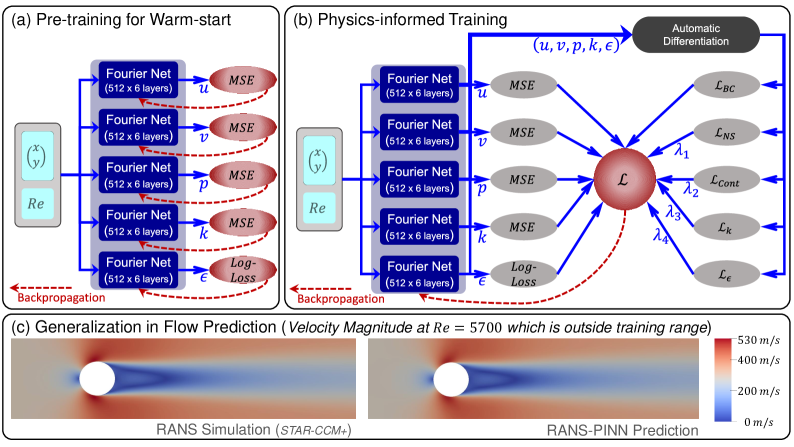
- 속도, 압력, k 및 ε 대리 모델의 백본으로 Fourier 신경망 연산자를 사용한다.
- 데이터 손실로 네트워크를 사전 학습한 뒤 잔차로 정규화된 PDE 기반 물리 손실을 도입한다.
- 벽 근처 및 전단 영역 처리를 위해 소멸항 ε에 대한 로그 손실을 적용한다.
- STAR-CCM+의 CFD 데이터로 지도하고 손실에서 연속성, NS 및 k-epsilon 방정식을 강제한다.
- Reynolds 수를 입력으로 포함시켜 매개변수 PINN을 학습시켜 서로 다른 Re 값에 일반화한다.
- 모듈의 구성 요소를 균형 있게 맞추기 위한 특정 손실 가중치 체계를 갖춘 감소 Adam 옵티마이저를 활용한다.
실험 결과
연구 질문
- RQ1k-epsilon RANS 모델을 사용한 난류 흐름에서 RANS-PINN이 속도 및 압력 필드를 정확히 예측할 수 있는가?
- RQ2단계적 학습 체계가 데이터-물리 손실의 균형과 난류 PINN의 수렴을 개선하는가?
- RQ3새로운 CFD 데이터 없이도 매개변수 PINN이 보이지 않는 Reynolds 수에 대해 유체 예측을 일반화할 수 있는가?
주요 결과
- RANS-PINN은 실린더 흐름에서 ε에 대한 로그 손실 없이 데이터만 또는 데이터+물리보다 더 낮은 검증 손실과 우수한 예측 성능을 달성한다.
- 주어진 Re에서 NACA 2412 및 역방향 계단의 경우 이 방법은 속도 및 압력 필드의 낮은 검증 오차를 산출한다.
- Re를 입력으로 하는 매개변수 PINN은 보지 못한 Reynolds 수에 대해 CFD 데이터 필요성을 줄이고 더 빠른 추론으로 흐름 필드를 예측할 수 있다.
- ε에 대한 로그 손실로 학습하면 벽 부근과 전단 층에서 예측 필드의 안정성이 개선되고 불연속성이 감소한다.
- 이 방법은 세 가지 기하(실린더, 역방향 계단, NACA 2412)에 걸쳐 정확한 예측을 시현하고 새로운 Re 케이스에 대해 실시간과 유사한 예측을 가능하게 한다.
더 나은 연구,지금 바로 시작하세요
연구 설계부터 논문 작성까지, 연구 시간을 획기적으로 줄여보세요.
카드 등록 없음 · 무료 플랜 제공
이 리뷰는 AI가 만들고, 인간 에디터가 검토했습니다.