
[논문 리뷰] Rapid Chemical Enrichment by Intermittent Star Formation in GN-z11
논문은 JWST가 관측한 GN-z11 (z=10.6)에서 관측된 태양 초과 질소 대 산소 비율을 설명하기 위해, 100 Myr의 휴면 단계를 사이에 두고 두 번의 강력한 별 형성 폭발이 반복되는 간헐적 별 형성이라는 가설을 제시한다. 두 번째 폭발에서 유래한 월프-레이엇 별(최대 120 M☉)은 일시적으로 질소, 플루오르, 나트륨, 알루미늄 및 13C, 18O와 같은 이소토프를 강화시켜, 매우 무거운 별이나 사전 enrichment가 필요 없이 관측된 CNO 비율을 성공적으로 재현한다.
We interpret the peculiar super-solar nitrogen abundance recently reported by the James Webb Space Telescope observations for GN-z11 ($z=10.6$) using our state-of-the-art chemical evolution models. The observed CNO ratios can be successfully reproduced -- independently of the adopted initial mass function, nucleosynthesis yields, and presence of supermassive ($>$1000$M_\odot$) stars -- if the galaxy has undergone an intermittent star formation history with a quiescent phase lasting $\sim$100 Myr, separating two strong starbursts. Immediately after the second burst, Wolf--Rayet stars (up to $120M_\odot$) become the dominant enrichment source, also temporarily ($<$1 Myr) enhancing particular elements (N, F, Na, and Al) and isotopes ($^{13}$C and $^{18}$O). Alternative explanations involving (i) single burst models, also including very massive stars and/or pair-instability supernovae, or (ii) pre-enrichment scenarios fail to match the data. Feedback-regulated, intermittent star formation might be common in early systems. Elemental abundances can be used to test this hypothesis and to get new insights on nuclear and stellar astrophysics.
연구 동기 및 목표
- JWST가 관측한 GN-z11 (z=10.6)에서 관측된 태양 수준을 초과하는 4배 이상의 이례적인 높은 N/O 비율을 설명하기 위해.
- 휴면 단계를 포함한 간헐적 별 형성 역사가 매우 무거운 별(VMS)이나 사전 enrichment를 요구하지 않고 관측된 CNO 원소 농도 비율을 재현할 수 있는지 테스트하기 위해.
- 초기 은하에서 빠른 화학적 enrichment를 이끄는 월프-레이엇 별의 역할을 평가하기 위해.
- 화학적 진화 모델을 사용하여 피드백에 의해 조절되고 불규칙적인 별 형성이 일어나는 고적색 이르기 은하의 가능성 평가하기 위해.
제안 방법
- 다양한 별 형성 역사를 가진 상황에서 은하 전체의 원소 농도를 시뮬레이션하기 위해 최신 화학적 진화 모델을 사용하였다.
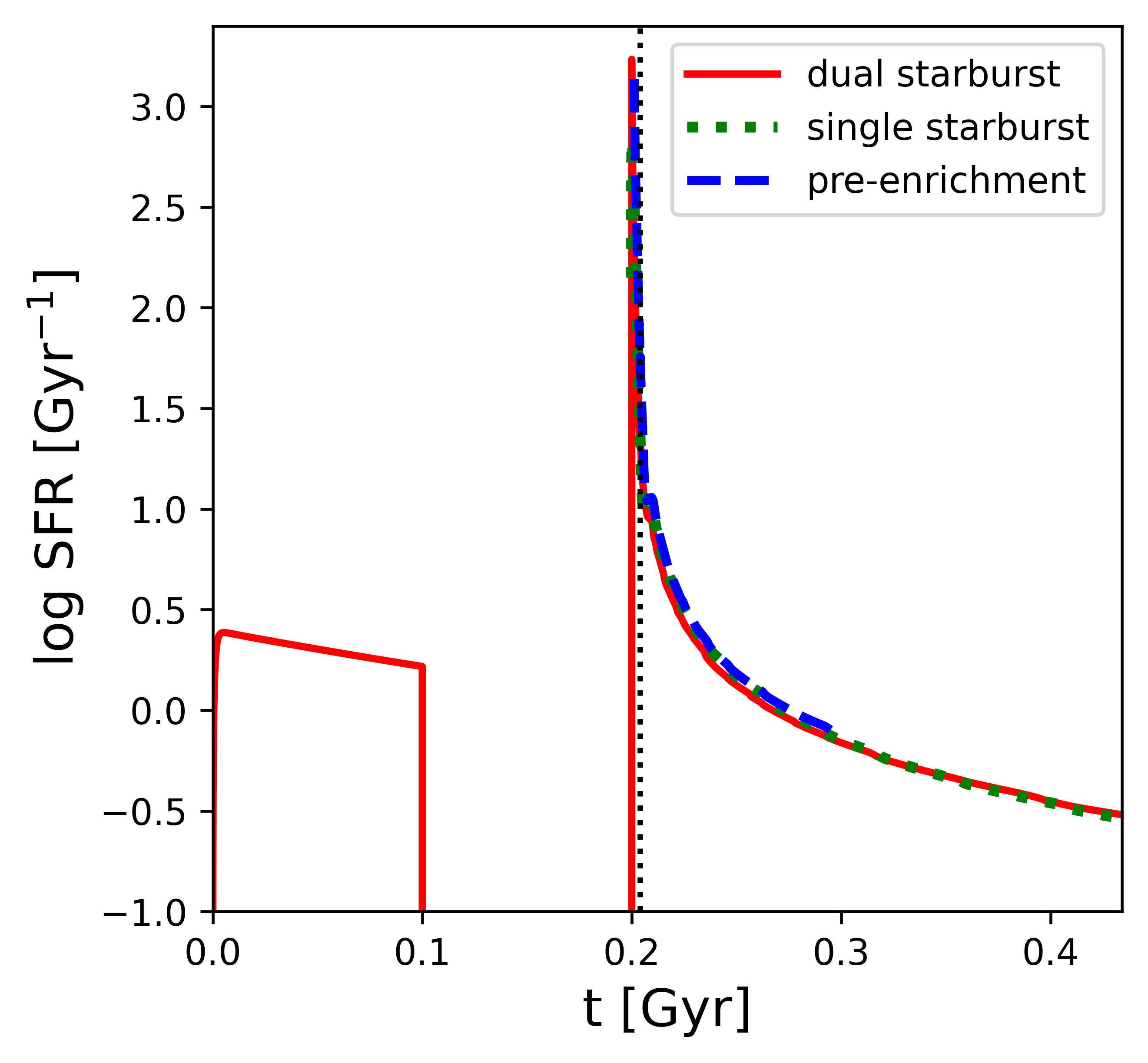
- GN-z11의 관측된 CNO 비율을 재현하기 위해 100 Myr의 휴면 단계를 사이에 두고 두 개의 별 폭발을 모델링하였다.
- 두 번째 폭발 이후의 강화를 주도하는 월프-레이엇 별(최대 120 M☉)의 핵합성 수확량을 통합하였다.
- 폭발 지속 시간, 간격, 유입 timescale을 다양하게 설정하여 모델의 탄력성 평가를 위해 여러 구성 조합을 테스트하였다.
- 매우 무거운 별(VMS)과/또는 쌍-불안정성 초신성(PISNe)이 포함된 단일 폭발 모델 및 사전 enrichment 시나리오와 결과를 비교하였다.
- 미래 관측 검증을 위해 13C, 18O 등의 이소토프 비율과 플루오르, 나트륨, 알루미늄 등의 원소 농도 예측을 수행하였다.
실험 결과
연구 질문
- RQ1100 Myr의 휴면 단계를 포함한 간헐적 별 형성 역사는 GN-z11에서 관측된 태양 초과 N/O 비율을 재현할 수 있는가?
- RQ2두 번째 폭발에서 유래한 월프-레이엇 별은 GN-z11에서 관측된 질소, 플루오르, 나트륨, 알루미늄 농도 증가를 설명할 수 있는가?
- RQ3매우 무거운 별 또는 쌍-불안정성 초신성가 포함된 단일 폭발 모델이 관측된 CNO 비율을 재현하지 못하는 이유는 무엇인가?
- RQ4GN-z11의 높은 금속도와 N/O 비율을 설명하기 위해 외부 원천으로부터의 사전 enrichment가 필수적인가?
- RQ5원소 및 이소토프 농도 패턴은 피드백에 의해 조절되고 불규칙적인 별 형성이 일어나는 초기 은하에서의 진단 도구로 사용될 수 있는가?
주요 결과
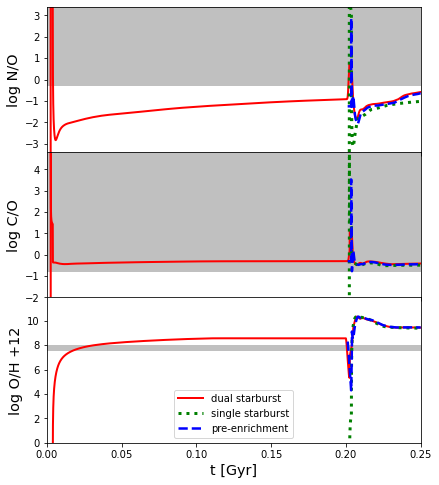
- 초기 질량 함수, 핵합성 수확량, 초거대 별과 무관하게, 100 Myr의 휴면 단계를 포함한 이중 폭발 별 형성 역사는 GN-z11에서 관측된 CNO 농도 비율을 성공적으로 재현한다.
- 월프-레이엇 별(최대 120 M☉)은 두 번째 폭발 직후 주요 강화 원천이 되며, 일시적으로 질소, 플루오르, 나트륨, 알루미늄 및 13C, 18O와 같은 이소토프를 강화시킨다.
- 피크 N/O 비율은 두 번째 폭발 후 1 Myr 이내에 도달하여, 짧은 수명의 화학적 신호로서 매우 빨리 사라질 수 있음을 시사한다.
- 매우 무거운 별 또는 쌍-불안정성 초신성을 포함한 단일 폭발 모델은 데이터를 재현하지 못한다: VMS는 N/O 비율을 충분히 높이지 못하고, PISNe는 N/O 비율을 감소시킨다.
- 사전 enrichment 시나리오 역시 관측 결과를 재현하지 못하여, 간헐적 폭발을 통한 내재적 강화가 필요하다는 것을 시사한다.
- 모델은 ALMA를 통해 검증할 수 있는 높은 플루오르 농도를 예측하며, 먼지가 제거되는 방사압에 의해 유도되는 외출류의 존재를 지지한다.
더 나은 연구,지금 바로 시작하세요
논문 읽기부터 검토까지, 연구 시간을 획기적으로 줄여보세요.
카드 등록 없음 · 무료 플랜 제공
이 리뷰는 AI가 만들고, 인간 에디터가 검토했습니다.