
[논문 리뷰] Rapid Flood Inundation Forecast Using Fourier Neural Operator
이 논문은 수문학적 시뮬레이션에서의 매핑을 학습하여 실시간, 고속의 홍수 침수 예측을 위한 푸리에 신경 연산자(Fourier Neural Operator, FNO) 기반의 서rogate 모델을 제안한다. 휴스턴의 6건의 역사적 폭풍 사건을 기반으로 훈련된 FNO 모델은 U-Net 기준선 대비 뛰어난 성능을 보이며, 3시간 선도 시간에서 CSI > 0.93의 높은 정확도를 유지하고, 보정 없이도 새로운 지역으로의 일반화 능력이 뛰어나다.
Flood inundation forecast provides critical information for emergency planning before and during flood events. Real time flood inundation forecast tools are still lacking. High-resolution hydrodynamic modeling has become more accessible in recent years, however, predicting flood extents at the street and building levels in real-time is still computationally demanding. Here we present a hybrid process-based and data-driven machine learning (ML) approach for flood extent and inundation depth prediction. We used the Fourier neural operator (FNO), a highly efficient ML method, for surrogate modeling. The FNO model is demonstrated over an urban area in Houston (Texas, U.S.) by training using simulated water depths (in 15-min intervals) from six historical storm events and then tested over two holdout events. Results show FNO outperforms the baseline U-Net model. It maintains high predictability at all lead times tested (up to 3 hrs) and performs well when applying to new sites, suggesting strong generalization skill.
연구 동기 및 목표
- 긴급 대응 계획 및 위험 완화를 지원하기 위해 실시간 고해상도 홍수 침수 예측의 필수적 필요성을 해결한다.
- 도시 환경에서 고해상도 수문학적 모델링(예: 2차원 수심 방정식)의 계산적 병목 현상을 극복한다.
- 물리적 일관성을 유지하면서 다양한 폭풍 사건과 지역으로 일반화 가능한 데이터 기반의 서rogate 모델을 개발한다.
- 푸리에 신경 연산자(FNO)를 다중 선도 시간 예측에 활용하여 홍수 범람 범위 및 수심 예측의 가능성을 입증한다.
- 모델의 성능을 U-Net 기준선과 비교하고, 보정 없이도 새로운 도메인으로의 이식 가능성(transferability)을 평가한다.
제안 방법
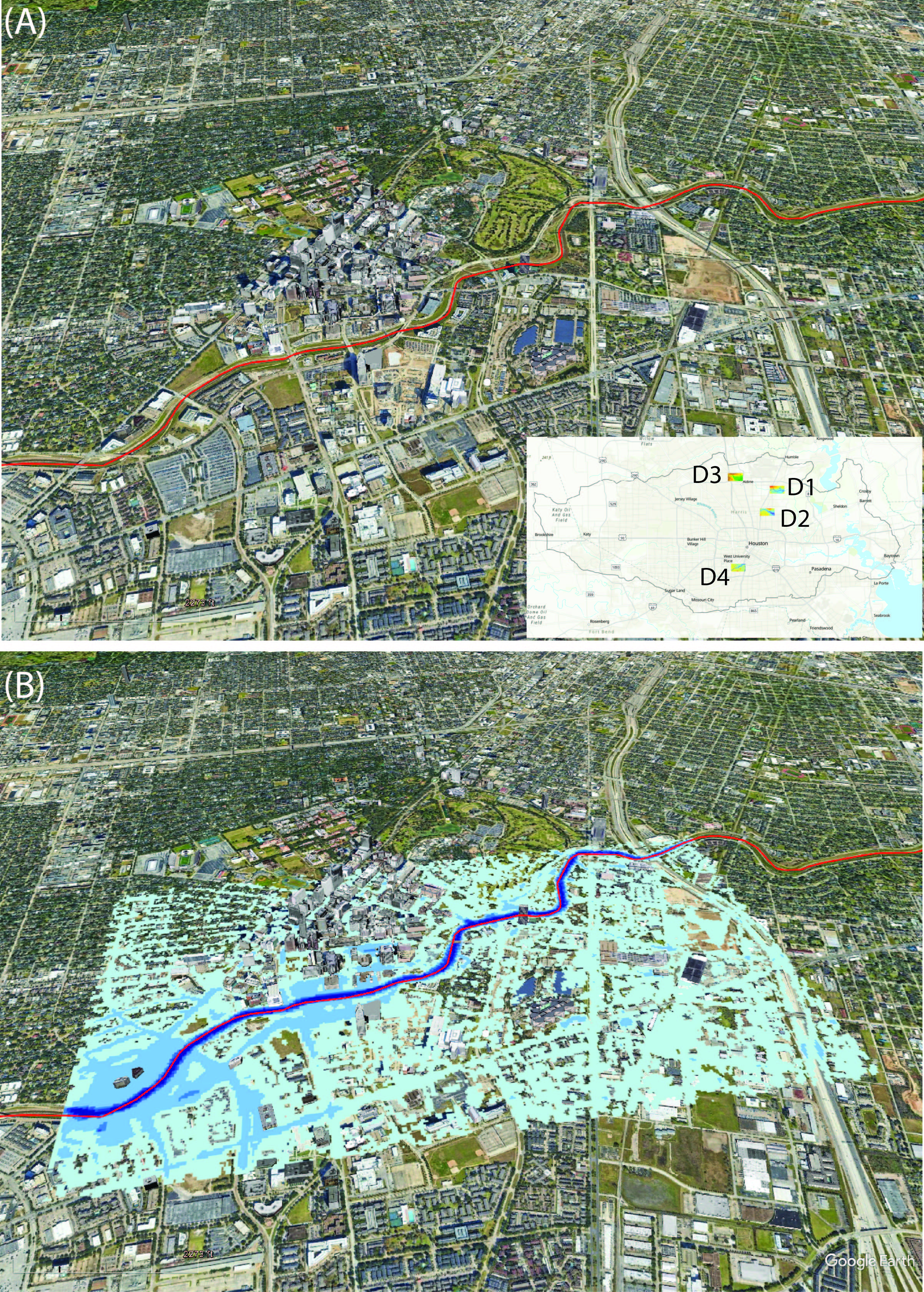
- 휴스턴의 6건의 역사적 폭풍 사건에서 유도된 15분 간격의 시뮬레이션 수심 시계열 데이터를 기반으로 FNO 모델을 훈련한다.
- 수심과 공간 기울기 오차를 모두 벌어지게 하는 물리 기반 손실 함수를 사용하여 물리적 일관성을 통합한다.
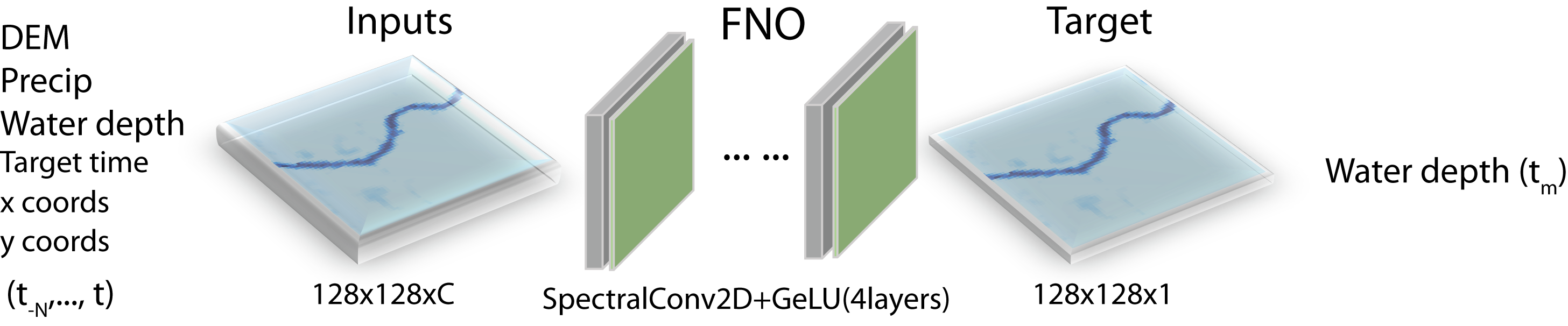
- 정적 지공간 특성(예: 디지털 고도 모델)과 동적 입력(예: 강수량, 유량)을 다중 채널 입력으로 통합한다.
- 푸리에 변환을 통해 스펙트럼 컨벌루션을 적용하여 무한차원 함수 공간 간의 매핑을 효율적으로 학습한다.
- 시간적 맥락을 확보하기 위해 12프레임(180분)의 봉인 윈도우를 사용하며, 더 긴 봉인(24프레임)과 강수량 전용 입력에 대한 분석도 실시한다.
- 다양한 도메인(D1–D3)에서 사전 훈련한 FNO를 새로운 도메인(D4)으로 이식하여 제로샷 일반화 능력을 평가한다.
실험 결과
연구 질문
- RQ1FNO 기반의 서rogate 모델은 다중 선도 시간 예측과 함께 스트리트 수준 해상도에서 정확하고 실시간 홍수 침수 예측을 달성할 수 있는가?
- RQ2예측 정확도와 추론 효율성 측면에서 FNO 모델은 U-Net 기준선 대비 어떻게 비교되는가?
- RQ3물리 기반 손실 함수는 모델의 일반화 능력과 물리적 타당성 향상에 얼마나 기여하는가?
- RQ4유사 도메인에서 사전 훈련된 FNO 모델은 보정 없이도 새로운 미사용 도시 지역으로 효과적으로 이식 가능한가?
- RQ5입력으로 과거 수심 데이터를 포함시키는 것과 강수량 전용 입력 간의 성능에 미치는 영향은 어떠한가?
주요 결과
- 2019/05/08 사건에서 FNO 모델은 15분 선도 시간에 CSI 0.9808, MAE 0.0044를 기록하여 U-Net 기준선(CSI: 0.9752, MAE: 0.0056)을 초월한 성능을 보였다.
- 3시간 선도 시간에 FNO는 CSI 0.9324, MAE 0.0153를 유지하여 장기 선도 시간 동안도 일관된 성능을 보였다.
- 24프레임 봉인(6시간)을 적용한 FNO 모델은 성능 향상이 없었으며, 이는 이 맥락에서 더 긴 기억력이 유의미한 이점이 되지 않는다는 것을 시사한다.
- 강수량 전용 FNO 변종(FNO-12P)은 성능이 극적으로 저하되었으며(15분 시점 CSI: 0.4861), 과거 수심 데이터의 중요성을 입증한다.
- D1–D3에서 사전 훈련한 다중 도메인 FNO(FNO-MD)는 보정 없이 D4에 적용되었을 때 15분 시점에 CSI 0.9659, 180분 시점에 CSI 0.9032를 기록하여 강력한 제로샷 일반화 능력을 입증하였다.
- FNO 모델의 추론 시간은 샘플당 단지 0.002초로 매우 짧아 실시간 구현이 가능했으며, RTX 3090 GPU에서 에포크당 훈련 시간은 72초였다.
더 나은 연구,지금 바로 시작하세요
논문 읽기부터 검토까지, 연구 시간을 획기적으로 줄여보세요.
카드 등록 없음 · 무료 플랜 제공
이 리뷰는 AI가 만들고, 인간 에디터가 검토했습니다.