
[논문 리뷰] Re-labeling ImageNet: from Single to Multi-Labels, from Global to Localized Labels
이 논문은 강력한 사전 훈련된 분류기와 함께 이미지넷 훈련 세트를 국소화된 다중 레이블 주석으로 재라벨링하는 ReLabel를 제안하며, 훈련 중에 이러한 풍부한 레이블을 활용하기 위해 LabelPooling을 도입한다. 이 방법은 ResNet-50의 ImageNet top-1 정확도를 78.9%로 향상시키고, CutMix를 사용할 경우 80.2%까지 상승시켜 전이 학습 및 다중 레이블 벤치마크 전반에 걸쳐 일관된 성능 향상을 이룬다.
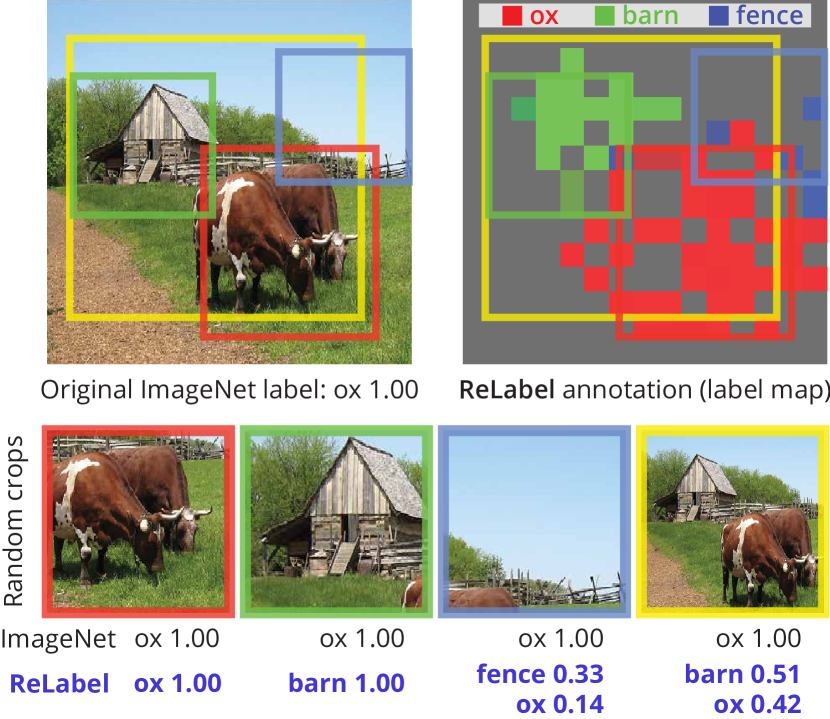
ImageNet has been arguably the most popular image classification benchmark, but it is also the one with a significant level of label noise. Recent studies have shown that many samples contain multiple classes, despite being assumed to be a single-label benchmark. They have thus proposed to turn ImageNet evaluation into a multi-label task, with exhaustive multi-label annotations per image. However, they have not fixed the training set, presumably because of a formidable annotation cost. We argue that the mismatch between single-label annotations and effectively multi-label images is equally, if not more, problematic in the training setup, where random crops are applied. With the single-label annotations, a random crop of an image may contain an entirely different object from the ground truth, introducing noisy or even incorrect supervision during training. We thus re-label the ImageNet training set with multi-labels. We address the annotation cost barrier by letting a strong image classifier, trained on an extra source of data, generate the multi-labels. We utilize the pixel-wise multi-label predictions before the final pooling layer, in order to exploit the additional location-specific supervision signals. Training on the re-labeled samples results in improved model performances across the board. ResNet-50 attains the top-1 classification accuracy of 78.9% on ImageNet with our localized multi-labels, which can be further boosted to 80.2% with the CutMix regularization. We show that the models trained with localized multi-labels also outperforms the baselines on transfer learning to object detection and instance segmentation tasks, and various robustness benchmarks. The re-labeled ImageNet training set, pre-trained weights, and the source code are available at {https://github.com/naver-ai/relabel_imagenet}.
연구 동기 및 목표
- 랜덤 컷을 통한 훈련 중 노이즈가 많은 지도 학습을 유발하는, 많은 이미지넷 이미지에 다수의 객체가 존재하는 현실과 단일 레이블 주석 간의 불일치를 해결한다.
- 이미지넷 훈련 세트 전체에 대해 픽셀 수준의 다중 레이블 주석을 생성하는 데 드는 높은 주석 비용을 해결한다.
- 훈련 중 더 정확하고 위치 인식이 가능한 지도 신호를 제공함으로써 모델의 일반화 능력과 강건성을 향상시킨다.
- 더 깔끔하고 국소화된 다중 레이블 지도 신호가 이미지넷 분류를 넘어선 탐지, 세분화, 세분화 인식 작업 등 하류 작업 전반에서 성능 향상에 기여함을 입증한다.
- 반복적 디스틸레이션을 피하고 효율적인 풍부한 지도 학습을 가능하게 하는 확장 가능한 일회성 라벨링 파이프라인을 개발한다.
제안 방법
- 외부 데이터 소스(예: 대규모 약한 지도 학습 데이터)에서 강력한 이미지 분류기를 훈련시어 각 이미지넷 이미지에 대해 밀도 높은 픽셀 수준의 다중 레이블 예측을 생성한다.
- 전역 평균 풀링 이전의 모델의 최종 합성곱 특징을 사용하여, 공간적 위치별로 각 클래스에 대한 신뢰도를 나타내는 밀도 높은 레이블 맵 $ L ∈ \mathbb{R}^{H \times W \times C} $ 를 생성한다.
- LabelPooling을 도입하여 각 랜덤 컷에 대해 컷 영역에서의 레이블 스코어를 풀링하여 다중 레이블 정답을 계산하는 훈련 방식을 제공한다.
- LabelPooling을 표준 크로스 엔트로피 손실과 조합하여 국소화된 다중 레이블 지도 신호를 사용하는 엔드 투 엔드 훈련을 가능하게 한다.
- 재라벨링된 데이터와 LabelPooling을 단일 레이블 및 다중 레이블 벤치마크 모두에 적용하며, 이미지넷 및 COCO를 포함한다.
- 재라벨링된 이미지넷 데이터셋에서 성능을 추가로 향상시키기 위해 CutMix 정규화를 적용한다.
실험 결과
연구 질문
- RQ1단일 레이블 주석을 국소화된 다중 레이블 주석으로 대체할 경우, 이미지넷에서 모델의 일반화 능력과 강건성이 향상되는가?
- RQ2사전 훈련된 분류기를 사용해 밀도 높은 레이블 맵을 생성함으로써 주석 비용을 줄일 수 있으며, 높은 품질의 지도 학습을 유지할 수 있는가?
- RQ3LabelPooling은 계산 비용이 과도하게 증가하지 않도록 하면서도, 무작위 컷 훈련 중에 밀도 높고 공간 인식이 가능한 레이블을 효과적으로 활용할 수 있는가?
- RQ4ReLabel로 사전 훈련한 모델이 객체 탐지 및 인스턴스 세분화와 같은 하류 작업에서 전이 학습 성능을 얼마나 향상시키는가?
- RQ5다중 레이블 벤치마크에서 ReLabel의 성능 향상은 표준 훈련 및 CutMix와 같은 다른 정규화 기법과 비교해 얼마나 뛰어난가?
주요 결과
- ReLabel는 ResNet-50의 ImageNet top-1 정확도를 기준선 단일 레이블 모델 대비 +1.4%p 향상시켜 78.9%로 개선한다.
- CutMix 정규화를 적용할 경우, ResNet-50의 top-1 정확도는 80.2%에 도달하여, 우리 지식상 최고의 성능을 기록한다.
- ReLabel된 이미지넷으로 사전 훈련한 모델은 다섯 개의 세분화 인식 벤치마크에서 일관된 성능 향상을 보이며, FGVC Aircraft에서 최대 +3.8%p의 성과 향상을 기록한다.
- COCO 객체 탐지에서 ReLabel 사전 훈련된 ResNet-50를 사용한 Faster-RCNN은 기준선 대비 +0.5 mAP 향상을 달성한다.
- COCO 인스턴스 세분화에서 ReLabel 사전 훈련된 ResNet-50를 사용한 Mask-RCNN은 +0.5 mAP 향상을 기록하여 향상된 특징 학습 능력을 보여준다.
- COCO 다중 레이블 분류 작업에서 오라클 레이블 맵을 사용한 ReLabel는 ResNet-101 기준 mAP를 +4.2 pp 향상시켜, 기존 다중 레이블 설정에서도 강력한 성능 향상을 입증한다.
더 나은 연구,지금 바로 시작하세요
논문 읽기부터 검토까지, 연구 시간을 획기적으로 줄여보세요.
카드 등록 없음 · 무료 플랜 제공
이 리뷰는 AI가 만들고, 인간 에디터가 검토했습니다.