
[논문 리뷰] Resolving the nature and putative nebular emission of GS9422: an obscured AGN without exotic stars
본 연구는 z=5.943의 GS9422에 대한 JWST 이미징 및 분광 관측을 통해 성운 발광이 연속체를 지배하지 않으며 이 은하가 숨겨진 타입-2 AGN을 가진 억제된 Ly-α 구름과 함께 존재한다는 것을 보인다.
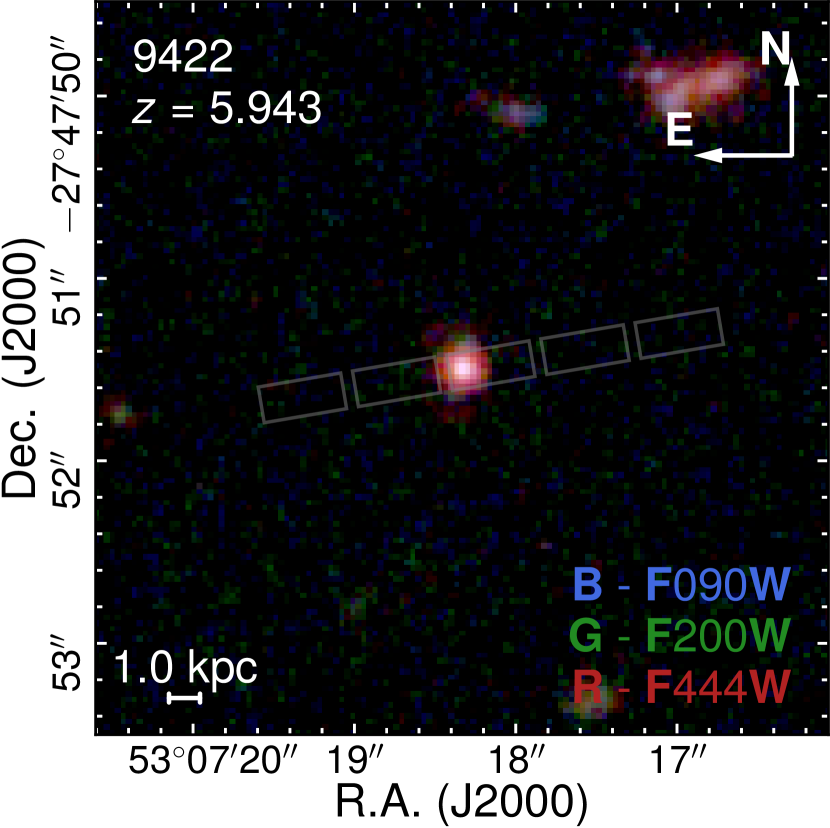
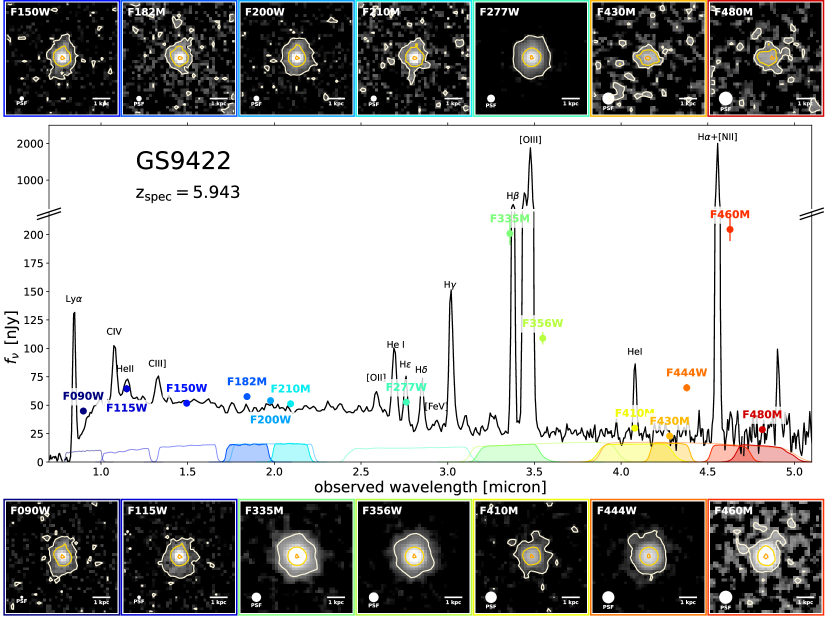
Understanding the sources that power nebular emission in high-redshift galaxies is fundamentally important not only for shedding light onto the drivers of reionisation, but to constrain stellar populations and the growth of black holes. Here we focus on an individual object, GS9422, a galaxy at $z_{ m spec}=5.943$ with exquisite data from the JADES, JEMS and FRESCO surveys, including 14-band JWST/NIRCam photometry and deep NIRSpec prism and grating spectroscopy. We map the continuum emission and nebular emission lines across the galaxy on 0.2-kpc scales. GS9422 has been claimed to have nebular-dominated continuum and an extreme stellar population with top-heavy initial mass function. We find clear evidence for different morphologies in the emission lines, the rest-UV and rest-optical continuum emission, demonstrating that the full continuum cannot be dominated by nebular emission. While multiple models reproduce the spectrum reasonably well, our preferred model with a type-2 active galactic nucleus (AGN) and local damped Ly-$α$ (DLA) clouds can explain both the spectrum and the wavelength-dependent morphology. The AGN powers the off-planar nebular emission, giving rise to the Balmer jump and the emission lines, including Ly-$α$, which therefore does not suffer DLA absorption. A central, young stellar component dominates the rest-UV emission and -- together with the DLA clouds -- leads to a spectral turn-over. A disc-like, older stellar component explains the flattened morphology in the rest-optical continuum. We conclude that GS9422 is consistent with being a normal galaxy with an obscured, type-2 AGN -- a simple scenario, without the need for exotic stellar populations.
연구 동기 및 목표
- GS9422의 성운 발광 기원을 조사하고 연속체가 성운-지배적일 가능성이 있는지 평가한다.
- 스펙트럼과 형태를 설명하기 위해 대립되는 시나리오(별, AGN, 또는 혼합)를 테스트한다.
- 발광선과 rest-UV 및 rest-optical 연속체의 공간 분포를 결정하여 동력원을 추론한다.
- 14-band NIRCam 광도계와 깊은 NIRSpec 분광 측정을 사용하여 별과 ISM 특성을 제약한다.
- 관찰을 설명하기 위해 이질적인 별 개체군(예: 상중심 IMF)이 필요한지 평가한다.
제안 방법
- 14-band JWST/NIRCam 광도계와 깊은 NIRSpec 프리즘 및 격자 분광 را를 결합하여 약 0.2 kpc 규모의 연속체와 성운 선을 맵핑한다.
- rest-UV 연속체, rest-optical 연속체, 발광선에 걸쳐 비모수(등거리) 및 모수적(Sérsic) 형태 분석을 수행한다.
- 추적자(Ly-α, rest-UV, 발광선, rest-optical 연속체)별로 이미지를 스택하여 형태를 비교한다.
- PySersic(및 ForcePho)으로 PSF-컨볼루션 광 프로파일를 앞으로 모델링하여 각 추적자에 대한 반빛 반경(half-light radius), Sérsic 지수, 타원도, 위치각을 도출한다.
- 중간대역 이미징으로 EW 지도와 Balmer 점프 평가를 사용하여 성운-연속체 지배 및 AGN 기여를 테스트한다.
- 다양한 물리 모델(오직 별, 오직 AGN, DLAs가 포함된 AGN+별)을 탐색하여 분광 및 파장 의존 형태를 맞춘다.
실험 결과
연구 질문
- RQ1GS9422의 rest-프레임 연속체가 성운 발광에 의해 지배되는가, 아니면 별 성분이 상당히 기여하는가?
- RQ2관찰된 파장 의존 형태를 단일 동력원(숨겨진 AGN 등)으로 조정할 수 있는가, 이질적 별 개체군이 필요한가?
- RQ3AGN 활동, DLAs, 그리고 별 구성요소의 어떤 조합이 스펙트럼과 발광선 및 연속체의 공간 분포를 가장 잘 설명하는가?
- RQ4NIRCam 중간 대역 측정이 Balmer 점프의 존재 및 성운 연속체의 강도를 뒷받침하는가?
- RQ5GS9422의 스펙트럴 에너지 분포와 선 비율을 설명하기 위해 상향 IMF 시나리오가 필요한가?
주요 결과
- GS9422는 발광선, rest-UV 연속체, 그리고 rest-optical 연속체에 대해 서로 다른 형태를 보이며 연속체가 성운 발광에 의해 지배되고 있지 않음을 시사한다.
- 선호되는 모델은 로컬의 감쇠된 Ly-α 구름을 가진 타입-2 AGN으로, 스펙트럼과 파장 의존 형태를 모두 설명한다.
- 중심의 젊은 별 구성요소가 rest-UV 발광을 지배하고 DLA 구름과 함께 더 짧은 파장의 스펙트럼 전이를 이끈다.
- 디스크 모양의 오래된 별 구성요소가 rest-optical 연속체 형태를 평탄화한 형태로 설명한다.
- Ly-α, rest-UV 연속체, 발광선은 서로 다른 공간적 확장을 보이며, Ly-α가 가장 확장되고 rest-UV가 가장 컴팩트하며, rest-optical 연속체는 디스크형이고 rest-UV/선 발광에서 약 90도 방향으로 정렬된다.
- GS9422는 이질적인 별 개체군이나 극단적인 IMF를 요구하지 않고 숨겨진 타입-2 AGN을 가진 정상 은하로 해석될 수 있다.
더 나은 연구,지금 바로 시작하세요
연구 설계부터 논문 작성까지, 연구 시간을 획기적으로 줄여보세요.
카드 등록 없음 · 무료 플랜 제공
이 리뷰는 AI가 만들고, 인간 에디터가 검토했습니다.