
[논문 리뷰] Rethinking Semi-Supervised Medical Image Segmentation: A Variance-Reduction Perspective
ARCO는 분산 감소 기반의 계층화된 그룹 샘플링을 반지도 학습 의료 영상 분할에 도입하여, 그래디언트 추정 분산을 줄임으로써 여러 데이터셋에서 강건성과 라벨 효율성을 향상시킵니다.
For medical image segmentation, contrastive learning is the dominant practice to improve the quality of visual representations by contrasting semantically similar and dissimilar pairs of samples. This is enabled by the observation that without accessing ground truth labels, negative examples with truly dissimilar anatomical features, if sampled, can significantly improve the performance. In reality, however, these samples may come from similar anatomical regions and the models may struggle to distinguish the minority tail-class samples, making the tail classes more prone to misclassification, both of which typically lead to model collapse. In this paper, we propose ARCO, a semi-supervised contrastive learning (CL) framework with stratified group theory for medical image segmentation. In particular, we first propose building ARCO through the concept of variance-reduced estimation and show that certain variance-reduction techniques are particularly beneficial in pixel/voxel-level segmentation tasks with extremely limited labels. Furthermore, we theoretically prove these sampling techniques are universal in variance reduction. Finally, we experimentally validate our approaches on eight benchmarks, <i>i.e</i>., five 2D/3D medical and three semantic segmentation datasets, with different label settings, and our methods consistently outperform state-of-the-art semi-supervised methods. Additionally, we augment the CL frameworks with these sampling techniques and demonstrate significant gains over previous methods. We believe our work is an important step towards semi-supervised medical image segmentation by quantifying the limitation of current self-supervision objectives for accomplishing such challenging safety-critical tasks.
연구 동기 및 목표
- 매우 제한된 라벨로 반지도 의료 영상 분할의 강건성과 라벨 효율성을 고취시키는 것을 목표로 한다.
- 대조 학습을 위한 픽셀/복셀 선택을 안내하기 위한 분산 감소 샘플링 프레임워크를 개발한다.
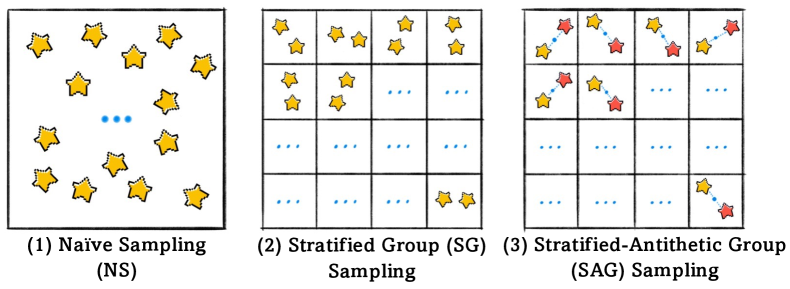
- 그래디언트 분산 및 수렴을 개선하기 위해 Stratified Group (SG) 및 Stratified-Antithetic Group (SAG) 샘플링을 제안한다.
- 다양한 데이터셋 및 아키텍처 간의 강건성과 2D/3D 의학 영상 및 의미 분할 벤치마크에서의 경쟁력 있는 성능을 입증한다.
제안 방법
- ARCO를 분산 감소 추정에 기초한 반지도 대비 학습 프레임워크로 공식화한다.
- 이미지를 클래스 기반 격자로 분할하고 각 격자 내에서 샘플링함으로써 Stratified Group (SG) 샘플링을 도입한다.
- 대칭 제약을 통해 분산을 추가로 감소시키기 위해 SG를 Stratified-Antithetic Group (SAG)로 확장한다.
- 나이브 샘플링과 비교한 편향 없음 및 분산 감소(SG/SAG) 같은 이론적 보장을 제공한다.
- 강건하고 꼬리 부분에 민감한 표현을 학습하기 위해 MONA 유사 관계 사전학습 및 해부학적 대비 미세조정을 포함하도록 ARCO를 통합하여 학습합니다.
![Figure 1: Pipeline overview. Our semi-supervised segmentation model $F$ takes a 2D/3D medical image $x$ as input and outputs the segmentation map and the representation map. We leverage a simplification of MONA pipeline [ 17 ] which is composed of two stages: (1) relational semi-supervised pre-train](https://ar5iv.labs.arxiv.org/html/2302.01735/assets/x1.png)
실험 결과
연구 질문
- RQ1극심한 라벨 부족 상황에서 분산 감소 샘플링이 반지도 의료 영상 분할의 강건성과 수렴을 향상시킬 수 있는가?
- RQ2SG와 SAG가 픽셀/복셀 수준의 대비 학습에 대해 편향되지고 더 낮은 분산의 그래디언트 추정치를 제공하는가?
- RQ3다양한 라벨 비율의 2D/3D 의학 영상 및 의미 분할 벤치마크에서 ARCO의 성능은 어떠한가?
- RQ4기존 SSL 프레임워크에 ARCO를 포함시키면 분할 정확도와 경계 구분에 일관된 이점을 얻을 수 있는가?
주요 결과
- ARCO 방법은 8개 벤치마크와 다양한 라벨 비율에서 우수한 분할 성능을 달성하여 최첨단 SSL 방법을 능가한다.
- ARCO-SG 및 ARCO-SAG는 MONA에 비해 1%, 5%, 10% 라벨 설정에서 주목할 만한 Dice 점수 향상을 보이며(예: 보고된 사례에서 상대 Dice가 약 0.3%–4.1% 수준의 개선).
- 이론적으로, SG는 편향이 없고 분산이 Naive Sampling보다 크지 않으며, SAG의 분산은 SG의 두 배의 상한 이내로, 보편적인 분산 감소 혜택을 입증한다.
- 경향은 그래디언트 분산 감소로 인한 더 빠른 수렴 및 더 안정적인 학습과 해부학적 구조의 경계 정확도 향상을 보여준다.
- 주요 주장 결과 중 하나는 분할 강인성 벤치마크에서 Dice가 최대 11.08% 절대 향상이다.
더 나은 연구,지금 바로 시작하세요
연구 설계부터 논문 작성까지, 연구 시간을 획기적으로 줄여보세요.
카드 등록 없음 · 무료 플랜 제공
이 리뷰는 AI가 만들고, 인간 에디터가 검토했습니다.