
[논문 리뷰] Room-temperature quantum sensing with photoexcited triplet electrons in organic crystals
본 논문은 pentacene-doped p-terphenyl crystals에서 photoexcited spin-triplet electrons를 이용한 실온 양자 센싱을 시연하고, high-contrast 및 coherent control을 갖춘 optically detected magnetic resonance (ODMR)을 달성했으며, 긴 코히런스 시간을 초래하는 pulsed schemes를 포함합니다.
Quantum sensors have notably advanced high-sensitivity magnetic field detection. Here, we report quantum sensors constructed from polarized spin-triplet electrons in photoexcited organic chromophores, specifically focusing on pentacene-doped para-terphenyl (${\approx}$0.1%). We demonstrate essential quantum sensing properties at room temperature: electronic optical polarization and state-dependent fluorescence contrast, by leveraging differential pumping and relaxation rates between triplet and ground states. We measure high optically detected magnetic resonance (ODMR) contrast ${\approx}16.8\%$ of the triplet states at room temperature, along with long coherence times under spin echo and CPMG sequences, $T_2{=}2.7μ$s and $T_2^{DD}{=}18.4μ$s respectively, limited only by the triplet lifetimes. The material offers several advantages for quantum sensing, including the ability to grow large ($cm$-scale) crystals at low cost, the absence of paramagnetic impurities, and the diamagnetism of electronic states used for sensing when not optically illuminated. Utilizing pentacene as a representative of a broader class of spin triplet-polarizable organic molecules, this study highlights new potential for quantum sensing in chemical systems.
연구 동기 및 목표
- Demonstrate optical initialization and readout of photoexcited triplet spins in organic crystals at room temperature.
- Show high-contrast ODMR and coherent microwave control of triplet sublevels.
- Quantify coherence times (T2, T2DD) and relaxation (T1) in the pentacene-doped p-terphenyl system.
- Assess practical advantages of organic-crystal q-sensors for scalable, low-cost quantum sensing.
제안 방법
- Use pentacene doped into para-terphenyl crystals as a model system for triplet-based quantum sensing.
- Implement optical pumping to polarize triplet sublevels via differential intersystem crossing rates.
- Probe spin transitions with optically detected magnetic resonance (ODMR) at room temperature.
- Employ both continuous-wave and pulsed optical excitation to enhance ODMR contrast.
- Characterize coherence with Rabi, Ramsey, Hahn echo, and Carr-Purcell-Meiboom-Gill (CPMG) sequences.
- Extract sensitivity estimates from measured slope, photon counts, and readout windows.
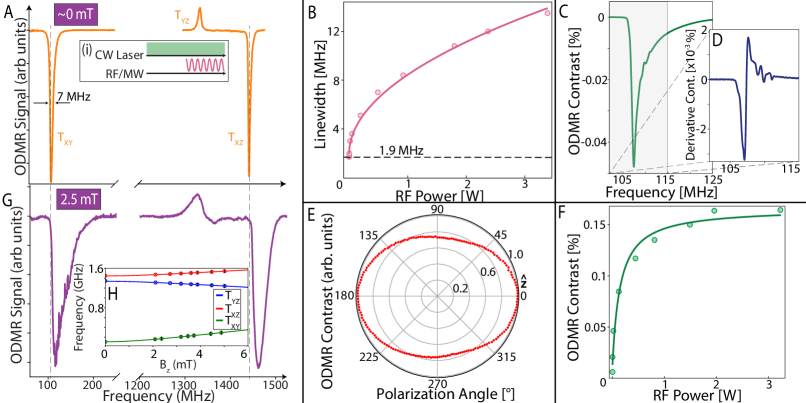
![Fig. 1: System and Principle. (A) Crystal structure of pentacene molecule doped in p -terphenyl. Primitive lattice vectors are marked $\hat{\textbf{a}}$ , $\hat{\textbf{b}}$ , and $\hat{\textbf{c}}$ , with lattice parameters: $a{=}8.2$ Å, $b{=}5.6$ Å, $c{=}13.6$ Å [ 26 ] . Molecular axis are marked](https://ar5iv.labs.arxiv.org/html/2402.13898/assets/x1.png)
실험 결과
연구 질문
- RQ1Can room-temperature quantum sensing be achieved with photoexcited triplet electrons in organic crystals?
- RQ2What ODMR contrast and coherence times are attainable in pentacene-doped p-terphenyl at room temperature?
- RQ3How do pulsed optical initialization and dynamical decoupling affect ODMR contrast and spin coherence in this system?
- RQ4What practical advantages do organic-crystal q-sensors offer for scalable, low-cost magnetic sensing compared to inorganic defect centers?
주요 결과
- ODMR contrast up to 16.8% for the Txy transition under pulsed illumination.
- Rabi oscillations observed at 12.9 MHz demonstrating coherent control.
- T2 = 2.7 μs from Hahn echo measurements.
- T2DD = 18.4 μs with a 148 ns CPMG train.
- T1 = 22.9 μs for triplet-ground relaxation.
- Under bias B0 = 2.5 mT, DC sensitivities of 327 nT/√Hz (Txy) and 257 nT/√Hz (Txz) were achieved (volume-normalized: 24 μT μm3/2/√Hz and 19.5 μT μm3/2/√Hz, respectively).
- Pulse-laser initialization yields higher ODMR contrast (up to 16.8%) than cw illumination, with potential for further gains.
더 나은 연구,지금 바로 시작하세요
연구 설계부터 논문 작성까지, 연구 시간을 획기적으로 줄여보세요.
카드 등록 없음 · 무료 플랜 제공
이 리뷰는 AI가 만들고, 인간 에디터가 검토했습니다.