
[논문 리뷰] Scale-Free Networks beyond Power-Law Degree Distribution
이 논문은 기존의 도수 분포(DD)보다 도수-도수 거리 분포(DDDD)가 스케일프리 네트워크를 더 보편적인 지표로 사용할 수 있음을 입증한다. 즉, 모든 거듭제곱 법칙을 따르는 DDDD를 가진 네트워크는 거듭제곱 법칙을 따르는 DD를 동시에 가지지만, 그 반대는 성립하지 않는다. 저자들은 선호적 연결과 적합도 기반 메커니즘을 바탕으로 한 두 가지 네트워크 모델을 제안하며, 이는 거듭제곱 법칙을 따르는 DD 없이도 거듭제곱 법칙을 따르는 DDDD를 생성함으로써 DDDD가 실제 네트워크에서 스케일프리 성격의 근본 원리를 더 잘 반영함을 보여준다.
Complex networks across various fields are often considered to be scale free -- a statistical property usually solely characterized by a power-law distribution of the nodes' degree $k$. However, this characterization is incomplete. In real-world networks, the distribution of the degree-degree distance $η$, a simple link-based metric of network connectivity similar to $k$, appears to exhibit a stronger power-law distribution than $k$. While offering an alternative characterization of scale-freeness, the discovery of $η$ raises a fundamental question: do the power laws of $k$ and $η$ represent the same scale-freeness? To address this question, here we investigate the exact asymptotic {relationship} between the distributions of $k$ and $η$, proving that every network with a power-law distribution of $k$ also has a power-law distribution of $η$, but \emph{not} vice versa. This prompts us to introduce two network models as counterexamples that have a power-law distribution of $η$ but not $k$, constructed using the preferential attachment and fitness mechanisms, respectively. Both models show promising accuracy by fitting only one model parameter each when modeling real-world networks. Our findings suggest that $η$ is a more suitable indicator of scale-freeness and can provide a deeper understanding of the universality and underlying mechanisms of scale-free networks.
연구 동기 및 목표
- 복잡한 네트워크에서 거듭제곱 법칙을 따르는 도수-도수 거리 분포(DDDD)와 도수 분포(DD)가 동일한 스케일프리 성격을 나타내는지 조사하기.
- 도수 $k$와 도수-도수 거리 $\eta$의 분포 간 渐近적 관계를 규명하기.
- 거듭제양 법칙을 따르는 DDDD를 가지지만 거듭제곱 법칙을 따르지 않는 DD를 가지는 네트워크를 보여주는 반례를 제시하여 DD가 스케일프리 성격의 유일한 지표라는 기존의 우선성을 도전하기.
- DD가 거듭제곱 법칙을 보이지 않을 경우에도 더 견고하고 보편적인 스케일프리 네트워크 메커니즘의 지표로 DDDD를 제안하기.
- 퍼콜레이션 및 동역학 시스템과 같은 스케일프리 네트워크 이론을 거듭제곱 법칙을 따르는 DD를 가진 네트워크를 초월하여 DDDD를 통합함으로써 확장하기.
제안 방법
- 도수 분포 $f(k) \propto k^{-\alpha}$와 도수-도수 거리 분포 $g(\eta)$ 간의 渐近적 관계를 분석하기 위해 분석적 유도와 극한 분석을 사용한 이론적 분석.
- 에르되시-레니 무작위 그래프 모델의 DDDD를 유도하여, $\eta$에 상한이 존재하고 지수 감소 항이 존재함에도 불구하고, $p_0$가 고정되어 있을지라도 DDDD가 거듭제곱 법칙이 아님을 보여줌.
- 시간에 따라 변화하는 적합도 임계값을 사용한 선호적 연결 기반 모델과 적합도 기반 연결 메커니즘을 사용한 모델을 각각 구성함. 이 두 모델은 모두 거듭제곱 법칙을 따르는 DD 없이도 거듭제곱 법칙을 따르는 DDDD를 생성하도록 설계됨.
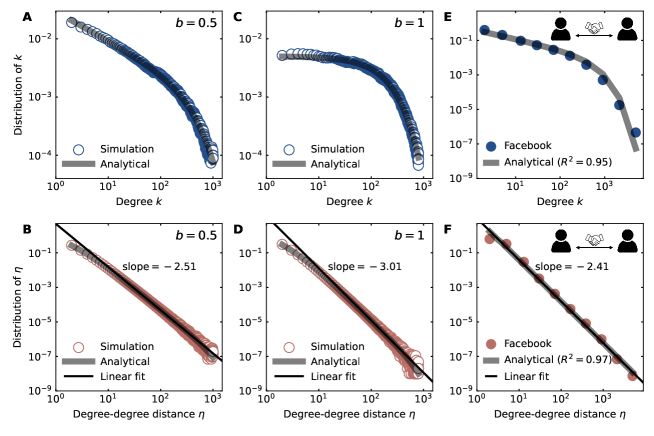
- 두 모델의 DDDD를 분석적으로 유도하여, 渐近적 영역에서 $g(\eta) \propto \eta^{-\beta}$ ($\beta \approx 2.5$)임을 확인함. 이와 동시에 $f(k)$는 거듭제곱 법칙을 따르지 않음.
- 노드 기반 도수 $k$를 대체하거나 보완하는 링크 기반 지표로, $\eta = \exp\left|\ln k_i - \ln k_j\right|$를 사용하여 연결 불균형을 정량화함.
- 실제 네트워크(예: 페이스북, 월드시티)에 모델을 적용하여 검증함. 각 모델에서 조정 가능한 매개변수를 하나만 사용하여도 뛰어난 피팅 성능을 보이며, 이는 실증적 타당성을 뒷받침함.
실험 결과
연구 질문
- RQ1도수-도수 거리 $\eta$의 거듭제곱 법칙 분포는 네트워크가 스케일프리로 간주되기 위해 필수적일까, 충분한 조건일까?
- RQ2거듭제곱 법칙을 따르는 도수 분포 $f(k)$를 가진 네트워크는 항상 거듭제곱 법칙을 따르는 도수-도수 거리 분포 $g(\eta)$를 가지는가?
- RQ3거듭제곱 법칙을 따르는 $g(\eta)$를 가지지만 거듭제곱 법칙을 따르지 않는 $f(k)$를 가지는 네트워크가 존재할 수 있는가? 만약 그렇다면, 이러한 네트워크를 생성하는 메커니즘은 무엇인가?
- RQ4실제 복잡한 네트워크의 근본 메커니즘을 포괄하는 데 DDDD가 DD보다 얼마나 더 효과적인가?
- RQ5특히 유한 크기이거나 비이상적인 네트워크에서 DD가 거듭제곱 법칙을 보이지 않을 경우, DDDD가 전통적인 DD보다 더 보편적이고 견고한 스케일프리 성격 지표로 기능할 수 있는가?
주요 결과
- 모든 거듭제곱 법칙을 따르는 도수 분포 $f(k) \propto k^{-\alpha}$를 가진 네트워크는 거듭제곱 법칙을 따르는 도수-도수 거리 분포 $g(\eta) \propto \eta^{-\beta}$를 동시에 가지며, 이는 거듭제곱 법칙 DDDD가 거듭제곱 법칙 DD의 必須 결과임을 입증한다.
- 반대로는 성립하지 않음: 선호적 연결 및 적합도 기반 메커니즘을 사용해 구성한 두 모델을 통해, 거듭제곱 법칙을 따르는 DDDD를 가지지만 거듭제곱 법칙을 따르지 않는 DD를 가지는 네트워크가 존재함을 입증함.
- 에르되시-레니 무작위 그래프 모델의 DDDD는 $\eta$의 유한한 상한과 지수 감소 항이 존재함에도 불구하고, 대규모 $N$ 근처에서도 거듭제곱 법칙이 아님.
- 구성된 선호적 연결 및 적합도 기반 모델은 각각 거듭제곱 법칙 DDDD를 생성하며, 그 지수는 $\beta \approx 2.5$로 나타나지만, 이와 동시에 DD는 거듭제곱 법칙을 따르지 않음. 이는 DDDD가 DD와 독립적으로 거듭제곱 법칙을 가질 수 있음을 확인함.
- DD보다 DDDD가 스케일프리 성격의 지표로 더 보편적이며, 도수 분포가 거듭제곱 법칙을 보이지 않더라도 스케일 불변 연결 불균형을 포착할 수 있음.
- 실제 네트워크(예: 페이스북, 월드시티)에 DDDD 기반 모델을 적용한 결과, 조정 가능한 매개변수를 하나만 사용하여도 높은 정확도로 피팅되었으며, 이는 복잡계 모델링에 실용적 유용성을 시사함.
![Figure 2: Distributions of (a,c) $k$ and (b,d) $\eta$ for the "hard-threshold" model, a network model that assigns a uniformly distributed fitness $\omega\in[0,\omega_{\max}=1]$ to each node, where two nodes are linked if and only if their fitness sum is larger than a threshold $z$ . The model simul](https://ar5iv.labs.arxiv.org/html/2310.08110/assets/x2.png)
더 나은 연구,지금 바로 시작하세요
논문 읽기부터 검토까지, 연구 시간을 획기적으로 줄여보세요.
카드 등록 없음 · 무료 플랜 제공
이 리뷰는 AI가 만들고, 인간 에디터가 검토했습니다.