
[논문 리뷰] Scientific CMOS sensors in Astronomy: IMX455 and IMX411
이 논문은 소니의 IMX455 및 IMX411 센서를 기반으로 한 QHY600M Pro와 QHY411M 과학용 CMOS 카메라를 천문학적 응용에 대해 평가한다. 이들은 −10°C에서 0.007–0.011 e⁻ px⁻¹ s⁻¹의 낮은 드레인 전류, 안정적인 뜨거운 픽셀, 몇 미리매그니튜드 이내의 광학적 정밀도를 보이며, 랜덤 텔레그래프 노이즈와 소금-후추 결함과 같은 과제가 있음에도 불구하고 넓은 시야, 고주기 조사에 적합함을 입증한다.
Scientific complementary metal-oxide-semiconductor (CMOS) detectors have developed quickly in recent years thanks to their low cost and high availability. They also have some advantages over charge-coupled devices (CCDs), such as high frame rate or typically lower readout noise. These sensors started to be used in astronomy following the development of the first back-illuminated models. Therefore, it is worth studying their characteristics, advantages, and weaknesses. One of the most widespread CMOS sensors are those from the Sony IMX series, which are included in large astronomical survey projects based on small and fast telescopes because of their low cost, and capability for wide-field and high-cadence surveys. In this paper, we aim to characterize the IMX455M and IMX411M sensors, which are integrated into the QHY600 and QHY411 cameras, respectively, for use in astronomical observations. These are large (36 $ imes$ 24 and 54 $ imes$ 40 mm) native 16 bit sensors with 3.76 $μ$m pixels and are sensitive in the optical range. We present the results of the laboratory characterization of both cameras. They showed a very low dark current of 0.011 and 0.007 e$^{-}$ px$^{-1}$ s$^{-1}$ @$-$10 C for the QHY600 and QHY411 cameras, respectively. They also show the presence of warm pixels, $\sim$0.024% in the QHY600 and 0.005% in the QHY411. Warm pixels proved to be stable and linear with exposure time, and are therefore easily corrected using dark frames. Pixels affected by the Salt \& Pepper noise are $\sim$2% of the total and a method to correct for this effect is presented. Both cameras were attached to night telescopes and several on-sky tests were performed to prove their capabilities. On-sky tests demonstrate that these CMOS behave as well as CCDs of similar characteristics and (for example) they can attain photometric accuracies of a few milli-magnitudes.
연구 동기 및 목표
- QHY600M Pro와 QHY411M 카메라(각각 IMX455 및 IMX411 sCMOS 센서 탑재)가 과학적 천문학적 영상에 적합한지 평가하기.
- 어둠 전류, 읽기 노이즈, 선형성, 비균일성과 같은 핵심 성능 매개변수를 실험실 및 현장 조건에서 특성화하기.
- 랜덤 텔레그래프 노이즈 및 소금-후추 결함과 같은 노이즈 원인이 광학적 정밀도에 미치는 영향 평가하기.
- 빠른 및 느린 망원경을 사용한 실제 천체 관측에서 카메라 성능 테스트하기.
- 대규모 16비트 sCMOS 데이터 세트를 효율적으로 처리하기 위한 계산적 과제를 규명하고 GPU 가속 방법을 통한 해결책 제안하기.
제안 방법
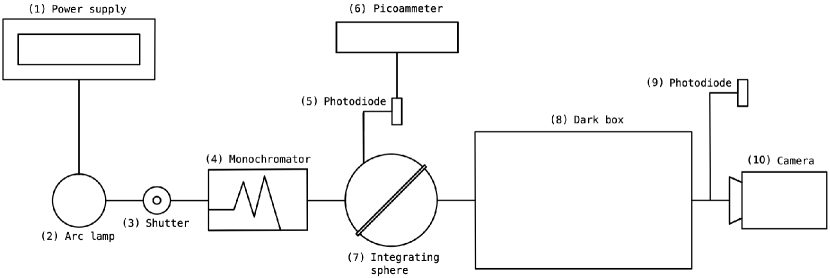
- 단색기, 통합 영역, 기준 광다이오드를 갖춘 校정된 광학 시험대를 사용해 실험실에서 QHY600M Pro 및 QHY411M 카메라의 특성 분석 수행.
- −10°C에서 여러 노출에 걸쳐 어둠 전류 및 바이어스 수준 측정하여 시간에 따른 안정성과 선형성 평가.
- 테이다 관측소의 이중 2m 망원경을 이용한 현장 관측을 통해 광학적 성능 검증.
- 뜨거운 픽셀 보정을 위해 어둠 프레임 차감을 적용하고, 중앙값 필터링 및 프레임 간 차분을 사용해 소금-후추 노이즈 완화.
- 고프레임레이트 시퀀스에서 노이즈 감소를 위한 시그마 클러핑 및 컨볼루션 기반 알고리즘의 효과 평가.
- 특히 고주기 조사에 적합한 대용량 120–300 MB 원시 이미지 파일을 효율적으로 처리하기 위해 GPU 기반 처리 파이프라인 탐색.
실험 결과
연구 질문
- RQ1제어된 실험실 조건에서 IMX455 및 IMX411 sCMOS 센서의 어둠 전류, 읽기 노이즈, 선형성은 어떻게 평가되는가?
- RQ2뜨거운 픽셀과 소금-후추 노이즈는 광학적 정밀도에 얼마나 큰 영향을 미치며, 효과적으로 보정 가능한가?
- RQ3이 sCMOS 카메라는 실제 천체 관측에서 기존 CCD와 유사한 광학적 정밀도를 달성할 수 있는가?
- RQ4고프레임레이트, 16비트 sCMOS 데이터 처리에서 발생하는 계산적 과제는 무엇이며, GPU 가속 알고리즘은 효율성을 어떻게 향상시킬 수 있는가?
- RQ5빠른 망원경을 사용한 넓은 시야, 고주기 조사 시나리오에서 센서는 어떻게 성능을 발휘하는가?
주요 결과
- QHY600M Pro와 QHY411M 카메라는 각각 −10°C에서 0.011 e⁻ px⁻¹ s⁻¹ 및 0.007 e⁻ px⁻¹ s⁻¹의 매우 낮은 어둠 전류를 보이며, 시간에 따라 안정적이고 선형적인 행동을 보인다.
- QHY600M Pro에서는 뜨거운 픽셀 비율이 0.024%이며 QHY411M는 0.005%이며, 노출 시간에 비례해 신호가 선형적으로 증가하므로 어둠 프레임 차감을 통해 효과적으로 보정 가능하다.
- 소금-후추 노이즈는 약 2%의 픽셀에 영향을 미치지만, 본 연구는 중앙값 보간 또는 프레임 기반 필터링을 통해 이러한 픽셀을 마스킹하고 보정하는 방법을 제시한다.
- 현장 테스트 결과 광학적 정밀도는 몇 미리매그니튜드 이내로 확인되었으며, 유사한 사양의 CCD와 비교해도 성능이 유사함을 입증한다.
- 센서는 전하 잔류 현상이나 가장자리 빛 유도 현상이 없으며, 475 nm에서 최대 80%의 양자 효율을 보이며 700 nm에서 40%로 감소하고 900 nm에서 10%로 감소한다.
- 랜덤 텔레그래프 노이즈는 낮은 신호 영역에서 광학적 편차를 유발하며, 단순 평균화나 시그마 클러핑만으로는 그 영향을 효과적으로 줄일 수 없다.
더 나은 연구,지금 바로 시작하세요
논문 읽기부터 검토까지, 연구 시간을 획기적으로 줄여보세요.
카드 등록 없음 · 무료 플랜 제공
이 리뷰는 AI가 만들고, 인간 에디터가 검토했습니다.