
[논문 리뷰] Self-supervised Group Meiosis Contrastive Learning for EEG-Based Emotion Recognition
이 논문은 자가지도 학습 기반의 그룹 미세분열 대비 학습(SGMC) 프레임워크를 제안하여, 동일한 자극에 대한 그룹 EEG 샘플 간 일관성을 활용해 EEG 기반 정서 인식을 수행한다. 새로운 미세분열 유사 데이터 증강 방법과 공유 표현을 학습하기 위한 그룹 프로젝터를 도입함으로써, 라벨이 제한된 조건에서도 DEAP 데이터셋에서 정성과 자극성에 대해 각각 94.72% 및 95.68%의 최신 기술 수준(SOTA) 정확도를 달성한다.
The progress of EEG-based emotion recognition has received widespread attention from the fields of human-machine interactions and cognitive science in recent years. However, how to recognize emotions with limited labels has become a new research and application bottleneck. To address the issue, this paper proposes a Self-supervised Group Meiosis Contrastive learning framework (SGMC) based on the stimuli consistent EEG signals in human being. In the SGMC, a novel genetics-inspired data augmentation method, named Meiosis, is developed. It takes advantage of the alignment of stimuli among the EEG samples in a group for generating augmented groups by pairing, cross exchanging, and separating. And the model adopts a group projector to extract group-level feature representations from group EEG samples triggered by the same emotion video stimuli. Then contrastive learning is employed to maximize the similarity of group-level representations of augmented groups with the same stimuli. The SGMC achieves the state-of-the-art emotion recognition results on the publicly available DEAP dataset with an accuracy of 94.72% and 95.68% in valence and arousal dimensions, and also reaches competitive performance on the public SEED dataset with an accuracy of 94.04%. It is worthy of noting that the SGMC shows significant performance even when using limited labels. Moreover, the results of feature visualization suggest that the model might have learned video-level emotion-related feature representations to improve emotion recognition. And the effects of group size are further evaluated in the hyper parametric analysis. Finally, a control experiment and ablation study are carried out to examine the rationality of architecture. The code is provided publicly online.
연구 동기 및 목표
- 정서 인식에서 라벨이 제한된 EEG 데이터 문제를 자가지도 학습을 활용해 해결하고자 한다.
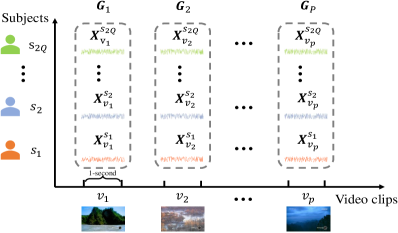
- 수동 라벨에 의존하지 않고도, 다수의 주체에서 온 EEG 샘플 간 자극 일관성을 활용해 대비 학습을 이끌어내고자 한다.
- 생물학적 미세분열에서 영감을 얻은 새로운 데이터 증강 방법을 개발하여 자극 관련 특징을 유지하고자 한다.
- 전용 그룹 프로젝터와 대비 손실를 통해 그룹 수준의 표현 학습을 향상시키고자 한다.
- 공개된 EEG 정서 데이터셋인 DEAP 및 SEED에서 프레임워크의 강건성과 일반화 능력을 검증하고자 한다.
제안 방법
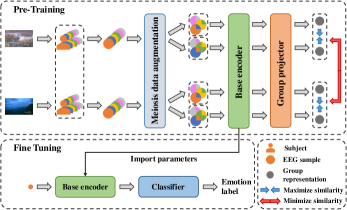
- 동일한 자극 그룹에서 온 EEG 샘플을 쌍으로 만들고, 교환하며 분리하여 증강된 그룹을 생성하는 유전학 기반의 데이터 증강 기법인 Meiosis를 도입한다.
- 동일한 정서 영상에 의해 유도된 다수의 EEG 샘플에서 공유되는 고수준 표현을 추출하기 위해 그룹 프로젝터를 활용한다.
- 동일한 자극을 가진 증강된 그룹 간의 그룹 수준 표현 유사도를 최대화함으로써 대비 학습을 수행한다.
- 자극 일관성을 기반으로 양성-음성 쌍을 설계하여 모델이 정서 관련 특징을 학습하도록 이끈다.
- 안정적인 훈련과 증강된 시각 간 표현 불변성을 확보하기 위해 대칭 손실 함수를 적용한다.
- 자기지도 대비 학습을 통한 사전 훈련과 제한된 라벨을 활용한 미세조정을 수행하는 두 단계 파이프라인으로 기본 인코더와 그룹 프로젝터를 훈련한다.
실험 결과
연구 질문
- RQ1다양한 주체의 EEG 샘플 간 자극 일관성을 효과적으로 활용하여 자가지도 정서 인식 성능을 향상시킬 수 있는가?
- RQ2기본적인 증강 기법인 Mixup과 비교할 때 제안된 Meiosis 증강 방법은 정서 관련 특징을 얼마나 잘 유지하는가?
- RQ3대비 EEG 정서 인식에서 그룹 수준 표현 학습과 개별 샘플 학습 간 기여도는 각각 어느 정도인가?
- RQ4낮은 라벨 레지임에서 프레임워크는 어떻게 성능을 내며, 완전히 지도 학습 기반 기준보다 뛰어난가?
- RQ5특징 시각화 결과에 따르면, 모델이 영상 수준의 정서 표현을 얼마나 잘 학습하는가?
주요 결과
- SGMC는 DEAP 데이터셋에서 정성에 대해 94.72%의 정확도, 자극성에 대해 95.68%의 정확도를 기록하여 완전히 지도 학습 기반 기준을 초월하는 최신 기술 수준의 성능을 달성한다.
- SEED 데이터셋에서는 94.04%의 정확도를 기록하여, 라벨이 제한된 조건에서도 경쟁 가능한 성능을 보여준다.
- 제거 실험 결과, Meiosis 증강을 제거할 경우 DEAP에서 정확도가 3% 이상, SEED에서 1.2% 이상 감소하여 그 중요성을 확인한다.
- 그룹 수준 학습을 제거한 Non-group 버전은 두 데이터셋 모두에서 1.5% 이상 성능 저하를 보이며, 그룹 표현의 중요성을 입증한다.
- 그룹 샘플이나 Meiosis를 제거한 Consistent-only 버전은 DEAP에서 완전히 지도 학습 기준보다 1.7% 높고, SEED에서는 0.6% 높은 성능을 기록하여 자극 일관성이 활용 가능함을 시사한다.
- 특징 시각화 결과, 모델이 영상 수준의 정서 관련 표현을 학습하고 있음을 확인하여, 다양한 주체 간 일반화 능력을 지닌다는 것을 뒷받침한다.
더 나은 연구,지금 바로 시작하세요
논문 읽기부터 검토까지, 연구 시간을 획기적으로 줄여보세요.
카드 등록 없음 · 무료 플랜 제공
이 리뷰는 AI가 만들고, 인간 에디터가 검토했습니다.