
[논문 리뷰] Self-Supervised Guided Segmentation Framework for Unsupervised Anomaly Detection
이 논문은 자기지도 학습 가이드 세그멘테이션 프레임워크(SGSF)를 제안하여 비지도 이상 탐지에 활용한다. SGSF는 선명도 증강 모듈(SAM)을 사용해 현실적인 위조 이상 샘플을 생성하고, 자기지도 학습 가이드 특징을 활용하여 정확도를 향상시킨다. 이 방법은 선명도 기반 이상 샘플 합성과 노이즈 없는 의미론적 풍부한 가이드 특징을 결합하여 벤치마크 데이터셋에서 최신 기술 수준(SOTA) 성능을 달성한다.
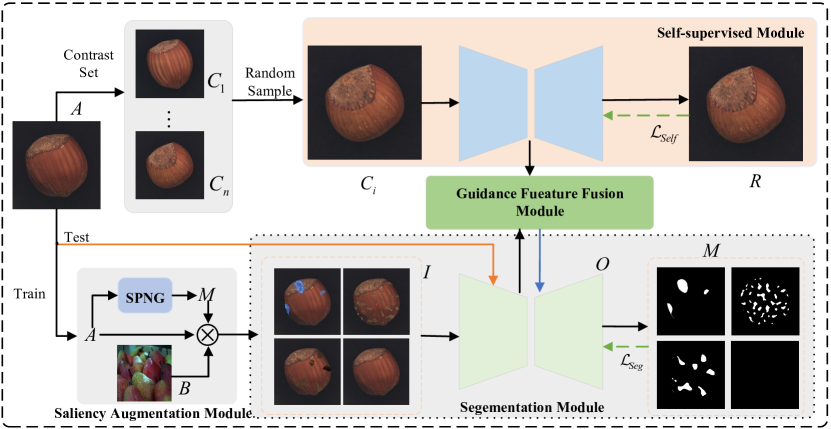
Unsupervised anomaly detection is a challenging task in industrial applications since it is impracticable to collect sufficient anomalous samples. In this paper, a novel Self-Supervised Guided Segmentation Framework (SGSF) is proposed by jointly exploring effective generation method of forged anomalous samples and the normal sample features as the guidance information of segmentation for anomaly detection. Specifically, to ensure that the generated forged anomaly samples are conducive to model training, the Saliency Augmentation Module (SAM) is proposed. SAM introduces a saliency map to generate saliency Perlin noise map, and develops an adaptive segmentation strategy to generate irregular masks in the saliency region. Then, the masks are utilized to generate forged anomalous samples as negative samples for training. Unfortunately, the distribution gap between forged and real anomaly samples makes it difficult for models trained based on forged samples to effectively locate real anomalies. Towards this end, the Self-supervised Guidance Network (SGN) is proposed. It leverages the self-supervised module to extract features that are noise-free and contain normal semantic information as the prior knowledge of the segmentation module. The segmentation module with the knowledge of normal patterns segments out the abnormal regions that are different from the guidance features. To evaluate the effectiveness of SGSF for anomaly detection, extensive experiments are conducted on three anomaly detection datasets. The experimental results show that SGSF achieves state-of-the-art anomaly detection results.
연구 동기 및 목표
- 실제 이상 샘플이 부족하거나 존재하지 않을 경우의 비지도 이상 탐지 과제를 해결하기 위해.
- 위조된 이상과 실제 이상 간의 분포 간격을 줄이기 위해 선명도 기반으로 더 현실적인 이상 영역을 생성하기 위해.
- 세그멘테이션을 위한 사전 지식으로 노이즈 없는 특징을 활용하여 이상 국소화 성능을 향상시키기 위해.
- 작고 비정형인 이상에 잘 일반화되는 견고한 프레임워크를 개발하기 위해.
제안 방법
- 선명도 증강 모듈(SAM)은 선명도 맵을 사용하여 선명한 영역에 집중된 페린 노이즈 맵을 생성하여 비정형적이고 현실적인 이상 마스크를 생성한다.
- 적응형 세그멘테이션 전략은 이러한 마스크를 정상 이미지에 적용하여 실제 이상과 더 유사한 위조 이상 샘플을 생성한다.
- 자기지도 가이드 네트워크(SGN)는 증강된 시각의 대조 셋에서 깔끔하고 의미론적으로 풍부한 특징을 추출하여 세그멘테이션을 위한 사전 지식으로 기능한다.
- 가이드 융합 모듈은 자기지도 특징과 위조 이상 이미지의 특징을 세그멘테이션 디코더에 융합한다.
- 모델은 자기지도 복원 손실과 세그멘테이션 손실의 조합을 사용하여 특징 품질과 이상 국소화 성능를 동시에 최적화한다.
- 추론 단계에서는 SAM이 제거되고 입력 이미지가 직접 세그멘테이션 네트워크에 입력된다.
![Figure 1: Comparison of different unsupervised anomaly detection methods. (1) Denoising-based method [ 11 , 13 ] . (2) DRAEM method [ 5 ] . (3) The proposed framework (SGSF). The denoising network in methods (1) and (2) cannot accurately remove anomalies, resulting in inaccurate anomaly localization](https://ar5iv.labs.arxiv.org/html/2209.12440/assets/x1.png)
실험 결과
연구 질문
- RQ1선명도 기반 위조 이상 샘플은 비지도 이상 탐지에서 학습 데이터의 현실성과 효과성을 향상시키는가?
- RQ2자기지도 특징 학습은 이상 세그멘테이션의 견고성과 정확도를 어떻게 향상시키는가?
- RQ3대조 셋에 원본 이미지를 포함시키는 것이 가이드 특징 품질과 모델 성능에 어떤 영향을 미치는가?
- RQ4마스크 생성 시 적응형 임계값 설정이 작은 또는 비정형 이상의 국소화 정밀도에 어떤 영향을 미치는가?
- RQ5자기지도 손실과 세그멘테이션 손실 간의 최적의 균형은 모델 수렴과 성능에 어떤 영향을 미치는가?
주요 결과
- SGSF는 이상 분류 및 국소화 모두에서 세 가지 벤치마크 데이터셋에서 최신 기술 수준 성능을 달성한다.
- 제거 실험 결과, 대조 셋에서 원본 이미지를 제외하는 것이 성능 향상에 기여하며, 이는 저수준 특징에 대한 과적합을 방지하기 때문이다.
- 원본 이미지를 제외한 채로 대조 셋 크기를 n=4로 설정할 경우, 특징 다양성과 가이드 품질의 균형을 고려해 최고의 국소화 성능를 기록한다.
- 고정 임계값보다 적응형 임계값 세그멘테이션 전략(a=0.4, b=0.2)이 작고 산만한 이상을 탐지하는 데서 더 뛰어난 성능을 보인다.
- 손실 함수에서 최적의 하이퍼파rameter λ=1은 자기지도와 세그멘테이션 목표를 균형 있게 조정하며, 이 값 이하 또는 초과 시 성능이 저하된다.
더 나은 연구,지금 바로 시작하세요
논문 읽기부터 검토까지, 연구 시간을 획기적으로 줄여보세요.
카드 등록 없음 · 무료 플랜 제공
이 리뷰는 AI가 만들고, 인간 에디터가 검토했습니다.