
[논문 리뷰] Simultaneously probing the sound speed and equation of state of the early Universe with pulsar timing arrays
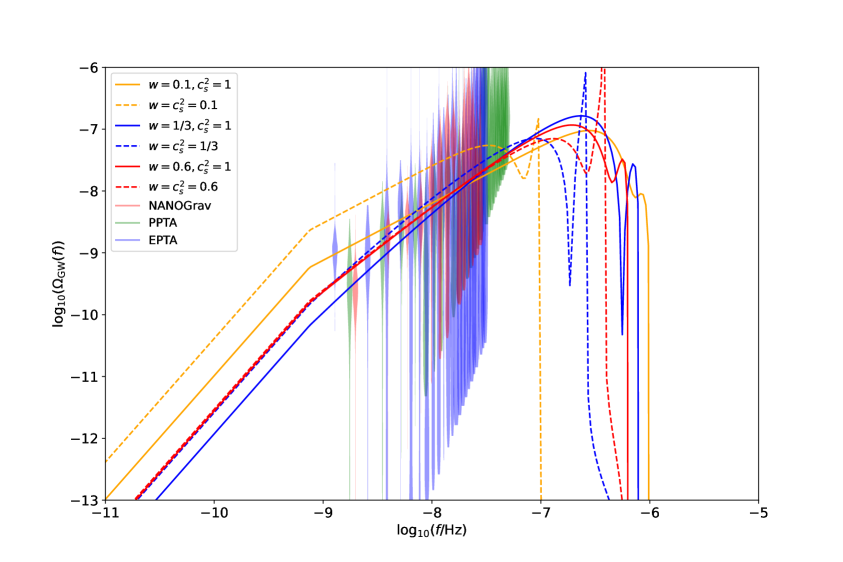
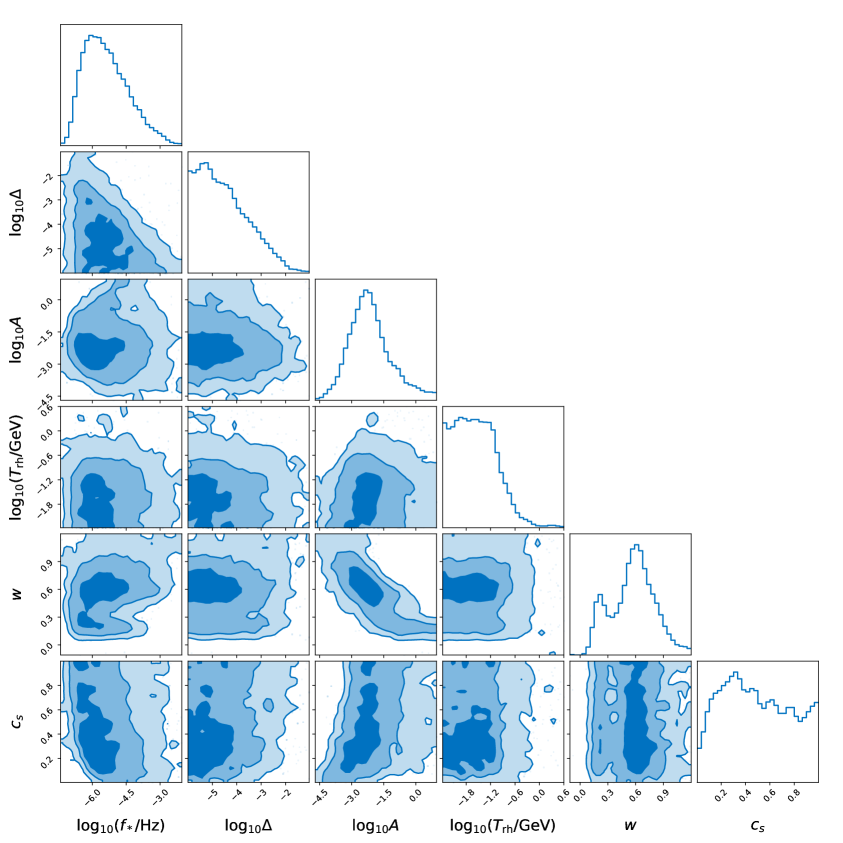
이 논문은 나노헤르츠 영역의 중력파 배경이 스칼라 유도 중력파에서 기인한다고 가정할 때, NANOGrav, PPTA 및 EPTA의 펄서 퍼지 배열(Pulsar Timing Array, PTA) 데이터를 사용하여 초기 우주의 상태방정식(w)과 음속(cₛ)을 동시에 제약한다. 결과적으로 w = 0.60⁺⁰.³²₋₀.³⁹, cₛ ≳ 0.09, T_rh ≲ 0.2 GeV를 도출하며, 이는 방사압 지배가 아닌 초기 우주를 지지하고 압력이 없는 유체 모형을 배제한다.
Recently, several major pulsar timing array (PTA) collaborations have assembled strong evidence for the existence of a gravitational-wave background at frequencies around the nanohertz regime. Assuming that the PTA signal is attributed to scalar-induced gravitational waves, we jointly employ the PTA data from the NANOGrav 15-year data set, PPTA DR3, and EPTA DR2 to probe the conditions of the early Universe. Specifically, we explore the equation of state parameter ($w$), the reheating temperature ($T_\mathrm{rh}$), and the sound speed ($c_s$), finding $w = 0.59^{+0.36}_{-0.40}$ (median + $90\%$ credible interval), and $T_\mathrm{rh}\lesssim 0.2\,\mathrm{GeV}$ at the $95\%$ credible interval for a lognormal power spectrum of the curvature perturbation. Furthermore, we compute Bayes factors to compare different models against the power-law spectrum model, effectively excluding the pressure-less fluid domination model. Our study underscores the significance of scalar-induced gravitational waves as a powerful tool to explore the nature of the early Universe.
연구 동기 및 목표
- 중력파 데이터를 사용하여 초기 우주의 상태방정식(w)과 음속(cₛ)을 동시에 제약하는 것.
- 관측된 펄서 퍼지 배열(PTA) 신호가 초거대 블랙홀 이원성과 같은 천체물리적 원인이 아닌 스칼라 유도 중력파(SIGWs)에서 기인하는지 테스트하는 것.
- 베이지안 모형 비교를 통해 표준 방사압 지배 우주론 모형(w = 1/3, cₛ² = 1/3)과 경쟁하는 다양한 우주론 모형을 평가하는 것.
- SIGWs가 초기 블랙홀(PBH) 형성과 재가열 온도(T_rh)에 미치는 영향을 탐색하는 것.
- 다중 기기 PTA 데이터 세트를 활용하여 일반적인 w와 cₛ를 가진 비표준 초기 우주 모형의 타당성을 평가하는 것.
제안 방법
- 초기 우주의 밀도 불균형을 모델링하기 위해 로그노멀 파wer 스펙트럼을 사용한다.
- 일반적인 w와 cₛ를 가진 우주에서 스칼라 유도 중력파(SIGWs)의 에너지 밀도를 2차 섭동 이론을 통해 계산한다.
- NANOGrav 15년, PPTA DR3, EPTA DR2의 PTA 데이터를 분석하기 위해 베이지안 추론과 내장 샘플링 도구 dynesty를 적용한다.
- 방사압 지배 기준 모형(w = 1/3, cₛ² = 1/3)과 다른 w와 cₛ를 가진 모형을 비교하기 위해 베이즈 요인을 계산한다.
- 큰 곡률 편차에서 기인하는 초기 블랙홀(PBH) 생성에 대한 제약 조건을 도입하여 파rameter 공간을 더욱 정밀하게 조정한다.
- 전체 사후 분포 샘플링과 모형 비교를 수행하기 위해 BILBY 베이지안 추론 라이브러리를 사용한다.
실험 결과
연구 질문
- RQ1PTA 관측을 통해 초기 우주의 상태방정식(w)과 음속(cₛ)에 대한 연합 제약 조건은 무엇인가?
- RQ2관측된 PTA 신호는 초거대 블랙홀 이원성과 같은 천체물리적 원인이 아닌 스칼라 유도 중력파(SIGW) 기원을 지지하는가?
- RQ3추정된 w와 cₛ 값은 표준 방사압 지배 모형(w = 1/3, cₛ² = 1/3)과 어떻게 비교되는가?
- RQ4압력이 없는 유체 모형(w = 0)이나 cₛ² = 1 모형은 데이터로 배제될 수 있는가?
- RQ5최적의 SIGW 시나리오 하에서 재가열 온도(T_rh)와 초기 블랙홀(PBH) 형성에 대한 함의는 무엇인가?
주요 결과
- 분석 결과 w = 0.60⁺⁰.³²₋₀.³⁹로 도출되었으며, 이는 방사압 지배 조건에서의 이탈을 시사한다.
- 음속은 cₛ ≳ 0.09로 제약되었으며, 이는 초기 우주에서 비이상적인 유체 거동을 시사한다.
- 재가열 온도는 T_rh ≲ 0.2 GeV로 추정되었으며, 이는 저에너지 스케일 재가열 시나리오와 일치한다.
- w = 1/3 및 cₛ² = 1/3 모형(방사압 지배)은 베이즈 요인에 의해 배제되었으며, 이는 대체적인 초기 우주 역학을 지지한다.
- 압력이 없는 유체 모형(w = 0)은 데이터에 의해 효과적으로 배제되었으며, 이는 상당히 낮은 증거를 제공하기 때문이다.
- 결과적으로, 강력한 베이지안 증거에 기반하여 PTA 신호에 대한 스칼라 유도 중력파 시나리오가 타당한 설명으로 지지된다.
더 나은 연구,지금 바로 시작하세요
논문 읽기부터 검토까지, 연구 시간을 획기적으로 줄여보세요.
카드 등록 없음 · 무료 플랜 제공
이 리뷰는 AI가 만들고, 인간 에디터가 검토했습니다.