
[논문 리뷰] SNeSCOPE - a python package for shock cooling fitting using the model of Morag et al 2024
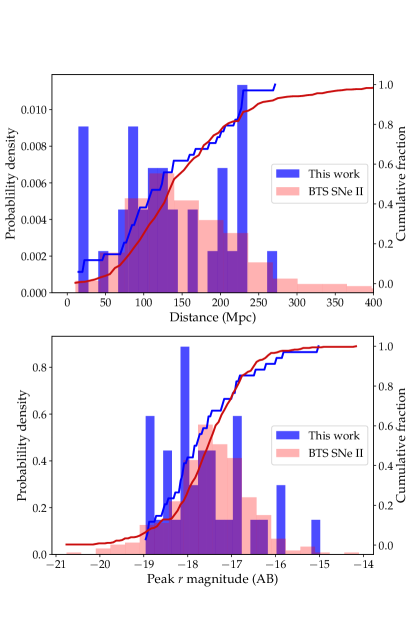
이 논문은 모라그 등(2024)의 프레임워크를 사용하여 초기 근적외선 및 가시광선 빛의 변화를 타입 II 초신성에 적합시키기 위한 파이썬 패키지인 SNeSCOPE를 소개한다. 초기 근적외선-가시광선 색깔과 블랙바디 진화가 구형 충격 냉각과 일관되며, 적색 초거성 원형성의 66%가 관측된 현장 RSG 분포와 일치하는 브레이크아웃 반경으로 폭발함을 발견했지만, CSM 봉쇄 또는 팽창한 대기권으로 인해 빛의 강도 편향이 더 큰 반경으로 향하게 하여 분포가 휠린다.
SNeSCOPE - SuperNovae Shock Cooling Observations Parameter Estimator Documentation SNeSCOPE is a python package for modeling supernova light curves using the analytic models of Morag et al 2023 and Morag et al 2024. Installation to install, git clone the repository. Then run from within the SNeSCOPE directory (where the script setup.py is) python setup.py install Alternatively, use pip pip install SNeSCOPE add simulation data files Use the following link to download the MG simulatiosn used for constructing the covariance matrix for the likelihood function: https://www.dropbox.com/scl/fi/kawt98t2lri5j90o61u60/RSG_batch_R03_20_removed_lines_Z1.mat?rlkey=1hnpbgiayol7jtu4cn4895slg&dl=0 and for the keys: https://www.dropbox.com/scl/fi/o22vj00kjskp9gk6ae2h1/RSG_batch_R03_20_removed_lines_Z1_key.mat?rlkey=kop5iq609h10pgkgsnycuvjyx&dl=0 If these links do not work for any reason, the files can be found in the zenodo repository linked in the bottom of this readme In addition to these, the filter transmission data I use is collected in the Filters folder avilable in this repository and in the zenodo repository. running the script To run pre exsiting script, modify the parameter files (e.g., see in tests). You will modify paths, SN parameters (e.g., distance, redshift, extinction), package options, and the photometric filters used while observing (an extensive folder is added, but you can always add more. Make sure to update the plotting parameters accordingly). If you encounter errors at this point, make sure you have the correct paths and consider moving from relative to absolute paths. Then run the script fit_SC.py, e.g., from the SNeSCOPE directory (for a unix based system): python ./scripts/fit_SC.py --path_params ./tests/params_2020jfo.py or (if using windows) python .\scripts\fit_SC.py --path_params . ests\params_2020jfo.py As the script is currently written, it requires a data file containing magnituds, fluxes, instruments and filters as is shown in the example test files. The script uses a non-rectangular prior on the recombination time of Hydrogen at a photospheric temperature of roughly t_rec 0.7 eV~ 8000K. Given the typical deviations from blackbody and given a mild amount of host extinction (up to E(B-V) = 0.2), a blackboyd fit assuming E(B-V) = 0 mag at 8000K can give anywhere between 5000 and 10000 K. I recommend to first fix the extinction to lower than 0.2, using the color curves of Irani 2024. Then add a dates files. This is a list of times (JD) where E(B-V) = 0 blackbody fits are made, and then used as priors. The script will run the fitter in the following steps: blackbody fits prepare covariance matrix for likelihood function using the light curve sampling provided fit the data get the results. re-fit a blackbody using the fit host-extinciton save the results as a pickle object plot calculate physical parameters and save to a table (for a full description of these parameters, see Irani 2024, and Morag 2024, and references therein). There are 4 plots which are provided. Light curve fits. These include a vertical line indicating the early validity time of the model (the time the breakout pulse is over and homologous expansion is reached). I also provide these plots with a logarithmic axis, which are more convenient for high cadence sampling of the early light curves. Blackbody fits compared to the model predictions. These are compared to the new blackbody fits, using the fit E(B-V) (and Rv, if fitted). A good fit should also fit the blackbody temperature and radius reasonable well, although some deviations are expected as the SED is not a perfect blackbody. corner plots SED plot - These can be used to evaluate the observed and model SED at various epochs. The different lines are both the blackbody and the frequency dependent formulas smapled from the posterior. Keep in mind sometimes, due to a low mass envelope or fast V*, the model can be no longer valid at the lowest temperature plotted in these plots. Python version python 3 Required python packages numpy dynesty matplotlib scipy astropy numba astropy os pandas Support I'm happy to provide support in setting up the package and interpreting its results. You can contact me at idoirani@gmail.com. For the most up to date version of the package, please visit the github repository at https://github.com/idoirani/shock_cooling. Credit If you are using SNeSCOPE, please cite the following papers: light curve fitter: Irani et al 2024, "the early UV light curves of Type II SNe" @ARTICLE{2023arXiv231016885I, author = {{Irani}, Ido and {Morag}, Jonathan and {Gal-Yam}, Avishay and {Waxman}, Eli and {Schulze}, Steve and {Sollerman}, Jesper and {Hinds}, K-Ryan and {Perley}, Daniel A. and {Chen}, Ping and {Strotjohann}, Nora L. and {Yaron}, Ofer and {Zimmerman}, Erez A. and {Bruch}, Rachel and {Ofek}, Eran O. and {Soumagnac}, Maayane T. and {Yang}, Yi and {Groom}, Steven L. and {Masci}, Frank J. and {Riddle}, Reed and {Bellm}, Eric C. and {Hale}, David}, title = "{The Early Ultraviolet Light-Curves of Type II Supernovae and the Radii of Their Progenitor Stars}", journal = {arXiv e-prints}, keywords = {Astrophysics - High Energy Astrophysical Phenomena}, year = 2023, month = oct, eid = {arXiv:2310.16885}, pages = {arXiv:2310.16885}, doi = {10.48550/arXiv.2310.16885}, archivePrefix = {arXiv}, eprint = {2310.16885}, primaryClass = {astro-ph.HE}, adsurl = {https://ui.adsabs.harvard.edu/abs/2023arXiv231016885I}, adsnote = {Provided by the SAO/NASA Astrophysics Data System} } analytic model for T,L evolution: Morag et al 2023 "Shock cooling emission from explosions of red super-giants: I. A numerically calibrated analytic model" @ARTICLE{2023MNRAS.522.2764M, author = {{Morag}, Jonathan and {Sapir}, Nir and {Waxman}, Eli}, title = "{Shock cooling emission from explosions of red supergiants - I. A numerically calibrated analytic model}", journal = {\mnras}, keywords = {shock waves, supernovae: general, Astrophysics - High Energy Astrophysical Phenomena}, year = 2023, month = jun, volume = {522}, number = {2}, pages = {2764-2776}, doi = {10.1093/mnras/stad899}, archivePrefix = {arXiv}, eprint = {2207.06179}, primaryClass = {astro-ph.HE}, adsurl = {https://ui.adsabs.harvard.edu/abs/2023MNRAS.522.2764M}, adsnote = {Provided by the SAO/NASA Astrophysics Data System} } deviations from blackbody: Morag et al 2024, "Shock cooling emission from explosions of red super-giants: II. An analytic model of deviations from blackbody emission" @ARTICLE{2024MNRAS.528.7137M, author = {{Morag}, Jonathan and {Irani}, Ido and {Sapir}, Nir and {Waxman}, Eli}, title = "{Shock cooling emission from explosions of red supergiants: II. An analytic model of deviations from blackbody emission}", journal = {\mnras}, keywords = {radiation: dynamics, radiative transfer, shock waves, transients: supernovae, Astrophysics - High Energy Astrophysical Phenomena, Astrophysics - Solar and Stellar Astrophysics}, year = 2024, month = mar, volume = {528}, number = {4}, pages = {7137-7155}, doi = {10.1093/mnras/stae374}, archivePrefix = {arXiv}, eprint = {2307.05598}, primaryClass = {astro-ph.HE}, adsurl = {https://ui.adsabs.harvard.edu/abs/2024MNRAS.528.7137M}, adsnote = {Provided by the SAO/NASA Astrophysics Data System} } Variable validity domain: Soumagnac et al 2020 "SN 2018fif: The Explosion of a Large Red Supergiant Discovered in Its Infancy by the Zwicky Transient Facility" @ARTICLE{2020ApJ...902....6S, author = {{Soumagnac}, Maayane T. and {Ganot}, Noam and {Irani}, Ido and {Gal-yam}, Avishay and {Ofek}, Eran O. and {Waxman}, Eli and {Morag}, Jonathan and {Yaron}, Ofer and {Schulze}, Steve and {Yang}, Yi and {Rubin}, Adam and {Cenko}, S. Bradley and {Sollerman}, Jesper and {Perley}, Daniel A. and {Fremling}, Christoffer and {Nugent}, Peter and {Neill}, James D. and {Karamehmetoglu}, Emir and {Bellm}, Eric C. and {Bruch}, Rachel J. and {Burruss}, Rick and {Cunningham}, Virginia and {Dekany}, Richard and {Golkhou}, V. Zach and {Graham}, Matthew J. and {Kasliwal}, Mansi M. and {Konidaris}, Nicholas P. and {Kulkarni}, Shrinivas R. and {Kupfer}, Thomas and {Laher}, Russ R. and {Masci}, Frank J. and {Riddle}, Reed and {Rigault}, Mickael and {Rusholme}, Ben and {van Roestel}, Jan and {Zackay}, Barak}, title = "{SN 2018fif: The Explosion of a Large Red Supergiant Discovered in Its Infancy by the Zwicky Transient Facility}", journal = {\apj}, keywords = {Supernovae, Type II supernovae, Astronomy data modeling, Observational astronomy, Ultraviolet transient sources, Transient sources, 1668, 1731, 1859, 1145, 1854, 1851, Astrophysics - High Energy Astrophysical Phenomena}, year = 2020, month = oct, volume = {902}, number = {1}, eid = {6}, pages = {6}, doi = {10.3847/1538-4357/abb247}, archivePrefix = {arXiv}, eprint = {1907.11252}, primaryClass = {astro-ph.HE}, adsurl = {https://ui.adsabs.harvard.edu/abs/2020ApJ...902....6S}, adsnote = {Provided by the SAO/NASA Astrophysics Data System} } If using Piro 2021 "Shock Cooling Emission from Extended Material Revisited" @ARTICLE{2021ApJ...909..209P, author = {{Piro}, Anthony L. and {Haynie}, Annastasia and {Yao}, Yuhan}, title = "{Shock Cooling Emission from Extended Material Revisited}", journal = {\apj}, keywords = {Radiative transfer, Supernovae, 1335, 1668, Astrophysics - High Energy Astrophysical Phenomena}, year = 2021, month = mar, volume = {909}, number = {2}, ei
연구 동기 및 목표
- 다중 대역 근적외선 및 가시광선 데이터를 사용하여 충격 냉각 모델을 초기 초신성 빛의 변화에 적합시키기 위한 견고한 프레임워크를 개발하는 것.
- 타입 II 초신성의 충격 브레이크아웃 단계를 분석하여 원형성 반경과 폭발 에너지를 제약 조건화하는 것.
- 초기 빛의 변화를 주도하는 주요 메커니즘이 충격 냉각인지, 또는 환경 물질(CSM) 상호작용인지를 구분하는 것.
- X선 탐지 및 상한값을 사용하여 환경 물질 밀도 및 질량 손실률에 대한 제약 조건을 유도하는 것.
- 관측된 근적외선-가시광선 색깔을 사용하여 주변 은하의 흡착을 경험적으로 보정하고, 다중 군대 시뮬레이션과의 비교를 통해 적합 프레임워크를 검증하는 것.
제안 방법
- SNeSCOPE 패키지는 모라그 등(2024)의 충격 냉각 모델을 구현하여 Zwicky Transient Facility(ZTF)의 다중 대역 빛의 변화, 즉 근적외선, 가시광선 및 X선 데이터를 적합한다.
- 모델은 원형성 반경, 밀도 프로파일, 폭발 에너지에 기반한 충격 브레이크 타임스케일과 빛의 세기 변화를 사용하며, 주요 매개변수로는 $ R_{bo} $, $ v_{bo ext{ }} $, $ E_{\text{exp}} $, 및 $ M_{\text{ej}} $ 가 포함된다.
- 포osterior 추론 및 불확실성 정량화를 위해 동적 샘플링 라이브러리인 dynesty를 사용하여 적합을 수행한다.
- 스펙트럼 모델링에 의존하지 않고 관측된 근적외선-가시광선 색깔 변화에서 경험적으로 주변 은하의 흡착 보정을 유도한다.
- X선 데이터는 에너지 예산과 복사 효율을 가정하여 $ \tilde{10^{15}} $ cm에서 CSM 밀도를 스펙트럼 피팅과 독립적으로 제약 조건화하는 데 사용된다.
- 다중 군대 복사 유체역학 시뮬레이션을 사용하여 프레임워크를 검증하였으며, 반경과 속도에 대해 입력 매개변수를 20% 이내로 편향 없이 복원함을 보였다.
실험 결과
연구 질문
- RQ1충격 브레이크 이온화 특징과 무관하게 초기 근적외선-가시광선 빛의 변화는 일관된 구형 충격 냉각 모델로 설명될 수 있는가?
- RQ2타입 II 초신성의 원형성 브레이크아웃 반경 분포는 어떻게 되며, 관측된 적색 초거성 집단과 어떤 관계가 있는가?
- RQ3환경 물질(CSM) 상호작용 또는 팽창한 대기권이 초기 빛의 변화 상승 및 브레이크아웃 특성에 어느 정도의 영향을 미치는가?
- RQ4X선 탐지 및 상한값을 사용하여 원형성의 질량 손실률과 CSM 밀도에 대해 어떤 제약 조건을 둘 수 있는가?
- RQ5관측된 빛의 강도 편향은 표본에서 추론된 브레이크아웃 반경 분포에 어떻게 영향을 미치는가?
주요 결과
- 34개의 타입 II 초신성의 초기 근적외선-가시광선 색깔과 블랙바디 진화는 플래시 이온화 특징과 무관하게 구형 충격 냉각 모델과 일관된다.
- SNeSCOPE는 다중 군대 시뮬레이션에서 입력 매개변수를 반경과 속도에 대해 20% 이내의 편향으로 회복하여 적합 프레임워크의 유효성을 검증한다.
- 표본의 약 절반(17/34)은 브레이크아웃 반경 $ <10^{14} $ cm로 가장 잘 맞는 모델을 보이며, 나머지 절반은 $ >10^{14} $ cm여야 하므로 이중 구조의 원형성 구조를 시사한다.
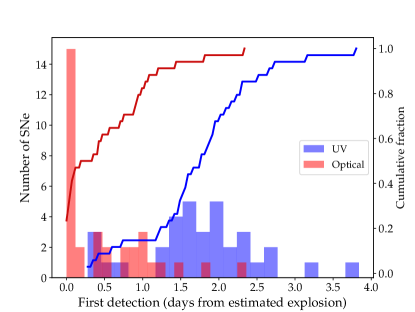
- 고반경 적합은 첫날에 매우 느린 상승을 예측하며, 이는 큰 브레이크아웃 사건이 대부분 팽창한 대기권 또는 급격한 CSM 밀도 프로파일로 인한 것으로 보인다.
- X선 탐지 및 상한값은 CSM 질량 손실률을 $ \dot{M} < 10^{-4} M_{\odot} \, \text{yr}^{-1} $ 이하로 제약 조건화하여 대부분의 타입 II 초신성 원형성이 CSM를 봉쇄하고 있음을 시사한다.
- 관측된 브레이크아웃 반경 분포는 빛의 강도 편향으로 인해 더 큰 반경으로 기울어져 있으며, 보정 후 66%의 RSG가 현장 RSG 분포와 일치하는 반경으로 폭발함을 보였고, 더 큰 반경으로 이어지는 尾첨은 CSM로 인한 것으로 보인다.
더 나은 연구,지금 바로 시작하세요
논문 읽기부터 검토까지, 연구 시간을 획기적으로 줄여보세요.
카드 등록 없음 · 무료 플랜 제공
이 리뷰는 AI가 만들고, 인간 에디터가 검토했습니다.