
[논문 리뷰] Stable Neural Stochastic Differential Equations in Analyzing Irregular Time Series Data
논문은 제어 경로를 가진 불규칙 시계열 처리를 위한 세 가지 안정적인 Neural SDE( Langevin-type SDE, Linear Noise SDE, 및 Geometric SDE) 클래스를 제시하고, 존재성과 uniqueness를 증명하며, 분포 변화 및 결측 데이터에 대한 강건성을 광범위한 실험을 통해 입증합니다.
Irregular sampling intervals and missing values in real-world time series data present challenges for conventional methods that assume consistent intervals and complete data. Neural Ordinary Differential Equations (Neural ODEs) offer an alternative approach, utilizing neural networks combined with ODE solvers to learn continuous latent representations through parameterized vector fields. Neural Stochastic Differential Equations (Neural SDEs) extend Neural ODEs by incorporating a diffusion term, although this addition is not trivial, particularly when addressing irregular intervals and missing values. Consequently, careful design of drift and diffusion functions is crucial for maintaining stability and enhancing performance, while incautious choices can result in adverse properties such as the absence of strong solutions, stochastic destabilization, or unstable Euler discretizations, significantly affecting Neural SDEs' performance. In this study, we propose three stable classes of Neural SDEs: Langevin-type SDE, Linear Noise SDE, and Geometric SDE. Then, we rigorously demonstrate their robustness in maintaining excellent performance under distribution shift, while effectively preventing overfitting. To assess the effectiveness of our approach, we conduct extensive experiments on four benchmark datasets for interpolation, forecasting, and classification tasks, and analyze the robustness of our methods with 30 public datasets under different missing rates. Our results demonstrate the efficacy of the proposed method in handling real-world irregular time series data.
연구 동기 및 목표
- 불규칙 시계열에서 결측 데이터를 포함한 Robust한 처리의 필요성을 Neural SDE로 모티베이션한다.
- 안정성과 잘 정의된 문제를 보장하기 위해 세 가지 안정적인 Neural SDE 클래스를 제안한다.
- drift에 제어 경로를 도입하여 순차 관찰 모델링을 개선한다.
- 분포 변화 및 결측 데이터 하에서의 강건성을 이론적으로 분석한다.
- 여러 데이터셋에 걸쳐 보간, 예측 및 분류 작업에서 실증적으로 검증한다.
제안 방법
- Langevin-type Neural LSDE를 드리프트 gamma와 확산 sigma로 정의하고, Lip시프스 및 성장 가정 하에서 존재성/고유성을 증명한다.
- 선형 승법적 확산을 갖는 Linear Noise Neural LNSDE를 정의하고 안정성 특성을 분석한다.
- Geometric 형태의 Neural GSDE를 정의하고 비음수성 및 흡수 상태 특성을 보인다.
- 신경 구성요소에 대해 Assumptions 3.1–3.3을 부과하여 SDE 해의 잘 정의된 해를 보장한다.
- 드리프트에 z̄(t)=zeta(t,z(t),X(t);θζ)로 제어 경로를 도입하고, 드리프트 항에서 z(t)를 z̄(t)로 대체한다.
- 입력 교란 하에서 출력 분포 차이에 대한 비점근적 경계(non-asymptotic bounds)를 제시하는 강건성 결과(Theorems 3.5 및 3.6)를 제공한다.
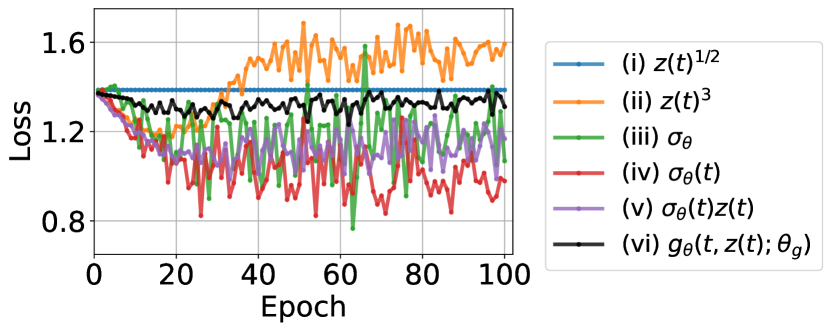
- 변수 제거 연구(ablation studies)를 수행하고 확산 비선형성 및 제어 경로(ζ 및 확산 σ)를 비교한다.
실험 결과
연구 질문
- RQ1분포 변화 및 결측 데이터 하에서 성능을 유지하도록 안정된 Neural SDE를 설계할 수 있는가?
- RQ2Langevin-type, Linear Noise, Geometric SDE 형식이 존재성, 고유성 및 강건성에 대한 이론적 보장을 제공하는가?
- RQ3드리프트에 제어 경로를 도입하면 불규칙 시계열에서 경험적 성능이 개선되는가?
- RQ4다른 확산 아키텍처(선형 대 비선형)가 안정성 및 정확도에 어떤 영향을 미치는가?
- RQ5결측이 존재하는 상황에서 보간, 예측 및 분류 작업에서 제안된 모델의 실용적 효과는 어느 정도인가?
주요 결과
- 세 가지 안정적인 Neural SDE 클래스(LSDE, LNSDE, GSDE)가 제안되며 합리적 가정 하에서 고유한 강한 해를 갖는 것으로 입증된다.
- Neural GSDE는 비음수성 및 흡수 상태 특성을 보이며 이는 깊은 ReLU 네트워크와 연결된다.
- 이론적 결과는 분포 변화 및 결측 데이터에 대한 강건성을 보여주며, 깊이가 증가할수록 감소하는 출력 분포 변화에 대한 비점근적 경계가 제시된다.
- 보간, 예측 및 분류를 위한 네 가지 벤치마크에서의 실증 결과는 다양한 결측률 하에서 제안된 방법이 기초 모델보다 우수함을 보여준다.
- 제어 경로와 비선형 확산 함수의 도입이 성능에 유익함을 확인하는 ablation 연구가 수행된다.
- 결정적으로 30개의 공개 데이터셋에서 다양한 결측률에 대해 제안된 Neural LSDE, LNSDE, GSDE가 전통적 RNN, Neural CDE 및 다른 Neural SDE 변형과 비교해 최상위 수준의 정확도와 강건성을 달성한다.
더 나은 연구,지금 바로 시작하세요
연구 설계부터 논문 작성까지, 연구 시간을 획기적으로 줄여보세요.
카드 등록 없음 · 무료 플랜 제공
이 리뷰는 AI가 만들고, 인간 에디터가 검토했습니다.