
[논문 리뷰] Standard Siren Cosmology with Gravitational Waves from Binary Black Hole Mergers in Active Galaxy Nuclei
이 논문은 활성은하핵(AGN) 내 이중 블랙홀 합성에서 발생하는 중력파를 이용한 표준 소리우주론 방법을 제안한다. AGN의 플레어 또는 카탈로그를 유일한 은하계 호스트 식별이 필요 없이 적색편이 지표로 활용함으로써, 설계 감도(A+)에 도달한 LIGO/Virgo/KAGRA 관측에서 1–2년 내에 H₀를 2–7% 정밀도로 제약할 수 있다. 이는 플레어 탐지 효율과 우주론적 사전 정보에 따라 달라진다.
The detection of gravitational waves (GW) with an electromagnetic counterpart enabled the first Hubble Constant $H_0$ measurement through the standard siren method. Current constraints suggest that $\sim 20-30\%$ of LIGO/Virgo/KAGRA (LVK) Binary Black Hole (BBH) mergers might occur in Active Galactic Nuclei (AGN) disks. The claim for a possible association of several BBH mergers with flaring AGNs suggests that cosmological analyses using BBH and AGNs might be promising. We explore standard siren analyses through a method that takes into account the presence of background flaring AGNs, without requiring a unique host galaxy identification, and apply it to realistic GW simulations. Depending on the fraction of LVK BBHs that induce flares, we expect to constrain $H_0$ at the $\sim 6-7\%$ ($\sim 4-5\%$) precision with $\sim 2-3$ years or $\sim 160-240$ events ($\sim 1$ year or $500$ events) of LVK at design (A+) sensitivity, assuming that systematic BBH follow-up searches are performed. %Assuming a more restrictive $Ω_{ m m}$ prior and that at least $20\%$ of BBHs produces detectable flares, we may reach a $3\%$ ($2\%$) precision in $H_0$ after 2 (1) year of LVK at design (A+) sensitivity. We also show that in a scenario where only $\sim 1\%$ of the BBHs induce detectable flares it is possible to achieve an $H_0$ precision from $7.5\%$ to $15\%$ with $\sim 240$ events. In addition, a $\sim 5-27\%$ precision is achievable with complete AGN catalogs and 1 year of LVK run, without the need of any flare identification.
연구 동기 및 목표
- 중력파를 이용한 독립적인 우주론적 측정을 가능하게 하여 지속적인 H₀ 갈등을 해결한다.
- 대부분의 이중 블랙홀(BBH) 합성에서 전자기 대응체가 없기 때문에 발생하는 과제를 해결하기 위해 AGN 플레어를 적색편이 지표로 사용한다.
- 시간에 민감한 후속 관측이나 유일한 은하계 호스트 식별이 필요 없이 GW 이벤트를 AGN 또는 플레어와 통계적으로 연관짓는 방법을 개발한다.
- 실제 AGN 밀도와 플레어 확률을 고려하여 BBH 합성을 이용한 우주론적 정밀도를 정량화한다.
- 우주론적 사전 정보와 AGN 플레어 탐지 효율이 H₀ 측정 정밀도에 미치는 영향을 평가한다.
제안 방법
- AGN와 플레어의 공간 및 시간 분포를 고려하기 위해 비균일 포아송 과정을 사용하여 GW-AGN 연관성을 모델링한다.
- 베이즈 정리에 따라 우주론적 파라미터의 사후분포를 계산하며, BBH가 플레어를 유도하는 비율(λ)과 천구 위치를 통합한다.
- 식(3)의 우도 함수를 사용하여, GW 이벤트가 AGN의 천구 위치와 적색편이와 일치할 확률과 우연한 일치 배경 빈도를 통합한다.
- AGN 및 플레어 탐지 확률(P_det^AGN)을 통합하고, 천구 및 적색편이에 대한 통합을 통해 배경 연관 수(μ_i)를 계산한다(식(4) 참조).
- emcee MCMC 패키지를 사용하여 사후분포를 샘플링하여 wCDM 우주론 모델에서 우주론적 파라미터와 λ를 추정한다.
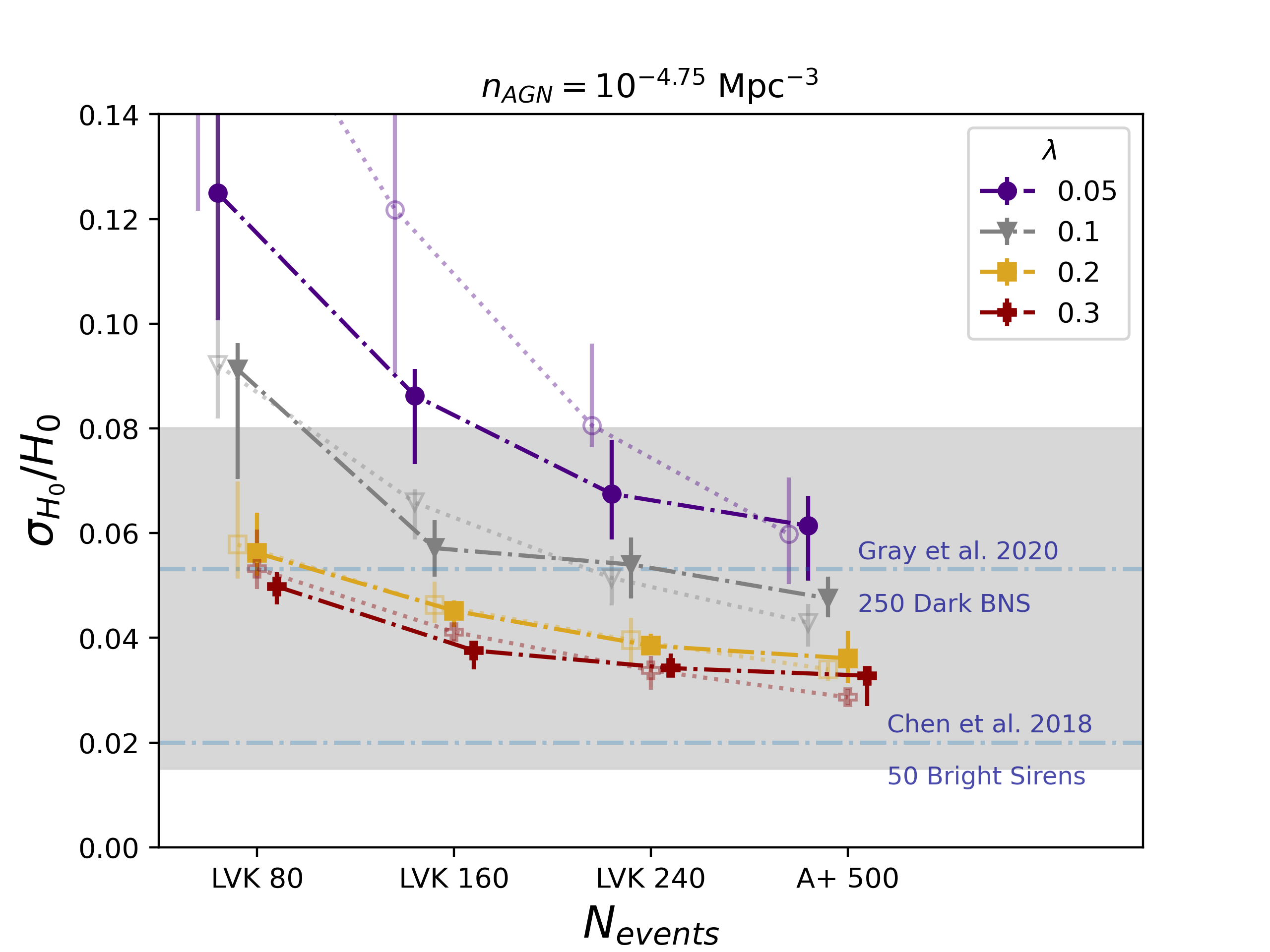
- 실제 GW 시뮬레이션을 사용하여 AGN 밀도(n_AGN = 10^{-4.75}에서 10^{-4.5} Mpc⁻³)와 플레어 확률(α_flare = 10^{-4}에서 10^{-3})를 다양하게 설정한 경우에 대해 방법을 테스트한다.
실험 결과
연구 질문
- RQ1고유한 은하계 호스트 식별이 없이 AGN 플레어 또는 카탈로그를 표준 소리 우주론의 적색편이 지표로 사용할 수 있는가?
- RQ2현재 및 향후 중력파 탐지기 감도에서 AGN 내 BBH 합성을 이용해 H₀를 어느 정도의 정밀도로 측정할 수 있는가?
- RQ3이 프레임워크에서 Ω_m 등의 우주론적 사전 정보가 H₀ 측정 정밀도에 어떤 영향을 미치는가?
- RQ4BBH 중에서 감지 가능한 AGN 플레어를 유도하는 비율(λ)을 측정할 수 있는 정밀도는 얼마이며, 이는 이벤트 수와 AGN 밀도에 따라 어떻게 달라지는가?
- RQ5시간에 민감한 후속 관측이 필요 없이 오직 AGN 카탈로그만으로도 5% 이내의 H₀ 정밀도를 달성할 수 있는가?
주요 결과
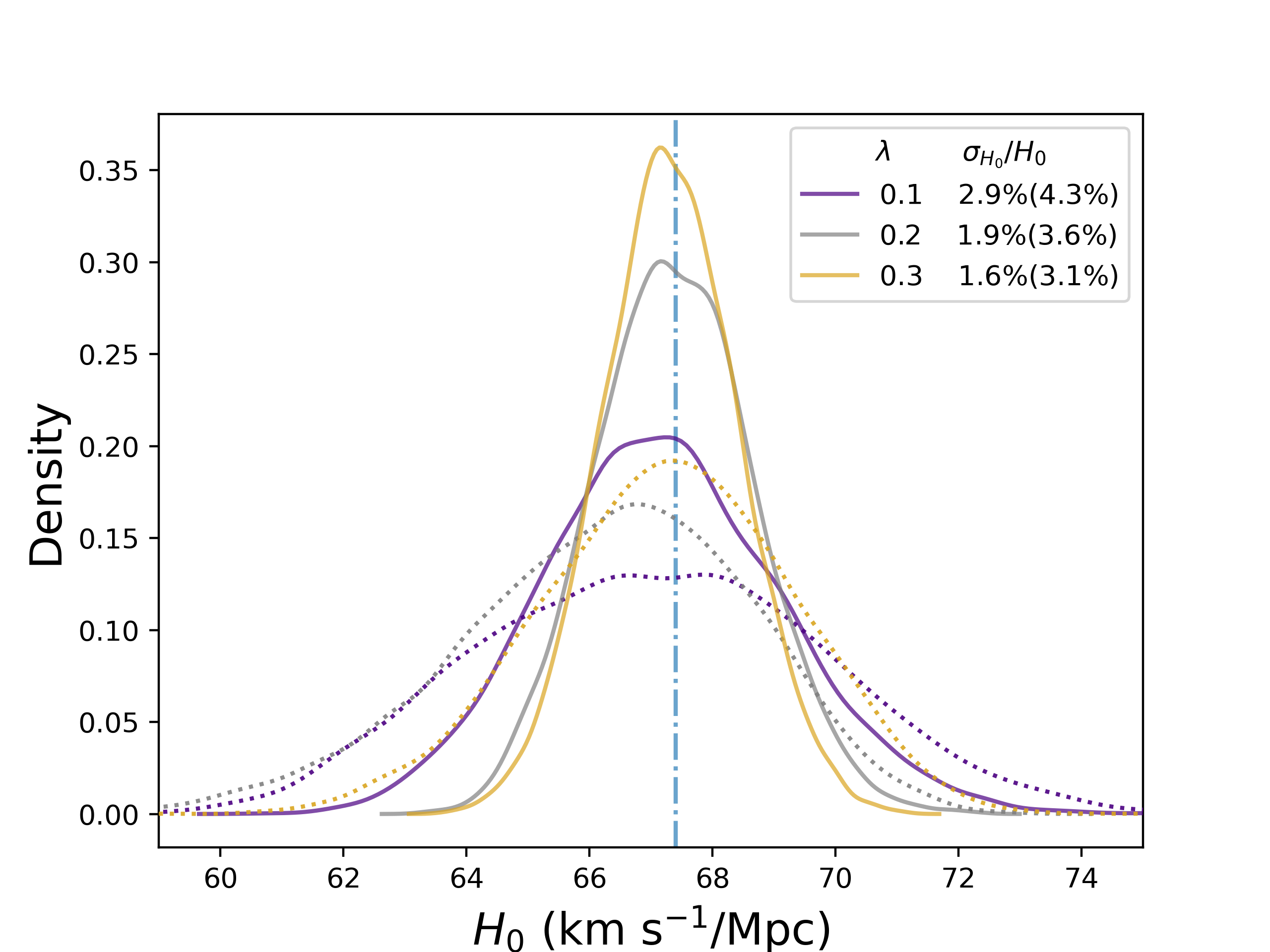
- LIGO/Virgo/KAGRA가 설계 감도(A+)에 도달한 지 약 2년 동안 160개의 BBH 이벤트를 확보할 경우, BBH의 20–80%가 AGN 내에서 발생한다고 가정할 때 H₀는 3.5–7% 정밀도로 제약된다.
- A+ 감도에서 약 1년 동안 500개의 이벤트를 확보할 경우, 동일한 가정 하에 H₀ 정밀도는 2.5–5%로 향상된다.
- BBH 플레어 비율이 20%이고 Ω_m에 엄격한 사전 정보가 있을 경우, A+ 감도에서 2년(1년) 후 H₀ 정밀도는 3%(2%)에 도달한다.
- 완전한 AGN 카탈로그와 1년 간의 LVK 데이터만으로도 H₀ 정밀도를 5–10%로 확보할 수 있으며, 시간에 민감한 후속 관측이 필요 없다.
- 이 방법을 통해 BBH 중 플레어를 유도하는 비율(λ)을 약 10–30% 정밀도로 제약할 수 있으며, 이는 AGN 내 BBH 형성 경로에 대한 통찰을 제공한다.
- 사후 등고선은 표준 소리에서 흔히 보이는 바나나 모양의 디게너레이션 특성을 보이며, 이는 방법이 표준 소리 우주론 원리와 일관성을 유지하고 있음을 확인한다.
더 나은 연구,지금 바로 시작하세요
논문 읽기부터 검토까지, 연구 시간을 획기적으로 줄여보세요.
카드 등록 없음 · 무료 플랜 제공
이 리뷰는 AI가 만들고, 인간 에디터가 검토했습니다.