
[논문 리뷰] Structural Chirality and Electronic Chirality in Quantum Materials
이 논문은 궤도운동량 결합을 통해 양자물질의 구조적 편재성과 전자적 편재성을 연결하는 통합 프레임워크를 수립하며, 원자 척도의 수동성(手性)이 스핀 분극화(_CISS_)와 다이오드 유사 전도성( _EMCA_ ) 및 비정상적인 원형 편광 빛 방출( _ACPLE_ )을 유도하는 방식을 규명한다. 핵심 기여는 이러한 편재 현상의 핵심 메커니즘으로 궤도운동량 결합을 규명한 것으로, 스핀트로닉스, 옵티오일렉트로닉스 및 토폴로지적 양자물질 분야에 응용 가능성을 제시한다.
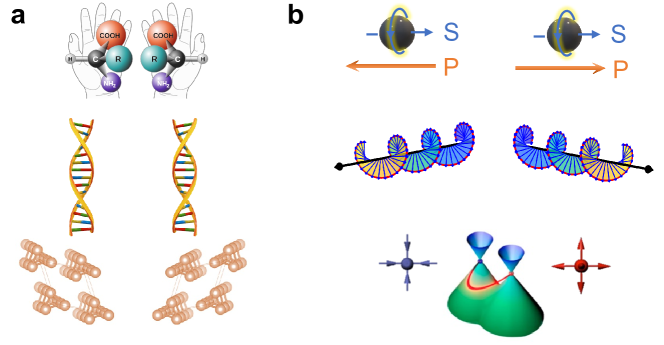
In chemistry and biochemistry, chirality represents the structural asymmetry characterized by non-superimposable mirror images for a material like DNA. In physics, however, chirality commonly refers to the spin-momentum locking of a particle or quasiparticle in the momentum space. While seemingly disconnected, structural chirality in molecules and crystals can drive electronic chirality through orbital-momentum locking, i.e. chirality can be transferred from the atomic geometry to electronic orbitals. Electronic chirality provides an insightful understanding of the chirality-induced spin selectivity (CISS), in which electrons exhibit salient spin polarization after going through a chiral material, and electric magnetochiral anisotropy (EMCA), which is characterized by the diode-like transport. It further gives rise to new phenomena, such as anomalous circularly polarized light emission (ACPLE), in which the light handedness relies on the emission direction. These chirality-driven effects will generate broad impacts in fundamental science and technology applications in spintronics, optoelectronics, and biochemistry.
연구 동기 및 목표
- 양자물질에서 원자 척도의 구조적 편재성과 나타나는 전자적 편재성 사이의 미시적 연결 고리를 확립하기 위해.
- 궤도운동량 결합과 스핀-오비탈 결합을 통해 편재성 유도 스핀 선택성(_CISS_)의 기원을 설명하기 위해.
- 궤도운동량 결합이라는 동일한 기초 메커니즘을 연결함으로써 _EMCA_ 와 _CISS_ 를 통합적으로 이해하기 위해.
- 비정상적인 원형 편광 빛 방출(_ACPLE_)의 물리적 기원을 광학 베리 위상으로 설명하기 위해.
- 하이브리드 퍼보스카이트 및 비틀린 2D 이종구조를 포함한 다양한 물질에서 편재성 양자현상을 예측하고 설계할 수 있는 일반 이론 프레임워크를 제안하기 위해.
제안 방법
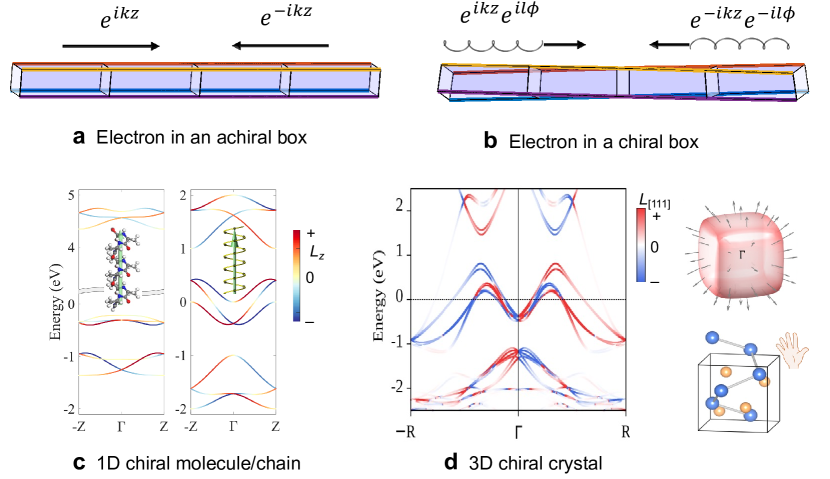
- 비틀린 3차원 상자 모형을 사용하여 편재 기하학이 전자 파동함수에 궤도운동량(_OAM_)을 유도하고 궤도운동량 결합을 초래하는 방식을 설명한다.
- 편재 분자의 파동함수 구조를 유도하기 위해 궤도운동량 결합 개념을 적용하며, $k$ 와 $l$ 이 부호와 크기에서 서로 결합되어 있음을 보여준다.
- 금속 접촉에서 스핀-오비탈 결합(_SOC_)의 역할을 도입하여 궤도 분극화를 스핀 분극화로 전환함으로써 _CISS_ 효과를 가능하게 한다.
- 온제거의 상호작용 원리를 적용하여 _EMCA_ 와 _CISS_ 를 연결함으로써, 양자역학적 시간역전 대칭성 파괴에 기인한 동일한 기원을 밝혀낸다.
- 광학 베리 위상을 통해 _ACPLE_ 를 분석하여, 전류 유도 궤도 분극화가 방출 방향에 따라 다른 원형 편광 빛 방출을 유도함을 보여준다.
- 비 centrosymmetric 물질의 내재 밴드 구조 특성과 연결하여, 비틀린 고체에서 광학 베리 휨성의 두 배를 일반화함으로써 _ACPLE_ 를 확장한다.
실험 결과
연구 질문
- RQ1물질 내의 구조적 편재성이 궤도운동량 결합를 통해 어떻게 내재 전자적 편재성을 유도하는가?
- RQ2편재 분자에서 편재성 유도 스핀 선택성(_CISS_) 효과의 미시적 메커니즘은 무엇인가?
- RQ3_EMCA_ 와 _CISS_ 는 어떻게 관련되어 있으며, 둘을 둘러싸는 공통된 물리적 기원은 무엇인가?
- RQ4비정상적인 원형 편광 빛 방출(_ACPLE_)을 가능하게 하는 광학 베리 위상의 역할은 무엇인가?
- RQ5비 centrosymmetric 고체에서 광학 베리 휨성의 두 배를 사용하여 새로운 물질에서 _ACPLE_ 를 예측하고 설계할 수 있는가?
주요 결과
- 편재 분자 및 결정에서의 구조적 편재성이 궤도운동량 결합를 통해 전자적 편재성을 유도하며, 전자의 궤도운동량(_OAM_)이 운동량과 결합되어 있다.
- 궤도운동량 결합 메커니즘이 _CISS_ 에서 관측된 스핀 분극화를 설명하며, 금속 접촉의 스핀-오비탈 결합을 통해 스핀 필터링이 가능하다.
- _EMCA_ 와 _CISS_ 는 시간역전 대칭성 파괴에 기인한 동일한 물리적 메커니즘—편재 전자 구조—의 두 양태로 밝혀졌으며, 온제거의 상호작용 원리를 통해 연결된다.
- 비정상적인 원형 편광 빛 방출(_ACPLE_)은 전류 유도 궤도 분극화에서 기인하며, 방출 방향이 방출되는 원형 편광 빛의 수동성 결정한다.
- _ACPLE_ 는 전자-정공 재결합에서 광학 베리 위상과 연결되며, 동일한 수동성이 정방향 및 역방향 방출에서 관측되며, 이는 운동량이 실체에서 광자로 전달됨에 따라 발생한다.
- 광학 베리 휨성의 두 배는 고체 상태 편재 물질에서 _ACPLE_ 를 예측할 수 있는 일반적 프레임워크를 제공하며, 유기 반도체를 넘어서 퍼보스카이트 및 2D 이종구조로의 현상 확장을 가능하게 한다.
더 나은 연구,지금 바로 시작하세요
논문 읽기부터 검토까지, 연구 시간을 획기적으로 줄여보세요.
카드 등록 없음 · 무료 플랜 제공
이 리뷰는 AI가 만들고, 인간 에디터가 검토했습니다.