
[논문 리뷰] Superconducting Diode Effect -- Fundamental Concepts, Material Aspects, and Device Prospects
초전도 다이오드 효과(SDE)의 포괄적 리뷰로, 기본 메커니즘, 물질 플랫폼, 및 장치 전망을 다루며 magnetochiral anisotropy, spin-orbit coupling, 및 finite-momentum pairing에 초점을 둡니다.
Superconducting diode effect, in analogy to the nonreciprocal resistive charge transport in semiconducting diode, is a nonreciprocity of dissipationless supercurrent. Such an exotic phenomenon originates from intertwining between symmetry-constrained supercurrent transport and intrinsic quantum functionalities of helical/chiral superconductors. In this article, research progress of superconducting diode effect including fundamental concepts, material aspects, device prospects, and theoretical/experimental development is reviewed. First, fundamental mechanisms to cause superconducting diode effect including simultaneous space-inversion and time-reversal symmetry breaking, magnetochiral anisotropy, interplay between spin-orbit interaction energy and the characteristic energy scale of supercurrent carriers, and finite-momentum Cooper pairing are discussed. Second, the progress of superconducting diode effect from theoretical predictions to experimental observations are reviewed. Third, interplay between various system parameters leading to superconducting diode effect with optimal performance is presented. Then, it is explicitly highlighted that nonreciprocity of supercurrent can be characterized either by current-voltage relation obtained from resistive direct-current measurements in the metal-superconductor fluctuation region ($T\approx T_c$) or by current-phase relation and nonreciprocity of superfluid inductance obtained from alternating-current measurements in the superconducting phase ($T
연구 동기 및 목표
- 초전도 다이오드 효과(SDE)를 가능하게 하는 기본 개념과 메커니즘을 요약한다.
- 벌크 초전도체에서 엔지니어링된 장치에 이르기까지 이론적 및 실험적 발전을 검토한다.
- SDE가 관찰된 물질 및 장치 구조를 분류한다.
- 시스템 매개변수 및 측정 접근법에 따라 SDE 강도가 어떻게 달라지는지 논의한다.
- 밴드 위상학과 helical superconductivity를 연결하는 향후 방향에 대한 시각을 제시한다.
제안 방법
- SDE의 기원으로서 반전 대칭 및 시간 반전 대칭의 깨짐 요건과 magnetochiral anisotropy를 논의한다.
- 저항성 및 초전도 영역에서 MCA가 전류-전압 및 유도 기반 측정에 어떻게 영향을 미치는지 설명한다.
- SDE를 모델링하는 이론적 프레임워크(Ginzburg-Landau, Bogoliubov–de Gennes, 평균장) 요약.
- dc 저항 측정 및 ac 유도 설정에서 SDE를 관찰하는 실험 방법 개요.
- SDE를 최적화하는 물질 매개변수(SOI, 자기화, 화학 퍼텐셜, 무질서)를 평가한다.
실험 결과
연구 질문
- RQ1초전도체에서 비대칭 초전류(SDE)가 발생하는 대칭 조건과 메커니즘은 무엇인가?
- RQ2물질 특성과 디바이스 설계가 SDE의 강도와 tunability에 어떤 영향을 미치는가?
- RQ3SDE는 junction-free bulk 초전도체에서도 고유적으로 실현될 수 있으며 Josephson 접합에서도 실현될 수 있는가?
- RQ4SDE를 가장 잘 특성화하는 측정 전략은 무엇인가? Tc 근처의 dc 저항 측정 vs. 초전도 페이즈의 ac 유도 측정?
- RQ5SDE를 가능하게 하는 데 있어 spin-orbit coupling과 helix/chiral 초전도성의 역할은 무엇인가?
주요 결과
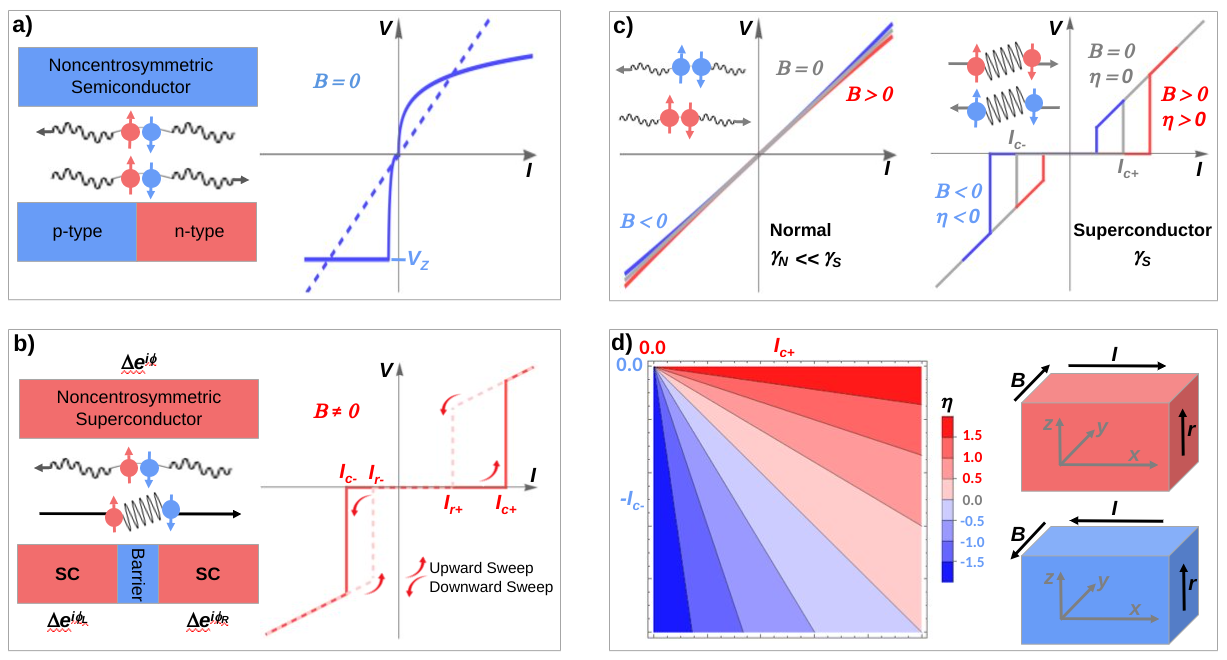
- 공간 반전 대칭과 시간 반전 대칭이 동시에 파괴될 때 초전류의 비대칭성이 발생하며, 이는 유한 모멘텀 코퍼 쌍을 가능하게 한다.
- Tc 근처의 변동/저항성 영역에서 MCA가 큰 비대칭 전류를 만들어낼 수 있으며, 일부 물질에서 gamma_S >> gamma_N이다.
- Junction-free 비 중심대칭이 아닌 bulk 초전도체와 다양한 재료 및 장벽을 갖춘 JJ 기반 소자에서 SDE를 관찰할 수 있다.
- SDE 강도는 자기장 방향, 온도, SOI, 화학 퍼텐셜, 무질서에 의존하며 Tc 근처의 dc I–V 또는 초전도 페이즈의 ac 유도에서 탐지될 수 있다.
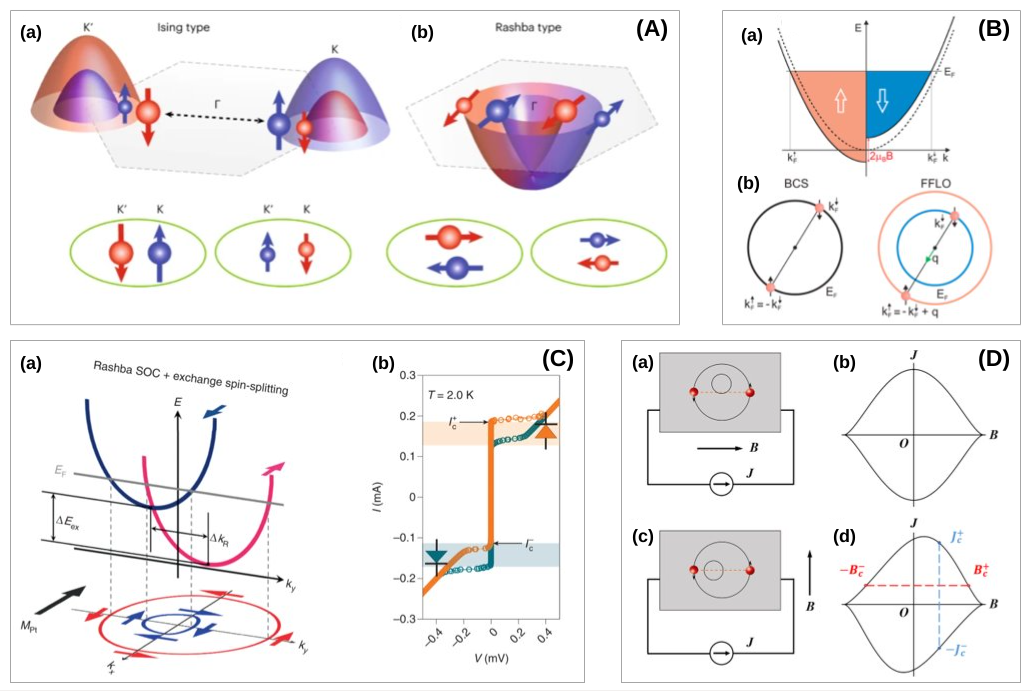
- Ising 및 Rashba 유형의 spin-orbit coupling과 적절한 자기화 방향이 SDE를 강화하고 위상학적/나선형 초전도성과 관련된다.
- 비전통적 및 위상적 초전도체에서 SDE의 관찰은 초전도 전자공학 및 양자 기술을 위한 더 넓은 플랫폼 가능성을 시사한다.
더 나은 연구,지금 바로 시작하세요
연구 설계부터 논문 작성까지, 연구 시간을 획기적으로 줄여보세요.
카드 등록 없음 · 무료 플랜 제공
이 리뷰는 AI가 만들고, 인간 에디터가 검토했습니다.