
[논문 리뷰] Superconductivity emerging from density-wave-like order in a correlated kagome metal
이 연구는 강한 전자 상호작용과 취약한 밀도파동(DW) 주기를 갖는 코어레이트(kagome) 악성 금속인 CsCr₃Sb₅를 규명한다. 고압 조건(~4–8 GPa)에서 DW 주기는 양자临계점 근처에서 억제되며, 이로 인해 최대 Tc가 6.4 K인 비보편 초전도성이 유도되며, 이는 강한 상관관계가 있는 코어레이트 시스템에서 비보편 초전도성 연구를 위한 흔치 않은 플랫폼을 제공한다.
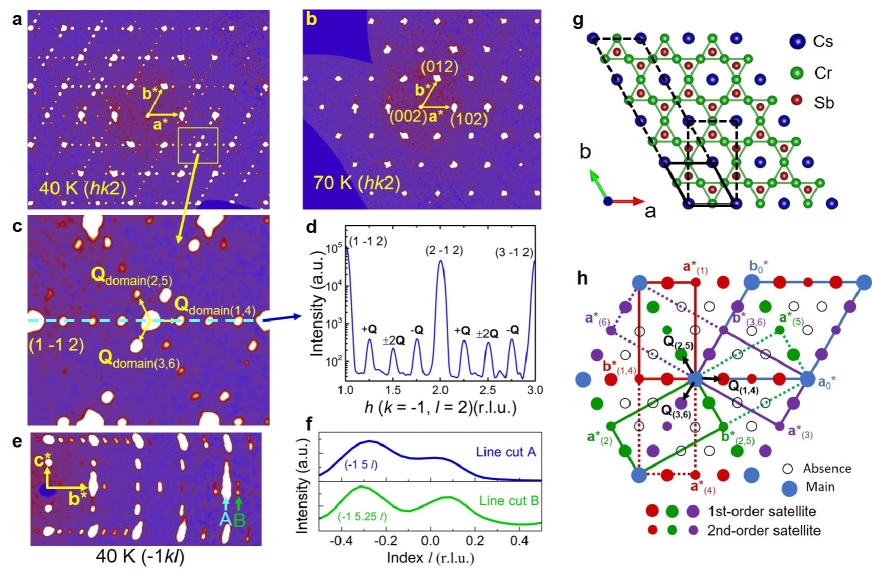
Unconventional superconductivity (USC) in a highly correlated kagome system has been theoretically proposed for years, yet the experimental realization is hard to achieve. The recently discovered vanadium-based kagome materials, which exhibit both superconductivity and charge density wave (CDW) orders, are nonmagnetic and weakly correlated, thus unlikely host USC as theories proposed. Here we report the discovery of a chromium-based kagome metal, CsCr$_3$Sb$_5$, which is contrastingly characterised by strong electron correlations, frustrated magnetism, and characteristic flat bands close to the Fermi level. Under ambient pressure, it undergoes a concurrent structural and magnetic phase transition at 55 K, accompanying with a stripe-like $4a_0$ structural modulation. At high pressure, the phase transition evolves into two transitions, probably associated with CDW and antiferromagnetic spin-density-wave orderings, respectively. These density-wave (DW)-like orders are gradually suppressed with pressure and, remarkably, a superconducting dome emerges at 3.65-8.0 GPa. The maximum of the superconducting transition temperature, $T_\mathrm{c}^{\mathrm{max}}=$ 6.4 K, appears when the DW-like orders are completely suppressed at 4.2 GPa, and the normal state exhibits a non-Fermi-liquid behaviour, reminiscent of USC and quantum criticality in iron-based superconductors. Our work offers an unprecedented platform for investigating possible USC in a correlated kagome system.
연구 동기 및 목표
- 강한 전자 상호작용과 취약한 밀도파동 주기를 갖는 새로운 크로뮴 기반 코어레이트 재료를 규명하고 특성화하는 것.
- 경쟁하는 밀도파동 및 자성 주기 존재 조건에서 초전도성의 발생을 조사하는 것.
- 코어레이트 격자에서 비보편 초전도성을 유도하는 전자 상호작용과 양자 임계성의 역할을 탐색하는 것.
- 상관관계가 있는 코어레이트 시스템에서 비보편 초전도성 연구를 위한 새로운 플랫폼을 구축하는 것.
제안 방법
- CsCr₃Sb₅의 단일 결정은 자가플럭스 방법으로 합성되었으며, 단일 결정 X선 회절 및 에너지 분산형 X선 분석을 통해 특성화되었다.
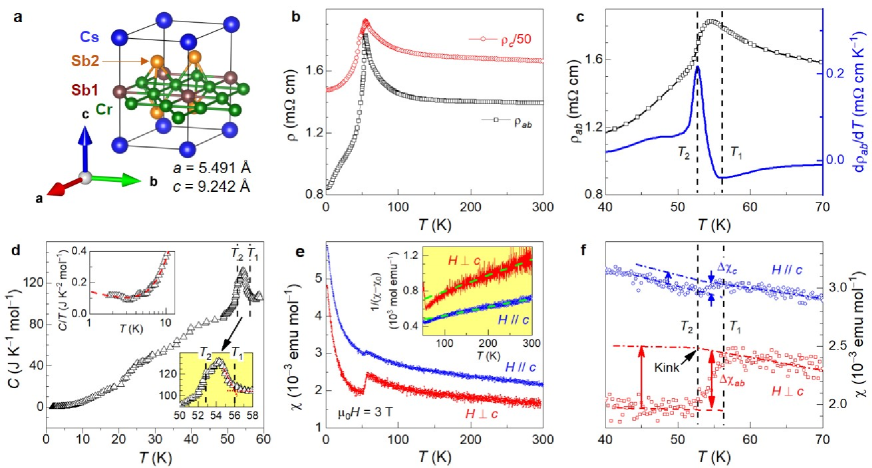
- 전기 저항도, 잠열, 자화율 및 자화율 전도도 측정을 통해 전자적 및 자성 전이를 탐색하였다.
- 고압 저항도 및 자화율 측정을 통해 시스템을 양자 임계점으로 조정하고 초전도 전이를 탐지하였다.
- 전자 구조 분석 및 코어레이트 격자에서 평탄한 밴드에의 근접성을 확인하기 위해 밀도함수이론(DFT) 계산을 시행하였다.
- T₁ ≈ 54 K 및 T₂ ≈ 52 K에서의 저항도 및 잠열 이질성 분석을 통해 스트립형 4a₀ 구조 조절에 기인한 연속적인 상전이가 확인되었으며, 이는 전하 밀도파동(CDW)과 반자성 스핀 밀도파동(SDW) 주기의 공존을 시사한다.
- 역자화율의 쿠리-웨이스 피팅을 통해 국소 자화모멘트와 반자성 스핀 상관관계의 존재를 확인하였다.
실험 결과
연구 질문
- RQ1강한 전자 상호작용과 경쟁하는 밀도파동 주기를 갖는 코어레이트 격자 물질에서 비보편 초전도성이 발생할 수 있는가?
- RQ2CsCr₃Sb₅에서 초전도성을 매개하는 전자 상호작용과 양자 임계성의 역할은 무엇인가?
- RQ3압력에 의해 유도된 상전이가 밀도파동 주기를 어떻게 억제하고 초전도성을 안정화하는가?
- RQ4CsCr₃Sb₅의 전자 구조는 무엇이며, 평탄한 밴드와 상관관계가 있는 양자상의 발생과 어떻게 관련되는가?
주요 결과
- CsCr₃Sb₅는 헥사고날 P6/mmm 구조를 가지며 크로뮴 원자가 코어레이트 격자를 형성하고, 강한 전자 상호작용과 난류 자성을 나타낸다.
- 약 54 K 및 약 52.7 K에서의 연속적인 상전이는 스트립형 4a₀ 구조 조절에 기인하며, 전하 밀도파동(CDW)과 반자성 스핀 밀도파동(SDW) 주기의 공존을 나타낸다.
- 고압 조건(4–8 GPa)에서 밀도파동 주기는 억제되고, 최대 전이 온도 Tc가 6.4 K인 초전도성이 나타난다.
- 압력 ≈ 4 GPa에서 양자 임계점이 확인되었으며, 이는 비페르미 액체 거동의 발생을 암시하며, 양자 상전이에의 근접성을 시사한다.
- 전자 구조 계산 결과, 전자 농도가 코어레이트 격자의 반바닥 특이점에 근접해 있음을 확인하였으며, 이는 평탄한 밴드와 증폭된 상관관계를 일으킨다.
- 상한 임계자장 Hc2,max는 온도가 0 K일 때 14.34 T에 도달하며, 이는 파울리 한계를 크게 초월하여 초전도 상태에서 스핀-삼중 상태 또는 강한 스핀-오비탈 결합이 존재할 가능성을 시사한다.
더 나은 연구,지금 바로 시작하세요
논문 읽기부터 검토까지, 연구 시간을 획기적으로 줄여보세요.
카드 등록 없음 · 무료 플랜 제공
이 리뷰는 AI가 만들고, 인간 에디터가 검토했습니다.