
[논문 리뷰] Survey of Gravitationally lensed Objects in HSC Imaging (SuGOHI) $-$ X. Strong Lens Finding in The HSC-SSP using Convolutional Neural Networks
이 연구는 하이퍼 수프림-Cam 수보 전략 프로그램(HSC-SSP) 설문을 대상으로 복소 신경망(CNN)을 적용하여 다중 대역 이미징에서 강한 중력 렌즈를 탐지한다. 모델은 235만 개의 은하에서 43개의 확실한 렌즈 시스템과 269개의 가능성이 있는 렌즈 시스템을 식별하였으며, 이 중 97개는 새로운 발견으로, 렌즈 탐지 효율을 크게 향상시키고 향후 우주론적 모델링을 위한 분광학적 후속 관측을 가능하게 한다.
We apply a novel model based on convolutional neural networks (CNNs) to identify gravitationally-lensed galaxies in multi-band imaging of the Hyper Suprime Cam Subaru Strategic Program (HSC-SSP) Survey. The trained model is applied to a parent sample of 2 350 061 galaxies selected from the $\sim$ 800 deg$^2$ Wide area of the HSC-SSP Public Data Release 2. The galaxies in HSC Wide are selected based on stringent pre-selection criteria, such as multiband magnitudes, stellar mass, star formation rate, extendedness limit, photometric redshift range, etc. Initially, the CNNs provide a total of 20 241 cutouts with a score greater than 0.9, but this number is subsequently reduced to 1 522 cutouts by removing definite non-lenses for further inspection by human eyes. We discover 43 definite and 269 probable lenses, of which 97 are completely new. In addition, out of 880 potential lenses, we recovered 289 known systems in the literature. We identify 143 candidates from the known systems that had higher confidence in previous searches. Our model can also recover 285 candidate galaxy-scale lenses from the Survey of Gravitationally lensed Objects in HSC Imaging (SuGOHI), where a single foreground galaxy acts as the deflector. Even though group-scale and cluster-scale lens systems were not included in the training, a sample of 32 SuGOHI-c (i.e., group/cluster-scale systems) lens candidates was retrieved. Our discoveries will be useful for ongoing and planned spectroscopic surveys, such as the Subaru Prime Focus Spectrograph project, to measure lens and source redshifts in order to enable detailed lens modelling.
연구 동기 및 목표
- 광역 영역의 옵티컬 이미징에서 강한 중력 렌즈를 자동 탐지하기 위한 딥러닝 모델을 개발하고 적용하는 것.
- 더 높은 정확도와 확장성 확보를 위해 복소 신경망(CNN)을 활용하여 전통적인 렌즈 탐지 방법을 향상시키는 것.
- 특히 은하 규모 렌즈를 포함하여 HSC-SSP 설문에서 새로운 렌즈 시스템을 식별하고, 기존에 알려진 시스템을 더 높은 신뢰도로 복원하는 것.
- 프라임 포커스 스펙트로그래프와 같은 프로젝트에서 사용할 수 있도록, 고우선도 렌즈 후보 목록을 정제하여 향후 분광학적 후속 관측을 가능하게 하는 것.
- 훈련 데이터에 포함되지 않은 군집 및 은하단 규모 렌즈를 탐지할 수 있는지 평가하여 모델의 일반화 능력을 검증하는 것.
제안 방법
- HSC-SSP 설문의 렌즈화 및 비렌즈화 은하 컷아웃을 포함한 정제된 데이터셋을 기반으로 맞춤형 복소 신경망(CNN)을 훈련한다.
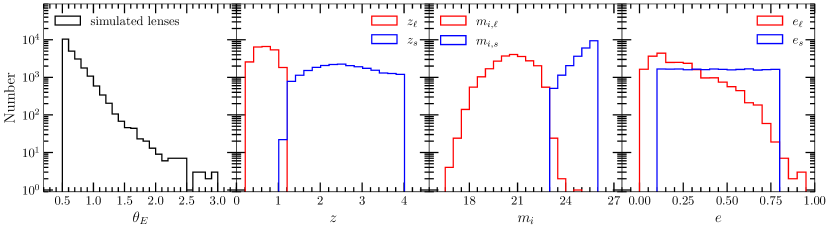
- 광도, 항성 질량, 성간별 형성률, 확장성, 광학적 적색편이를 기반으로 사전 선별된 2,350,061개의 은하에 대해 다중 대역 이미징 컷아웃(g, r, i, z, y)을 처리한다.
- CNN 신뢰도 점수 >0.9인 컷아웃을 선별하여 분석 대상으로 선정하며, 명백한 비렌즈를 제거함으로써 초기 풀에서 20,241개에서 1,522개의 후보로 감소시킨다.
- 인간 전문가가 남은 후보들을 시각적 검토하여 렌즈 형태에 따라 A(확실함), B(가능성 있음), C(가능성 있음)로 평가한다.
- 모델의 예측 결과를 기존 렌즈 목록과 비교하여 중복 항목을 식별하고, 이전에 평가된 시스템을 재분류한다.
- 모델의 성능을 평가하기 위해 알려진 시스템을 대상으로 테스트를 수행하며, 이는 SuGOHI 설문의 285개 은하 규모 렌즈와 문헌에서 기록된 289개의 알려진 시스템을 포함한다.
실험 결과
연구 질문
- RQ1CNN 기반 딥러닝 모델이 HSC-SSP와 같은 대규모 다중 대역 옵티컬 설문에서 강한 중력 렌즈를 효과적으로 탐지할 수 있는가?
- RQ2CNN 기반 접근 방식이 이전의 자동화된 방법 및 인간 검토 방법에 비해 발견률과 신뢰도 측면에서 어떻게 비교되는가?
- RQ3은하 규모 렌즈로 훈련된 모델이 군집 및 은하단 규모 렌즈 시스템을 탐지하는 데 얼마나 잘 일반화되는가?
- RQ4신규 렌즈 후보 중 진정으로 새로운 경우는 어느 정도이며, 이전에 잘못 분류되거나 간과된 경우는 얼마나 되는가?
- RQ5이전 검색보다 더 높은 신뢰도로 알려진 렌즈 시스템을 복원할 수 있는가?
주요 결과
- CNN은 신뢰도 점수 >0.9인 20,241개의 컷아웃을 식별하였으며, 명백한 비렌즈를 제거한 후 시각적 검토를 통해 1,522개의 후보로 감소되었다.
- 최종 샘플에는 43개의 확실한(등급 A) 및 269개의 가능성이 있는(등급 B) 강한 렌즈 후보가 포함되어 있으며, 이 중 97개는 완전히 새로운 발견이다.
- 880개의 등급 C 후보 중 143개는 이전 문헌에서 A 또는 B로 평가된 바가 있었으며, 이는 탐지 정확도 향상의 증거로 볼 수 있다.
- 모델은 SuGOHI 설문의 285개 알려진 은하 규모 렌즈 후보를 성공적으로 복원하여 강력한 일반화 능력을 입증하였다.
- 훈련 데이터에 군집 및 은하단 규모 렌즈가 포함되지 않았음에도 불구하고, 모델은 SuGOHI-c 샘플에서 32개의 후보를 회수하여 잠재적 일반화 능력을 보여주었다.
- 후보 렌즈 은하의 광학적 적색편이는 0.2에서 1.2 사이로, 향후 분광학적 관측 및 렌즈 모델링에 적합함을 뒷받침한다.
더 나은 연구,지금 바로 시작하세요
논문 읽기부터 검토까지, 연구 시간을 획기적으로 줄여보세요.
카드 등록 없음 · 무료 플랜 제공
이 리뷰는 AI가 만들고, 인간 에디터가 검토했습니다.