
[논문 리뷰] Symfind: Addressing the Fragility of Subhalo Finders and Revealing the Durability of Subhalos
Symfind는 입자 추적 기반의 새로운 서할로 찾기 방법으로, 유도입 시점부터 추적함으로써 천체역학 시뮬레이션에서 서할로의 탐지를 크게 향상시킨다. 이는 Rockstar보다 수십 배에서 수백 배 낮은 질량의 서할로를 복원할 수 있게 하며, 서할로가 이전에 예상한 것보다 훨씬 오래 지속된다는 사실을 드러낸다. 이로 인해 '고립 서할로' 모델링에 대한 의존도가 감소하고, 질량 손실은 $n_{\text{peak}} \gtrsim 4\times10^3$에서, $v_{\text{max}}$는 $n_{\text{peak}} \gtrsim 3\times10^4$에서 정확하게 해석 가능하다.
A major question in $Λ$CDM is what this theory actually predicts for the properties of subhalo populations. Subhalos are difficult to simulate and to find within simulations, and this propagates into uncertainty in theoretical predictions for satellite galaxies. We present Symfind, a new particle-tracking-based subhalo finder, and demonstrate that it can track subhalos to orders-of-magnitude lower masses than commonly used halo-finding tools, with a focus on Rockstar and consistent-trees. These longer survival mean that at a fixed peak subhalo mass, we find $\approx 15\%{-}40\%$ more subhalos within the virial radius, $R_ extrm{vir}$, and $\approx 35\%-120\%$ more subhalos within $R_ extrm{vir}/4$ in the Symphony dark-matter-only simulation suite. More subhalos are found as resolution is increased. We perform extensive numerical testing. In agreement with idealized simulations, we show that the $v_{ m max}$ of subhalos is only resolved at high resolutions ($n_ extrm{peak}\gtrsim3 imes 10^4$), but that mass loss itself can be resolved at much more modest particle counts ($n_ extrm{peak}\gtrsim4 imes 10^3$). We show that Rockstar converges to false solutions for the mass function, radial distribution, and disruption masses of subhalos. We argue that our new method can trace resolved subhalos until the point of typical galaxy disruption without invoking ``orphan'' modeling. We outline a concrete set of steps for determining whether other subhalo finders meet the same criteria. We publicly release Symfind catalogs and particle data for the Symphony simulation suite at \url{http://web.stanford.edu/group/gfc/symphony}.
연구 동기 및 목표
- 기존의 서할로 찾기 방법인 Rockstar와 같이 낮은 질량에서 수렴하지 못하는 문제를 해결하기 위해.
- 입자 유입 시점부터 파괴 시점까지 추적함으로써 $\Lambda$CDM에서 서할로의 진정된 내구성을 정량화하기 위해.
- 정확한 서할로 질량 및 속도 함수 측정을 위해 필요한 최소 해상도를 규명하기 위해.
- 수렴성과 물리적 일관성 기반으로 다른 서할로 찾기 방법을 평가할 수 있는 강력하고 검증 가능한 프레임워크를 제공하기 위해.
제안 방법
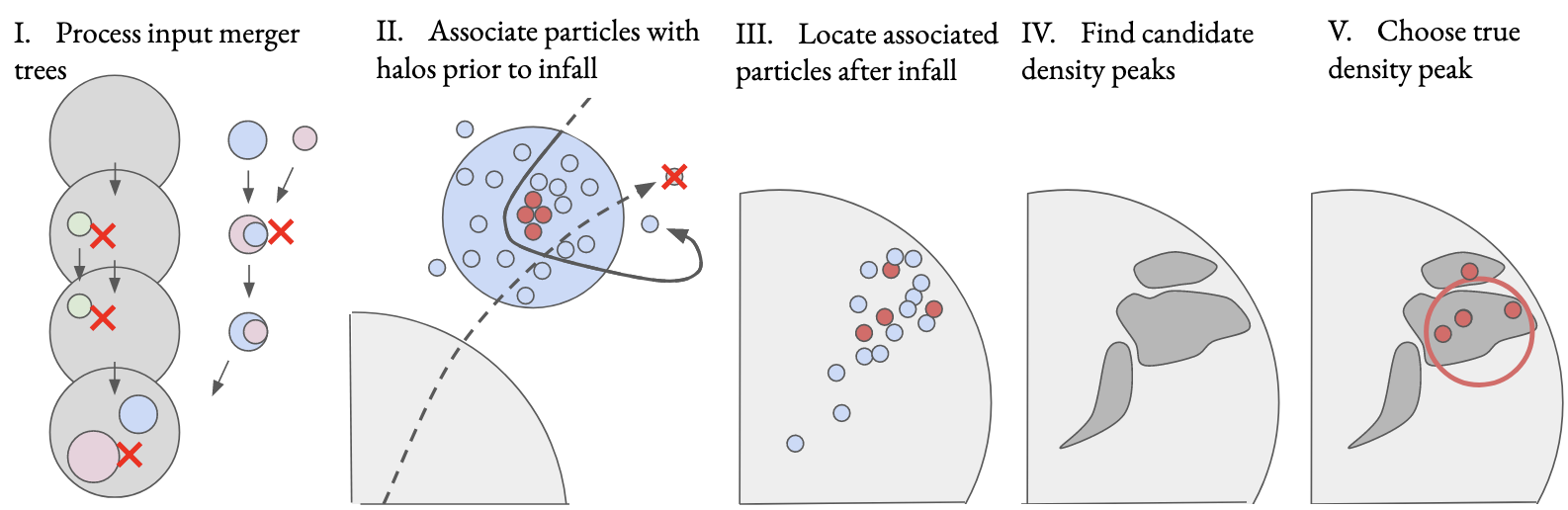
- Symfind는 서할로의 입자를 유도입 시점부터 주할로에 통합되는 동안 추적하여, tidal stripping 동안에도 그 정체성을 유지한다.
- 유도입 시점의 가장 유도된 입자들을 기반으로 Subfind 알고리즘을 사용해 서할로 식별을 시작한다.
- 시간에 따라 서할로 성질(질량, $v_{\text{max}}$, $m_{\text{peak}}$)을 평가하여 생존 및 파괴 여부를 분석한다.
- 다양한 해상도 수준에서 광범위한 수치 수렴 테스트를 수행하여 물리적 관측량의 해상도 한계를 규명한다.
- Symfind 결과를 Rockstar 및 consistent-trees와 직접 비교하여 기존 도구에서 발생하는 가짜 수렴 현상을 드러낸다.
- 스택된 질량 손실 곡선에서 생존자 편향을 방지하기 위한 통계적 보정을 도입하여 정확한 질량 변화 추적을 보장한다.
실험 결과
연구 질문
- RQ1표준 서할로 찾기 방법인 Rockstar가 해상도가 증가함에 따라 수렴하지 못하는 정도는 어느 정도이며, 이로 인해 잘못된 서할로 집단이 생성되는가?
- RQ2서할로 질량 손실과 $v_{\text{max}}$ 진화를 신뢰성 있게 해석하기 위해 필요한 최소 입자 수($n_{\text{peak}}$)는 얼마인가?
- RQ3$\Lambda$CDM 시뮬레이션에서 서할로는 얼마나 오래 지속되며, '고립 서할로'를 도입하지 않고도 은하 파괴 시점까지 추적할 수 있는가?
- RQ4스택된 질량 손실 곡선에서 생존자 편향이 얼마나 심각한가, 그리고 이를 어떻게 보정할 수 있는가?
- RQ5입자 추적 기반 방법인 Symfind가 낮은 질량 서할로 복원에서 기존의 위상공간 기반 찾기 방법보다 뛰어난 성능을 보일 수 있는가?
주요 결과
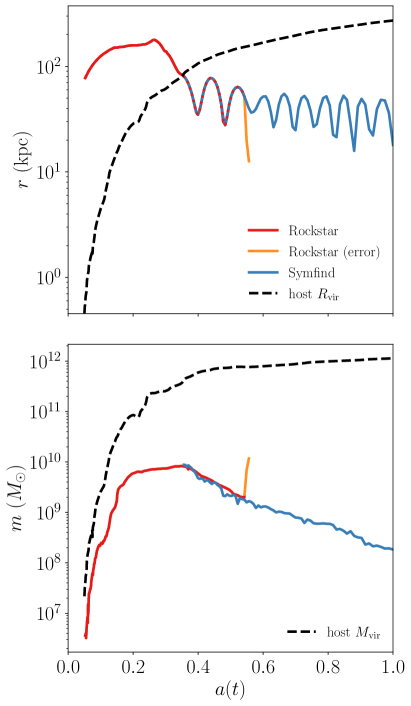
- 고정된 $m_{\text{peak}}$에서 Symfind는 $R_{\text{vir}}$ 내부에서 Rockstar보다 15%에서 40% 더 많은 서할로를 복원하고, $R_{\text{vir}}/4$ 내부에선 35%에서 120% 더 많은 서할로를 확보한다.
- 서할로 질량 손실은 $n_{\text{peak}} \gtrsim 4\times10^3$에서 해석 가능하며, $v_{\text{max}}$는 $n_{\text{peak}} \gtrsim 3\times10^4$에서 정확하게 해석 가능하다.
- Rockstar는 해상도가 증가함에 따라 잘못된 수렴을 보이며, 신뢰할 수 없는 질량 함수와 반경 분포를 생성한다.
- 생존자 편향은 스택된 질량 손실 곡선을 심각하게 왜곡하지만, Symfind의 통계적 보정은 이 편향을 제거한다.
- Symfind로 추적된 서할로는 충분히 오래 지속되어 $n_{\text{peak}} > 4\times10^3$에서는 '고립 서할로' 모델링이 불필요하다.
- 이 방법은 해상도가 충분할 경우 이상화된 시뮬레이션에서 $v_{\text{max}}$ 진화를 깊은 질량 손실 영역에서 정확히 예측할 수 있음을 확인한다.
더 나은 연구,지금 바로 시작하세요
논문 읽기부터 검토까지, 연구 시간을 획기적으로 줄여보세요.
카드 등록 없음 · 무료 플랜 제공
이 리뷰는 AI가 만들고, 인간 에디터가 검토했습니다.