
[논문 리뷰] Systematic Meets Unintended: Prior Knowledge Adaptive 5G Vulnerability Detection via Multi-Fuzzing
이 논문은 LAL, SyAL, SoAL 전략을 포함한 디지털 트윈 기반의 사전 지식 적응 퍼징 프레임워크를 제안하여 5G 취약점 및 의도치 않은 emergent behavior를 탐지하고 srsRAN에서 129개의 취약점을 발견하고 회상(recall)을 개선했다.
The virtualization and softwarization of 5G and NextG are critical enablers of the shift to flexibility, but they also present a potential attack surface for threats. However, current security research in communication systems focuses on specific aspects of security challenges and lacks a holistic perspective. To address this challenge, a novel systematic fuzzing approach is proposed to reveal, detect, and predict vulnerabilities with and without prior knowledge assumptions from attackers. It also serves as a digital twin platform for system testing and defense simulation pipeline. Three fuzzing strategies are proposed: Listen-and-Learn (LAL), Synchronize-and-Learn (SyAL), and Source-and-Learn (SoAL). The LAL strategy is a black-box fuzzing strategy used to discover vulnerabilities without prior protocol knowledge, while the SyAL strategy, also a black-box fuzzing method, targets vulnerabilities more accurately with attacker-accessible user information and a novel probability-based fuzzing approach. The white-box fuzzing strategy, SoAL, is then employed to identify and explain vulnerabilities through fuzzing of significant bits. Using the srsRAN 5G platform, the LAL strategy identifies 129 RRC connection vulnerabilities with an average detection duration of 0.072s. Leveraging the probability-based fuzzing algorithm, the SyAL strategy outperforms existing models in precision and recall, using significantly fewer fuzzing cases. SoAL detects three man-in-the-middle vulnerabilities stemming from 5G protocol vulnerabilities. The proposed solution is scalable to other open-source and commercial 5G platforms and protocols beyond RRC. Extensive experimental results demonstrate that the proposed solution is an effective and efficient approach to validate 5G security; meanwhile, it serves as real-time vulnerability detection and proactive defense.
연구 동기 및 목표
- 복잡하고 프로그래밍 가능한 스택 속에서 5G/NextG의 포괄적 보안 테스트를 촉진한다.
- 프로토콜 전반에 걸친 체계적이고 적응적인 퍼징을 가능케 하는 디지털 트윈 플랫폼을 개발한다.
- 세 가지 퍼징 전략(Listen-and-Learn, Synchronize-and-Learn, Source-and-Learn)을 다양한 지식 가정과 함께 제안한다.
- 취약점 탐지 효율성을 정량화하고 실시간 탐지 및 방어 가능성을 입증한다.
제안 방법
- 상호 운용성을 위한 MITM 릴레이, srsRAN, Open5GS, ZMQ를 연결하는 디지털 트윈 기반 취약점 테스트 플랫폼을 도입한다.
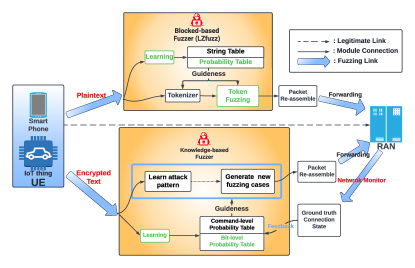
- LAL(블랙박스), SyAL(확률 기반 퍼징이 적용된 그레이박스), SoAL(화이트박스 비트 레벨 퍼징) 등 세 가지 퍼징 전략을 정의한다.
- 선형적 증가에서 로그 증가로 필요한 퍼징 케이스 수를 줄이는 확률 기반 퍼징 방식을 구현한다.
- 상태-거래 그래프와 LSTM 기반 예측을 사용하여 명령 수준 및 비트 수준의 퍼징 상태를 기록하고 분석한다.
- srsRAN에서 RRC 프로토콜 퍼징을 시연하여 129개의 발견된 취약점과 평균 탐지 시간 0.072s를 달성한다.
- 다른 5G/Open-RAN 플랫폼 및 프로토콜로 확장 가능한 디지털 트윈 프레임워크를 제공한다.
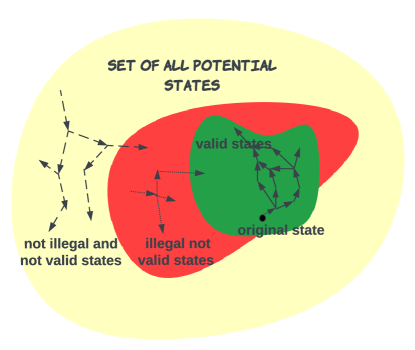
실험 결과
연구 질문
- RQ1사전 지식이 5G 취약점 탐지를 위한 퍼징 효과에 어떤 영향을 미칠 수 있는가?
- RQ2디지털 트윈 기반 다중 퍼징 프레임워크가 5G 프로토콜 전반의 취약점과 의도치 않은 emergent behavior를 모두 탐지할 수 있는가?
- RQ3확률 기반 퍼징 방식이 필요한 퍼징 케이스 수를 줄이는 효율성 이득은 무엇인가?
- RQ4LAL, SyAL, SoAL의 RRC 취약점 및 MITM 위협 식별 및 예측 효과는 어느 정도인가?
주요 결과
- LAL 프레임워크를 사용하여 RRC 프로토콜에서 129개의 취약점을 식별했다.
- 확률 기반 퍼징을 이용한 SyAL은 훨씬 적은 퍼징 케이스로 더 높은 정밀도와 재현율을 달성한다.
- SoAL은 5G 프로토콜의 약점에서 기인한 세 가지 중간자 공격 취약점을 탐지한다.
- LAL은 프로토콜에 의존하지 않고 작동하며 새로운 5G 스택과 프로토콜에 적응할 수 있다.
- 상태-거래 분석과 LSTM 예측기가 향상된 취약점 예측과 조기 경고를 제공한다.
더 나은 연구,지금 바로 시작하세요
연구 설계부터 논문 작성까지, 연구 시간을 획기적으로 줄여보세요.
카드 등록 없음 · 무료 플랜 제공
이 리뷰는 AI가 만들고, 인간 에디터가 검토했습니다.