
[논문 리뷰] Testing symmetry on quantum computers
이 논문은 양자 컴퓨터를 사용하여 양자 상태와 양자 채널의 대칭성을 테스트하기 위한 양자 알고리즘을 제안하며, 이러한 알고리즘의 수용 확률이 최대 대칭 허명도와 일치함을 보여, 이러한 측정치에 운영적 의미를 부여한다. 이 접근법은 변이 양자 회로를 사용하여 양자 증인을 대체함으로써, 노이즈가 없는 및 노이즈가 있는 시뮬레이터에서 뛰어난 성능을 보이며, 얽힘, 분리 가능성, 비대칭성의 자원 이론 등에 적용된다.
Symmetry is a unifying concept in physics. In quantum information and beyond, it is known that quantum states possessing symmetry are not useful for certain information-processing tasks. For example, states that commute with a Hamiltonian realizing a time evolution are not useful for timekeeping during that evolution, and bipartite states that are highly extendible are not strongly entangled and thus not useful for basic tasks like teleportation. Motivated by this perspective, this paper details several quantum algorithms that test the symmetry of quantum states and channels. For the case of testing Bose symmetry of a state, we show that there is a simple and efficient quantum algorithm, while the tests for other kinds of symmetry rely on the aid of a quantum prover. We prove that the acceptance probability of each algorithm is equal to the maximum symmetric fidelity of the state being tested, thus giving a firm operational meaning to these latter resource quantifiers. Special cases of the algorithms test for incoherence or separability of quantum states. We evaluate the performance of these algorithms on choice examples by using the variational approach to quantum algorithms, replacing the quantum prover with a parameterized circuit. We demonstrate this approach for numerous examples using the IBM quantum noiseless and noisy simulators, and we observe that the algorithms perform well in the noiseless case and exhibit noise resilience in the noisy case. We also show that the maximum symmetric fidelities can be calculated by semi-definite programs, which is useful for benchmarking the performance of these algorithms for sufficiently small examples. Finally, we establish various generalizations of the resource theory of asymmetry, with the upshot being that the acceptance probabilities of the algorithms are resource monotones and thus well motivated from the resource-theoretic perspective.
연구 동기 및 목표
- 양자 상태와 양자 채널의 대칭성을 테스트하는 양자 알고리즘을 개발하여, 대칭 허명도 측정치에 운영적 의미를 제공한다.
- 이전 연구를 넘어서 비대칭성의 자원 이론을 일반화하여 보세 대칭성과 확장 가능성까지 포함한다.
- 근접한 양자 장치에서 실용적으로 대칭성을 테스트할 수 있도록 변이 양자 알고리즘을 활용한다.
- 소규모 예제를 위한 준선형계획법(SDP)을 사용하여 성능을 벤치마킹한다.
- 프레임워크를 양자 채널로 확장하여 공변성 대칭성과 신호 전파 금지 조건을 포함한다.
제안 방법
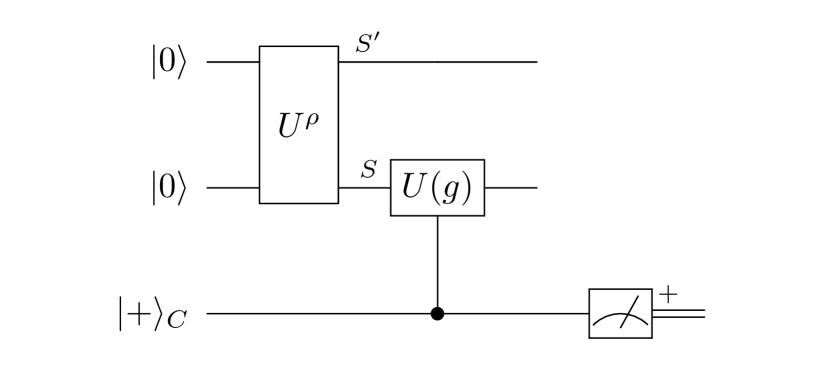
- 양자 회로를 사용하여 $G$-보세 대칭성, $G$-대칭성 및 그 확장성 형태를 테스트하는 양자 알고리즘을 제안한다.
- 상호작용 증명 프레임워크에서 양자 증인을 사용한 후, 근접한 장치를 위한 파arameterized 변이 회로로 대체한다.
- 유니터리 표현과 대칭 투영을 통해 수용 확률이 최대 대칭 허명도와 동일함을 증명한다.
- 벤치마킹을 위해 준선형계획법(SDP)을 사용하여 소규모 예제의 최대 대칭 허명도를 계산한다.
- 변이 접근법을 사용하여 이원 및 다중 양자 상태의 $k$-확장 가능성과 $k$-보세 확장 가능성을 테스트한다.
- 비대칭성의 자원 이론을 일반화하며, 수용 확률이 자원 단조성임을 증명한다.
실험 결과
연구 질문
- RQ1양자 상태와 양자 채널의 대칭성을 운영적 의미를 지닌 양자 테스트로 설계할 수 있는가?
- RQ2최대 대칭 허명도는 양자 테스트의 수용 확률과 어떻게 연결될 수 있는가?
- RQ3변이 양자 회로는 근접한 양자 하드웨어에서 대칭성 테스트의 양자 증인을 효과적으로 대체할 수 있는가?
- RQ4이 알고리즘은 노이즈가 있는 및 없는 양자 시뮬레이터에서 어떤 성능을 보이는가?
- RQ5제안된 대칭 개념은 분리 가능성, 확장 불가능성, 프레임리스성과 같은 기존 개념을 어떻게 일반화하는가?
주요 결과
- 각 대칭성 테스트 알고리즘의 수용 확률은 입력 상태의 최대 대칭 허명도와 동일하며, 이는 자원 측정치에 운영적 의미를 제공한다.
- 알고리즘은 노이즈가 없는 시뮬레이션에서 잘 작동하며, 노이즈가 있는 시뮬레이터에서도 노이즈에 강건함을 보여, 실용적 타당성을 입증한다.
- 준선형계획법(SDP)을 사용하면 소규모 예제의 최대 대칭 허명도를 정확히 계산할 수 있어, 양자 알고리즘의 벤치마킹이 가능하다.
- 변이 접근법은 양자 증인을 성공적으로 대체하여 현재의 양자 하드웨어에서 대칭 허명도를 추정할 수 있게 한다.
- 프레임워크는 비대칭성의 자원 이론을 일반화하며, 수용 확률이 자원 단조성임을 증명함으로써, 이들이 측정치로 사용되는 것이 타당함을 입증한다.
- 이 접근법은 양자 채널로도 확장되며, 공변성 대칭성과 채널의 $G$-대칭 확장 가능성을 테스트하기 위한 알고리즘을 제안한다.
더 나은 연구,지금 바로 시작하세요
논문 읽기부터 검토까지, 연구 시간을 획기적으로 줄여보세요.
카드 등록 없음 · 무료 플랜 제공
이 리뷰는 AI가 만들고, 인간 에디터가 검토했습니다.