
[논문 리뷰] The Effect of Thermal Torques on AGN Disc Migration Traps and Gravitational Wave Populations
이 논문은 AGN 원반에서의 열 토크가 항성 질량 블랙홀의 이주 트랩을 만들어 이주를 바꾸고, EMRI 공급 및 LVK GW 인구를 변화시킬 수 있는지 분석한다.
Accretion discs in active galactic nuclei (AGN) foster black hole (BH) formation, growth, and mergers. Stellar mass BHs migrate inwards under the influence of hydrodynamical torques unless they encounter a region where the torque flips sign. At these migration traps, BHs accumulate and merge via dynamical or gas-assisted interactions, producing high-frequency LIGO/Virgo/KAGRA (LVK) gravitational wave (GW) sources and potentially cutting off the supply of extreme mass ratio inspirals that would otherwise make low-frequency, {\it LISA}-band GWs. In this paper, we study the interplay between different types of migration torques, focusing especially on the ``thermal torques'' generated by the thermal response of the AGN to embedded stellar-mass BHs that accrete through their own mini-discs.In contrast to previous work, we find that Type I torques cannot produce migration traps on their own, but thermal torques often do, particularly in low-mass AGN. The migration traps produced by thermal torques exist at much larger radii ($\sim 10^{3-5}$ gravitational radii) than do previously identified Type I traps, carrying implications for GW populations at multiple frequencies. Finally, we identify a bifurcation of AGN discs into two regimes: migration traps exist below a critical AGN luminosity, and do not at higher luminosities. This critical luminosity is fit as $\log_{10} L_{ m AGN}^c = 45 - 0.32 \log_{10}{(α/0.01)}$ where $α$ is the AGN alpha viscosity parameter, a range compatible with recent claims that LVK GWs are not preferentially associated with high-luminosity AGN.
연구 동기 및 목표
- AGN 원반에서의 열 토크가 블랙홀 이주에 미치는 영향 평가.
- 이주 트랩이 형성되거나 소멸하는 조건 결정.
- 이주 트랩이 중력 파동원 인구(LVK 및 EMRIs)에 어떤 영향을 주는지 파악.
- AGN 광도와 원반 매개변수(α, dot{m}, MBH 질량)에 따른 의존성 탐구.
제안 방법
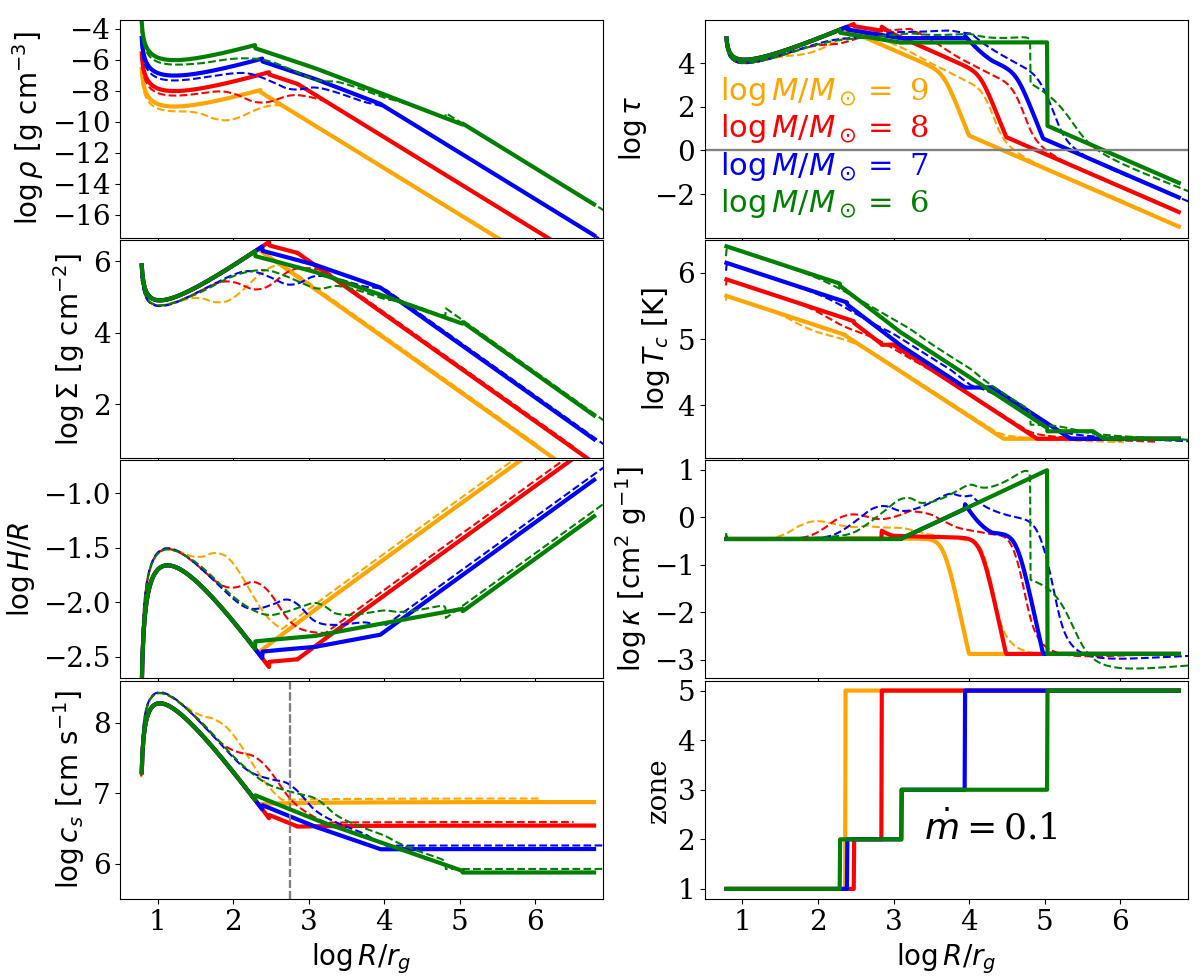
- 다중 구역과 불투명도 체계를 갖춘 Shakura–Sunyaev 스타일의 Analytic AGN 원반 모델을 구성합니다.
- 최근 보정(Paardekooper et al. 2010; Jime9nez & Masset 2017)을 사용하여 업데이트된 Type I 이주 토크를 도출하고 열 토크 기여와 비교합니다.
- Masset (2017)의 열 토크 형식을 포함하여 임계 광도 L_c 및 소용돌이 확산 스케일 lambda를 포함합니다.
- 원반 매개변수와 MBH 질 mass를 가로질러 Type I 및 열 토크를 합산하여 순 토크를 계산합니다.
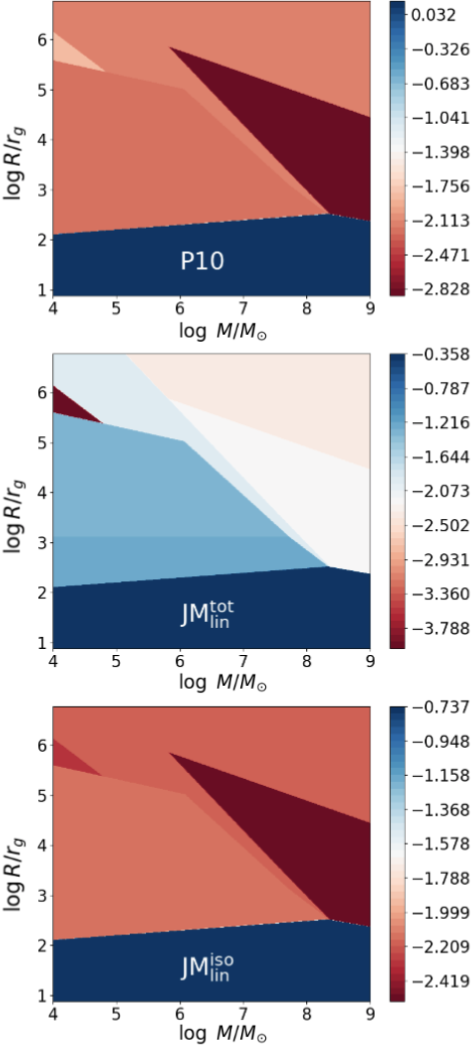
- 총 토크가 부호를 바꾸는 영역을 식별하여 이주 트랩과 반트랩을 위치시킵니다.
- 트랩의 존재가 MBH 질량과 AGN 광도에 어떻게 의존하는지 분석하여 임계 광도 관계를 도출합니다.
실험 결과
연구 질문
- RQ1AGNs 원반에서 열 토크가 Type I 토크를 지배하는지, 어떤 조건에서 이주 트랩을 생성하는지?
- RQ2이주 트랩의 위치가 MBH 질량, 원반 점성도 α, 물질 공급률 dot{m}, AGN 광도에 따라 어떻게 달라지나?
- RQ3트랩이 존재하거나 사라지는 원반 체계에서 광도에 따른 분기점이 있는가?
- RQ4이주 트랩이 LVK BH 승박 및 LISA 대역의 EMRI 인구에 어떤 시사점을 가지는가?
주요 결과
- 열 토크가 일반적인 Type I 토크보다 자주 우세하며, 특히 저 질량의 AGN 원반에서 Type I 만으로는 불가능한 이주 트랩을 형성할 수 있다.
- 열 토크로 인한 이주 트랩은 고전적 Type I 트랩보다 더 큰 반지름(대략 10^3–10^5 은 중력 반지름)에서 발생한다.
- AGN 원반에는 분岐점이 존재한다: 임계 AGN 광도 이하에서 이주 트랩이 존재하고, 높은 광도에서 존재하지 않는다.
- 임계 광도는 대략 log10 L_AGN^c = 45 - 0.32 log10(alpha/0.01)로 스케일링된다.
- 낮은 MBH 질량 원반은 열 토크로 인한 외향 이주에 더 취약해 SMBH 쌍의 환경과 GW 원천 인구에 영향을 준다.
- 결과는 LVK GW 이벤트가 고광도 AGN과 선호적으로 관련되어 있지 않다는 주장과 일치한다.
더 나은 연구,지금 바로 시작하세요
논문 읽기부터 검토까지, 연구 시간을 획기적으로 줄여보세요.
카드 등록 없음 · 무료 플랜 제공
이 리뷰는 AI가 만들고, 인간 에디터가 검토했습니다.