
[논문 리뷰] The evolution of the galaxy UV luminosity function at redshifts z ~ 8-15 from deep JWST and ground-based near-infrared imaging
이 연구는 초기 JWST NIRCam 데이터와 COSMOS의 UltraVISTA 이미징을 COSMOS에서 결합하여 z ≃ 8에서 15까지 evolving galaxy UV luminosity function를 도출하고, z ≈ 10까지 이중 파워-법칙 LF를 발견하며 z ≈ 15까지 ρUV 및 ρSFR의 점진적 감소를 확인한다.
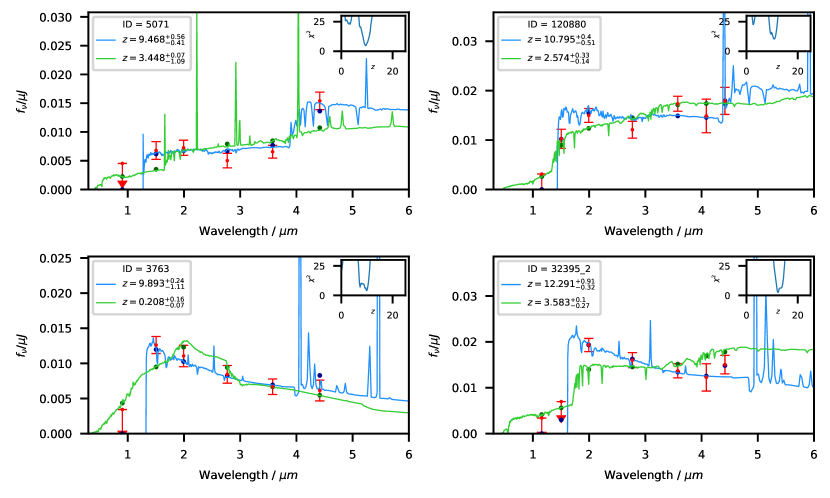
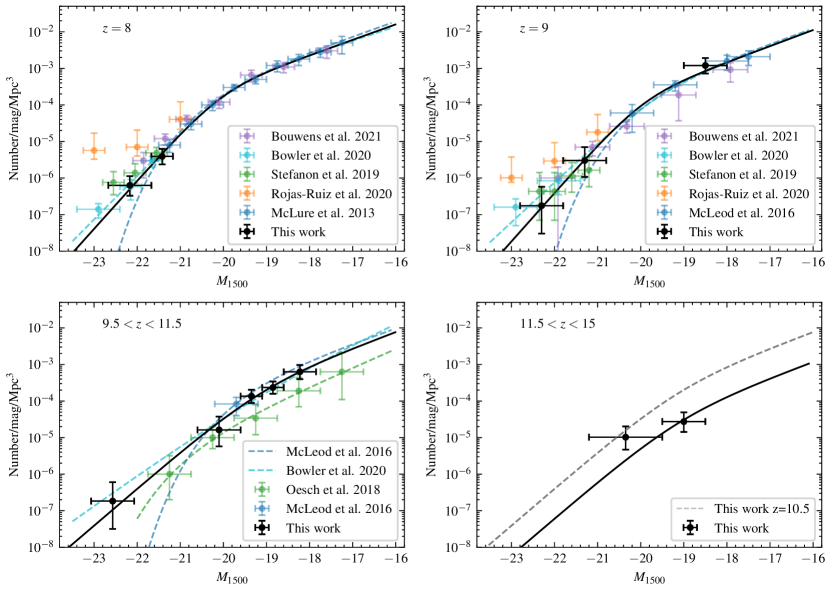
We reduce and analyse the available James Webb Space Telescope (JWST) ERO and ERS NIRCam imaging (SMACS0723, GLASS, CEERS) in combination with the latest deep ground-based near-infrared imaging in the COSMOS field (provided by UltraVISTA DR5) to produce a new measurement of the evolving galaxy UV luminosity function (LF) over the redshift range $z = 8 - 15$. This yields a new estimate of the evolution of UV luminosity density ($ρ_{ m UV}$), and hence cosmic star-formation rate density ($ρ_{ m SFR}$) out to within $< 300$\, Myr of the Big Bang. Our results confirm that the high-redshift LF is best described by a double power-law (rather than a Schechter) function up to $z\sim10$, and that the LF and the resulting derived $ρ_{ m UV}$ (and thus $ρ_{ m SFR}$), continues to decline gradually and steadily up to $z\sim15$ (as anticipated from previous studies which analysed the pre-existing data in a consistent manner to this study). We provide details of the 61 high-redshift galaxy candidates, 47 of which are new, that have enabled this new analysis. Our sample contains 6 galaxies at $z \ge 12$, one of which appears to set a new redshift record as an apparently robust galaxy candidate at $z \simeq 16.4$, the properties of which we therefore consider in detail. The advances presented here emphasize the importance of achieving high dynamic range in studies of early galaxy evolution, and re-affirm the enormous potential of forthcoming larger JWST programmes to transform our understanding of the young Universe.
연구 동기 및 목표
- z ≳ 8에서의 은하 UV 광도함수 진화를 새로운 JWST ERO/ERS NIRCam 데이터와 COSMOS/UltraVISTA DR5 이미징으로 동기화하고 정량화한다.
- 세 개의 JWST 필드와 COSMOS/UltraVISTA에 걸쳐 z > 7.5의 견고한 고적대 은하 샘플을 구성하고 LF 및 파생된 UV 광도와 스타-형성률 밀도를 측정한다.
- LF 형태(이중 파워-법칙 대 Schechter)와 z ≈ 15까지의 진화를 평가하고 z ≈ 16.4 개체의 가능한 고적대 은하를 포함한 후보를 식별한다.
- 멀티 밴드 광사진상(photometry), SED 적합, 필드 간 일관성을 활용하여 저-z 오염원을 최소화하고 고적대 선택의 다이내믹 레인지와 신뢰성을 평가한다.]
- method2:Combine JWST NIRCam imaging (SMACS0723, CEERS, GLASS) with COSMOS/UltraVISTA DR5 near-infrared data to build z > 7.5 galaxy samples.
- method3:Perform PSF homogenisation and local depth estimation to obtain consistent multi-band photometry.
- method4:Compute photometric redshifts with EAZY using Pegase templates, check against brown dwarf contaminants, and validate with LePhare and McLure et al. codes.
- method5:Select high-z candidates via dropout criteria tailored to each field and require robust high-z solutions with Δχ2 criteria.
- method6:Derive UV absolute magnitudes, correct for total flux, and compute the UV luminosity function across redshift bins from z = 8 to z ≈ 15.
제안 방법
- 맺다 JWST NIRCam 이미징 (SMACS0723, CEERS, GLASS)과 COSMOS/UltraVISTA DR5 근적외선 데이터를 결합해 z > 7.5 은하 샘플을 구축한다.
- PSF 균일화와 지역 깊이 추정으로 다밴드 광도를 일관되게 얻는다.
- Pegase 템플릿을 사용한 EAZY로 광도적 적합(redshift)을 계산하고 갈색 난쟁이 오염원을 확인하며 LePhare 및 McLure 등 코드를 사용해 검증한다.
- 필드별로 맞춤 dropout 기준을 통해 고-z 후보를 선택하고 Δχ2 기준으로 강건한 고-z 해를 요구한다.
- UV 절대광도를 도출하고 총 플럭스 보정한 뒤 z = 8에서 z ≈ 15까지의 적분에서 UV 광도함수를 계산한다.
실험 결과
연구 질문
- RQ1JWST 딥 필드를 COSMOS/UltraVISTA 데이터와 결합할 때 은하 UV 광도함수의 진화 형태는 z ≈ 8에서 15까지 어떻게 되는가?
- RQ2고-z UV LF가 z ≈ 10까지는 이중 파워-법칙 혹은 Schechter 함수로 더 잘 설명되는가, 그리고 이를 z ≈ 15로 갈수록 어떻게 진화하는가?
- RQ3z > 8에서의 UV 광도 밀도 및 우주적 별 형성률 밀도에 대한 시사점은 무엇이며 z ≈ 16까지의 가능한 밝은 엔드 은하 포함 여부는 어떤가?
주요 결과
- 고-z UV 광도함수는 z ≈ 10까지는 Schechter 함수보다는 이중 파워-법칙으로 가장 잘 설명된다.
- UV 광도밀도 ρUV와 암시된 우주적 스타-형성률 밀도 ρSFR은 z ≈ 15까지 점진적이고 지속적으로 감소한다.
- LF 분석을 가능하게 하는 61명의 고-z 은하 후보 샘플(새로 발견된 47명 포함)이며, z ≥ 12의 6개 은하 및 강건한 z ≈ 16.4 후보가 포함된다.
- 딥 필드를 JWST와 광대역 지상 이미징을 결합하는 고다이나믹 레인지의 가치를 보여주며 초기 은하 진화에 대한 시사점을 제공한다.
- 자세한 내용으로 COSMOS에서 45 arcmin^2의 JWST NIRCam 데이터와 COSMOS/UltraVISTA 이미지의 1.8 deg^2가 포함되며 z > 7.5 은하 16개가 COSMOS/UltraVISTA에 있다.
더 나은 연구,지금 바로 시작하세요
연구 설계부터 논문 작성까지, 연구 시간을 획기적으로 줄여보세요.
카드 등록 없음 · 무료 플랜 제공
이 리뷰는 AI가 만들고, 인간 에디터가 검토했습니다.