
[논문 리뷰] The field theoretical ABC of epidemic dynamics
이 논문은 시간 확장 불변성의 대칭성을 통해 순환 모델, 분할 SIR 유형 모델, 그리고 재규격화군(eRG) 접근법을 연결함으로써 전염병 역학을 기술하는 통합 장 이론적 프레임워크를 제안한다. 이 형식에서는 임계성, 시간 스케일 재조정에 대한 자가유사성, 다중파 동역학이 자연스럽게 유도됨을 보여주며, 실제 팬데믹인 코로나19와 같은 상황에 적용 가능한 강력하고 대칭적인 질병 전파 기술을 제공한다.
Infectious diseases are a threat for human health with tremendous impact on our society at large. The recent COVID-19 pandemic, caused by the SARS-CoV-2, is the latest example of a highly infectious disease ravaging the world, since late 2019. It is therefore imperative to develop efficient mathematical models, able to substantially curb the damages of a pandemic by unveiling disease spreading dynamics and symmetries. This will help inform (non)-pharmaceutical prevention strategies. For the reasons above we wrote this report that goes at the heart of mathematical modelling of infectious disease diffusion by simultaneously investigating the underlying microscopic dynamics in terms of percolation models, effective description via compartmental models and the employment of temporal symmetries naturally encoded in the mathematical language of critical phenomena. Our report reviews these approaches and determines their common denominators, relevant for theoretical epidemiology and its link to important concepts in theoretical physics. We show that the different frameworks exhibit common features such as criticality and self-similarity under time rescaling. These features are naturally encoded within the unifying field theoretical approach. The latter leads to an efficient description of the time evolution of the disease via a framework in which (near) time-dilation invariance is explicitly realised. As important test of the relevance of symmetries we show how to mathematically account for observed phenomena such as multi-wave dynamics. The models presented here are of immediate relevance for different realms of scientific enquiry from medical applications to the understanding of human behaviour. Our review offers novel perspectives on how to model, capture, organise and understand epidemiological data and disease dynamics for modelling real-world phenomena.
연구 동기 및 목표
- 전염병 전파의 상이한 수학적 모델—순환 모델, 분할(SIR) 모델, 재규격화군 접근법—을 동일한 장 이론적 프레임워크 아래 통합하기.
- 특히 임계점 근처에서 전염병 역학의 근본적인 대칭성을 이루는 시간 확장 불변성을 식별하고 활용하기.
- 이 대칭성이 다중파 팬데믹과 선형 성장 단계와 같은 관측된 현상을 설명하는 방식을 보여주기.
- 예측 가능하고 정책적으로 유의미한 통찰을 제공하는 물리학 기반의 체계적인 모델링 프레임워크를 제공하기.
- 이러한 모델의 적용 범위를 인간의 전염병을 넘어서 정보 확산과 네트워크 역학을 포함한 더 넓은 복잡계로 확장하기.
제안 방법
- 미세한 순환 과정에서의 전염병 전파 역학을 코딩하는 주행동역학을 수립한다.
- 계면적 평균과 평균장 근사를 통해 격자 순환 모델에서 효과적인 분할 모델(예: SIR)을 유도한다.
- SIR 모델을 시간 진동을 다스리는 베타-함수를 갖는 재규격화군(RG) 방정식의 집합으로 재해석한다.
- 고정점이 질병 없음 또는 만성 상태를 나타내는 전염병 재규격화군(eRG) 프레임워크를 도입하며, 이들 사이의 흐름이 전염병 진행을 묘사한다.
- 시간 스케일 재조정 대칭성을 사용하여 자가유사적 해와 임계 행동을 식별한다.
- eRG에 복소수 고정점과 비트리비얼한 흐름 궤적을 도입하여 다중파 동역학을 모델링한다.
실험 결과
연구 질문
- RQ1장 이론은 순환 모델과 분할 모델을 포함한 다양한 전염병 모델링 접근법을 어떻게 통합적인 기술로 제공할 수 있는가?
- RQ2시간 확장 불변성은 전염병 전파의 역학을 어떻게 조직화하는가? 임계 행동과 자가유사성에 어떻게 반영되는가?
- RQ3전염병 재규격화군(eRG) 프레임워크는 실제로 관측된 다중파 팬데믹 패턴(예: 코로나19 팬데믹에서의 것들)을 설명할 수 있는가?
- RQ4eRG 형식에서의 시간 스케일 재조정 대칭성과 고정점은 선형 성장이나 지속적인 전파와 같은 관측 가능한 역학적 특성과 어떻게 관련되는가?
- RQ5이 장 이론적 프레임워크는 비약리적 조치, 백신 접종, 병원체 진화를 모델링하기 위해 얼마나 일반화될 수 있는가?
주요 결과
- 장 이론적 접근는 시간 스케일 재조정에 대한 임계성과 자가유사성이 전염병 역학의 보편적 특성임을 드러내며, 이는 기초 대칭성에서 자연스럽게 유도된다.
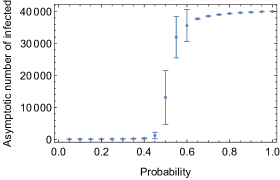
- SIR와 같은 분할 모델은 계면적 평균과 평균장 평균을 통해 미세한 순환 모델에서 도출될 수 있으며, 이는 미세 및 거시적 기술 간의 다리를 놓는다.
- SIR 모델이 잘 정의된 베타-함수를 갖는 재규격화군 방정식의 집합과 동치임을 보여주며, 이는 역학계 해석이 가능하게 한다.
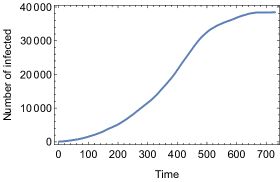
- eRG 프레임워크는 복소수 고정점과 비트리비얼한 흐름 궤적을 도입함으로써 다중파 동역학을 성공적으로 모델링하며, 관측된 팬데믹 파동과 일치한다.
- 선형 성장 단계에서 시간 스케일 재조정 불변성이 계측되며, 활성 감염자의 수가 약간의 변화를 보이며 체계가 거의 척도 불변성을 나타낸다.
- 이 프레임워크는 코로나19 팬데믹의 실제 데이터를 바탕으로 검증되었으며, 비약리적 조치와 이동 패턴은 eRG 접근법에서 시간에 따라 변하는 매개변수를 통해 효과적으로 모델링될 수 있음을 보여준다.
더 나은 연구,지금 바로 시작하세요
논문 읽기부터 검토까지, 연구 시간을 획기적으로 줄여보세요.
카드 등록 없음 · 무료 플랜 제공
이 리뷰는 AI가 만들고, 인간 에디터가 검토했습니다.