
[논문 리뷰] The Herschel Virgo Cluster Survey. XVII. SPIRE point-source catalogs and number counts
이 논문은 히어슈엘 바이로 클러스터 설문 조사에서 250, 350, 500 µm 파장에서 반복적 소스 추출 방법을 사용한 타임라인 기반 광도 측정 및 가우시안 소스 제거를 통해 세 개의 독립적인 SPIRE 점원소자료를 제시한다. 자료는 200 mJy 이하에서 수치 계수의 급격한 기울기 증가를 보이며, 어두운 밀리미터파 은하의 강한 진화를 시사하며, 이론적 모델은 빛나는 밀도에서 부족한 레일리-지운 SED 모델링으로 인해 관측치를 충족하지 못한다.
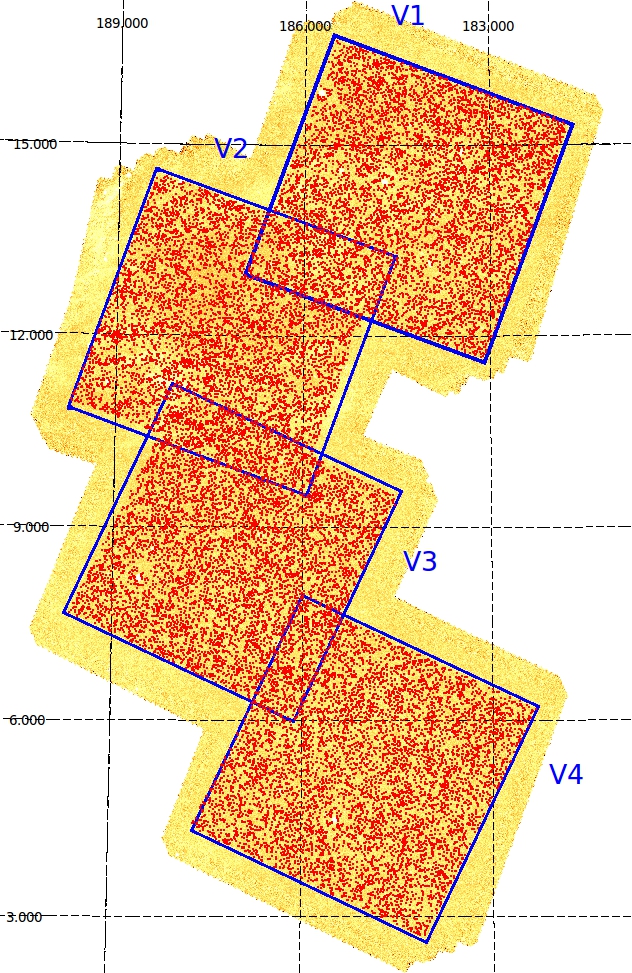
We present three independent catalogs of point-sources extracted from SPIRE images at 250, 350, and 500 micron as a part of the Herschel Virgo Cluster Survey (HeViCS). The source positions are determined by estimating the likelihood to be a real source for each peak on the maps and the flux densities are estimated using the sourceExtractorTimeline, a timeline-based point source fitter. Afterwards, each source is subtracted from the maps, removing a Gaussian function in every position with the full width half maximum equal to that estimated in sourceExtractorTimeline. This procedure improves the robustness of our algorithm in terms of source identification. The HeViCS catalogs contain about 52000, 42200, and 18700 sources selected at 250, 350, and 500 micron above 3sigma and are ~ 75%, 62%, and 50% complete at flux densities of 20 mJy at 250, 350, 500 micron, respectively. We then measured source number counts at 250, 350, and 500 micron and we also cross-correlated the catalogs with the Sloan Digital Sky Survey to investigate the redshift distribution of the nearby sources. From this cross-correlation, we select ~2000 sources with reliable fluxes and a high signal-to-noise ratio, finding an average redshift z~0.3+/-0.22. The number counts at 250, 350, and 500 micron show an increase in the slope below 200 mJy, indicating a strong evolution in number of density for galaxies at these fluxes. In general, models tend to overpredict the counts at brighter flux densities, underlying the importance of studying the Rayleigh-Jeans part of the spectral energy distribution to refine the theoretical recipes of the models. Our iterative method for source identification allowed the detection of a family of 500 micron sources that are not foreground objects belonging to Virgo and not found in other catalogs.
연구 동기 및 목표
- 히어슈엘 SPIRE 지도에서 바이로 클러스터 영역의 신뢰성 있고 완전하며 안정적인 점원소자료를 제작하기 위해.
- 밀리미터파 은하의 진화를 탐색하기 위해 250, 350, 500 µm에서 소스 수치 계수를 측정하기 위해.
- 인위적 소스 주입 및 순열 방법을 통해 자료의 신뢰성과 완전성을 평가하기 위해.
- SDSS와의 교차 식별을 통해 소스의 적색편이 분포를 결정하고, 저적색과 고적색 인구를 구분하기 위해.
- 반분석 모델의 성능을 관측된 수치 계수와 비교하여 SED 모델링의 불일치를 식별하기 위해.
제안 방법
- SourceExtractorSussextractor 작업을 사용한 반복적 피크 가능성 추정을 통한 소스 탐지.
- 타임라인 기반 점원소 피팅기인 sourceExtractorTimeline을 사용한 광도 측정. 이는 소스 프로파일을 가우시안 함수로 모델링한다.
- 검출된 소스 위치에서 가우시안 제거를 통해 소스 제거를 수행하여 혼잡도를 감소시키고 더 희미한 소스의 탐지 성능을 향상시킨다.
- 타임라인에 인위적 소스를 주입하고 복원률을 측정하여 완전성과 광도 정확도를 평가한다.
- 거짓 탐지율을 추정하기 위해 순열 방법을 사용하여 자료 신뢰도를 평가한다.
- SDSS DR10과의 교차 상관을 통해 일부 소스의 옵티컬 대응체와 적색편이를 할당한다.
실험 결과
연구 질문
- RQ1250, 350, 500 µm에서 바이로 클러스터 영역의 SPIRE 점원소자료의 완전성과 신뢰성은 어떠한가?
- RQ2SPIRE 대역에서 밀리미터파 소스의 수치 계수는 어떻게 진화하며, 은하 진화에 대해 무엇을 드러내는가?
- RQ3검출된 소스의 적색편이 분포는 어떠한가? 그리고 옵티컬로 탐지된 인구와 탐지되지 않은 인구로 어떻게 나뉘는가?
- RQ4현재 반분석 모델은 왜 빛나는 밀도에서 관측된 수치 계수를 재현하지 못하는가?
- RQ5SED의 레일리-지운 부분이 관측된 수치 계수와 모델 불일치에 얼마나 큰 영향을 미치는가?
주요 결과
- 250, 350, 500 µm에서 각각 약 52,000개, 42,200개, 18,700개의 소스가 3σ 이상에 존재하며, 각각 20 mJy에서 완전성이 약 ~75%, ~62%, ~50%이다.
- 수치 계수는 200 mJy 이하에서 기울기가 급격히 기울어지며, 어두운 밀리미터파 은하의 수밀도 진화가 뚜렷하게 나타남을 시사한다.
- 250 µm에서 더 긴 파장으로 갈수록 수치 계수의 기울기가 더 급격해지며, 고적색, 활발한 항성 형성 중인 은하의 기여가 증가함을 시사한다.
- 40 mJy 이하에서는 혼잡도 노이즈로 인해 계수의 기울기가 평탄해지고 감소하며, 매우 희미한 밀도에서 신뢰할 수 있는 소스 탐지가 제한됨을 나타낸다.
- 모델은 항상 빛나는 밀도에서 관측된 수치 계수를 과도하게 예측하며, 이론적 프레임워크에서 레일리-지운 SED 모델링의 개선이 필요함을 시사한다.
- SDSS에서 옵티컬 대응체가 없는 소스는 대응체가 있는 소스보다 더 빠른 진화를 보이며, 그들의 SED는 더 높은 적색편이(z ~ 0.3 ± 0.22)와 더 낮은-dust 온도와 일치한다.
더 나은 연구,지금 바로 시작하세요
논문 읽기부터 검토까지, 연구 시간을 획기적으로 줄여보세요.
카드 등록 없음 · 무료 플랜 제공
이 리뷰는 AI가 만들고, 인간 에디터가 검토했습니다.