
[논문 리뷰] The hot circumgalactic medium in the eROSITA All-Sky Survey I. X-ray surface brightness profiles
이 논문은 eROSITA eRASS:4 데이터를 적층하여 Milky Way 질량과 더 큰 중심 은하들을 둘러싼 뜨거운 circum-galactic medium(CGM)을 virial 반지름까지 탐지하고 특성화하며, AGN/XRB 오염을 모델링하고 차감한다.
The circumgalactic medium (CGM) provides the material needed for galaxy formation and influences galaxy evolution. The hot ($T>10^6K$) CGM is poorly detected around galaxies with stellar masses ($M_*$) lower than $3 imes10^{11}M_\odot$ due to the low surface brightness. We used the X-ray data from the first four SRG/eROSITA All-Sky Surveys (eRASS:4). Based on the SDSS spectroscopic survey and halo-based group finder algorithm, we selected central galaxies with spectroscopic redshifts of $z_{ m spec}<0.2$ and stellar masses of $10.0<\log(M_*/M_\odot)<11.5$ (85,222 galaxies) -- or halo masses of $11.5<\log(M_{ m 200m}/M_\odot)<14.0$ (125,512 galaxies). By stacking the X-ray emission around galaxies, masking the detected X-ray point sources and carefully modeling the X-ray emission from the unresolved active galactic nuclei (AGN) and X-ray binaries (XRB), we obtain the X-ray emission from the hot CGM. We detected the X-ray emission around MW-mass and more massive central galaxies extending up to the virial radius ($R_{ m vir}$). We used a $β$ model to describe the X-ray surface brightness profile and found $β=0.43^{+0.10}_{-0.06}\,(0.37^{+0.04}_{-0.02})$ for MW-mass (M31-mass) galaxies.We estimated the baryon budget of the hot CGM and obtained a value that is lower than the prediction of $Λ$CDM cosmology, indicating significant gas depletion in these halos. We extrapolated the hot CGM profile measured within $R_{ m vir}$ to larger radii and found that within $\approx 3 R_{ m vir}$, the baryon budget is close to the $Λ$CDM cosmology prediction. Our results set a firm footing for the presence of the hot CGM around such galaxies. These measurements constitute a new benchmark for galaxy evolution models and possible implementations of feedback processes therein.
연구 동기 및 목표
- 뜨거운 CGM을 주요 바리온 저장소로 연구하고 그것이 은하 진화에서 차지하는 역할을 동기화한다.
- MW 질량 및 더 큰 중심 은하를 둘러싼 뜨거운 CGM의 X선 표면 밝기 프로파일을 eROSITA 전체 하늘 설문 데이터로 측정한다.
- CGM 방출을 AGN 및 X-ray 바이너리로부터 분리하기 위한 견고한 적층 및 마스킹 프레임워크를 개발하고 검증한다.
- 적층 분석에서 위성 오염을 최소화하기 위해 중앙 및 고립 은하 샘플을 신중하게 정의한다.]
- method:["0.5–2 keV 대역에서 최초 네 차례의 eROSITA 전체 하늘 설문(eRASS:4)의 X선 데이터를 적층한다.","각 은하에 대해 물리적 거리 큐브를 만들고, 탐지된 X선원을 마스킹하며, 마스킹 영역과 흡수에 대해 보정한다.","해석되지 않은 AGN 및 X-선 바이너리의 잔류 발광을 모델링하여 뜨거운 CGM 발광을 분리한다.","결과 표면 밝기 프로파일을 beta 모델로 적합하고, eROSITA PSF와 컨벌루션하며, 매개변수(S_X,0, beta, r_c)를 추정하기 위해 MCMC를 사용한다.","포아송 통계와 적층의 Jackknife 재샘플링으로 불확실성을 추정한다."]
- research_questions:[
제안 방법
- Stack X-ray data from the first four eROSITA all-sky surveys (eRASS:4) in the 0.5–2 keV band.
- Build physical distance cubes for each galaxy, mask detected X-ray sources, and correct for masked area and absorption.
- Model residual emission from unresolved AGN and X-ray binaries to isolate hot CGM emission.
- Fit the resulting surface brightness profiles with a beta model, convolved with the eROSITA PSF, using MCMC to estimate parameters (S_X,0, beta, r_c).
- Estimate uncertainties via Poisson statistics and Jackknife resampling of the stacking.
실험 결과
연구 질문
- RQ1What is the average X-ray surface brightness profile of the hot CGM around MW-mass and more massive central galaxies out to the virial radius?
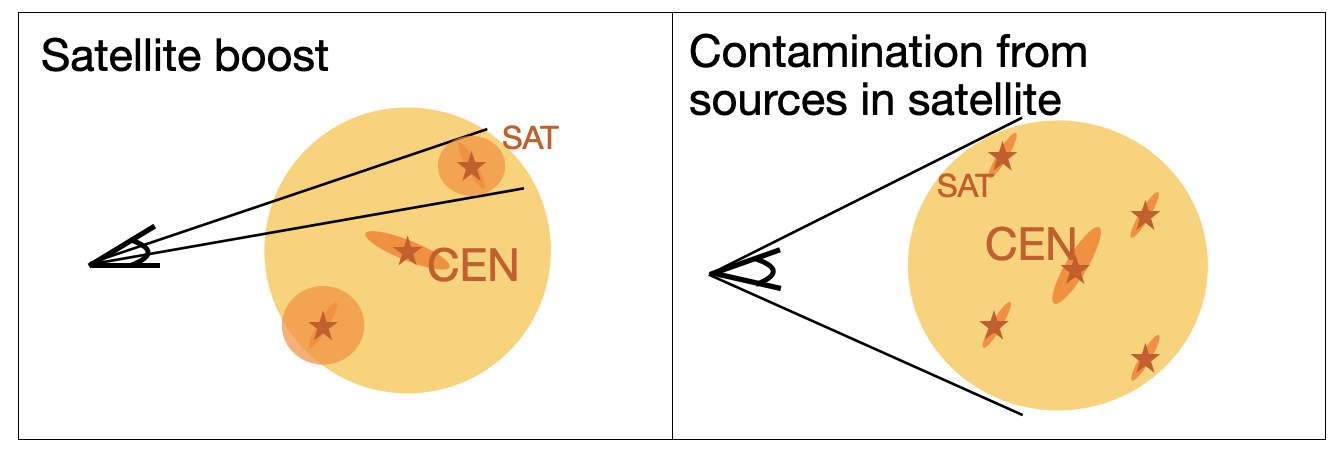
- RQ2How do unresolved AGN/XRB contamination and satellite galaxies bias stacking measurements, and how can they be mitigated?
- RQ3What are the best-fit beta-model parameters describing the hot CGM, and what do they imply about its structure?
- RQ4What is the inferred baryon budget of the hot CGM for MW-mass and more massive systems, and how does it compare to ΛCDM predictions?
주요 결과
- Significant detection of extended X-ray emission from the hot CGM around MW-mass and more massive central galaxies out to the virial radius (R_vir).
- MW-mass galaxy: S_X,0 ≈ 3.1×10^35 erg s^-1 kpc^-2, β ≈ 0.42; M31-mass galaxy: S_X,0 ≈ 1.3×10^36 erg s^-1 kpc^-2, β ≈ 0.37; higher-mass bin (log M_* = 11.25–11.50): S_X,0 ≈ 6.3×10^36 erg s^-1 kpc^-2, β ≈ 0.35.
- Significance levels: ≈12.3σ for M31-mass and ≈8.1σ for MW-mass within R_vir; ≈4.5σ (MW) and ≈3.1σ (M31) within 0.5–1 R_vir.
- Extended emission detected out to R_vir, providing a firm footing for the presence of hot CGM around MW-mass and more massive galaxies.
- Isolated galaxies show no strong differences in surface brightness profiles compared to central galaxies after accounting for environment.

더 나은 연구,지금 바로 시작하세요
연구 설계부터 논문 작성까지, 연구 시간을 획기적으로 줄여보세요.
카드 등록 없음 · 무료 플랜 제공
이 리뷰는 AI가 만들고, 인간 에디터가 검토했습니다.