
[논문 리뷰] The interstellar medium conditions of a strong Lya emitter at z = 8.279 revealed by JWST: a robust LyC leaker candidate at the Epoch of Reionization
JWST NIRSpec 및 NIRCam 데이터를 사용하여, z = 8.279에 위치한 강력한 라이먼 알파 발광체인 GN-z8-LAE를 분석한 이 연구는 f_esc > 14%인 강력한 라이먼 연속체(LyC) 누출 후보로 이를 규명하였다. 이 은하에서는 극도로 높은 항성 형성과 항성 질량 표면 밀도, 딱딱한 이온화장치, 희귀한 NIII] 발광선을 관측하였으며, 이는 고도로 태양 이하의 질량 분포를 지닌 것으로 나타나, 재이온화 시대의 주요 초기 재이온화 기여자로 작용할 가능성이 높다.
Making use of JWST NIRSpec and NIRCam data, we conduct a detailed analysis of the spectroscopic and photometric properties of GN-z8-LAE, a strong Lya emitter at z=8.279. Our goal is to investigate the interstellar medium (ISM) physical conditions that enable the Lya detection in this source at the Epoch of Reionization (EoR) and scrutinize GN-z8-LAE as an early reionizer. In broad agreement with previous results, we find that GN-z8-LAE is a young galaxy (age ~ 10 Myr) with a low stellar mass (M* ~ 10^7.66 Msun), significantly lower than those of most Lya emitters known at similarly high redshifts. The derived stellar mass and star formation rate surface densities are 355 Msun/pc^2 and 88 Msun/yr/kpc^2, respectively. Our spectral analysis indicates that: the Lya line peak has a small velocity offset 133+-72 km/s with respect to the galaxy systemic redshift; CIV] / CIII] ~ 3.3; the ISM is characterized by a hard ionization field, although no signature of AGN is present. Moreover, we report the presence of NIII]1750 emission with super-solar N abundance, which makes GN-z8-LAE one of the first known cases of a simultaneous strong Lya and nitrogen emitter at the EoR. Based on all these properties, we apply a wide range of methods to constrain the absolute Lyman continuum escape fraction of GN-z8-LAE, and find that it is >14% in all cases. Therefore, we conclude that GN-z8-LAE is a robust candidate for a Lyman continuum (LyC) leaker at the EoR which is being caught at the moment of efficiently reionizing its surrounding medium.
연구 동기 및 목표
- 재이온화 시대(Epoch of Reionization, EoR) 동안 고적색계 은하에서 라이먼 알파 발광을 가능하게 하는 은하간성간매체(ISM) 조건을 조사하기 위해.
- GN-z8-LAE가 라이먼 연속체(LyC) 누출에 강력한 후보인지 평가하기 위해, 이는 우주 재이온화를 이끄는 데 핵심 조건이기 때문이다.
- 항성 질량, 항성 형성률 표면 밀도, 이온화장치 경도 등의 물리적 성질을 특성화하기 위해.
- 고적색계 은하에서 희귀한 NIII] λ1749–1753 발광선의 기원을 탐색하고, 금속성과 항성 피드백에 대한 함의를 조사하기 위해.
- 다양한 간접 방법을 사용하여 LyC 누출 분율(f_esc)을 결정하여 재이온화 잠재력에 대한 견고한 제약 조건을 설정하기 위해.
제안 방법
- JWST NIRSpec 및 NIRCam 데이터를 활용해 깊은 스펙트로스코픽 분석을 수행하여, 라이먼 알파, CIV, CIII], 및 NIII] 선의 발광선 특성을 측정하였다.
- 시스템적 적색편이에 대한 라이먼 알파 선의 속도 이격도(Δv = 133 ± 72 km/s)를 계산하여 공명 산란과 ISM 기하학을 평가하였다.
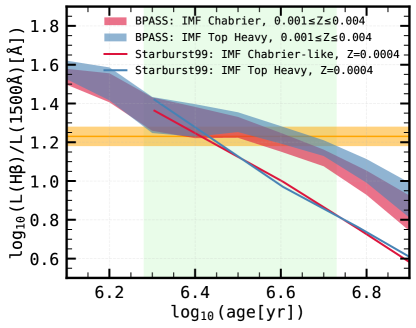
- BAGPIPES 코드를 사용한 SED 피팅과 먼지 흡수 모델링을 통해 항성 질량(M* ≈ 10^7.66 M☉)과 항성 형성률(SFR)을 추정하였다.
- 표면 밀도를 계산하여: Σ_M* ≈ 355 M☉/pc² 및 Σ_SFR ≈ 88 M☉ yr⁻¹ kpc⁻²로, 밀도와 항성 형성 강도를 평가하였다.
- 다양한 간접 지표—CIV/CIII] 비율, [OIII]/[OII] 비율, 라이먼 알파 선의 너비, 및 UV 기울기(β ≈ -2.2에서 -2.7)—를 사용하여 f_esc를 제약 조건화 하였다.
- CIV/CIII] 비율(≈3.3)과 NIII] 검출을 적용하여, 이온화장치 경도와 질소 과잉을 각각 추론하였다.
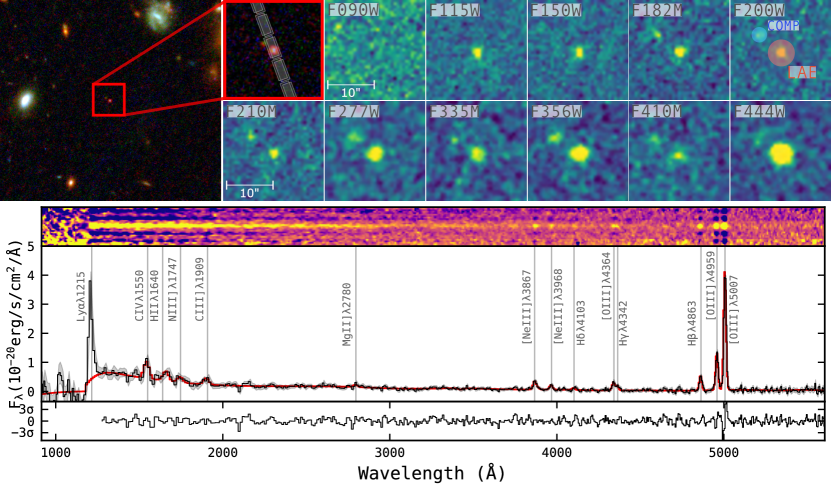
실험 결과
연구 질문
- RQ1z = 8.279에서 GN-z8-LAE의 은하간성간매체(ISM) 조건은 무엇이며, 강력한 라이먼 알파 발광을 가능하게 하는가?
- RQ2GN-z8-LAE의 라이먼 연속체(LyC) 누출 분율(f_esc)은 얼마이며, 재이온화를 이끄는 데 필요한 임계치를 초과하는가?
- RQ3이 고적색계 은하에서 NIII] λ1749–1753 발광선이 관측되는 원인은 무엇이며, 이는 금속성과 이온화 상태에 대해 어떤 함의를 지닌다?
- RQ4GN-z8-LAE의 극도로 높은 항성 질량 및 항성 형성률 표면 밀도는 라이먼 연속체(LyC) 누출 상태와 어떻게 관련되어 있는가?
- RQ5여러 간접 지표가 서로 일관되게 GN-z8-LAE가 재이온화 시대에 강력한 라이먼 연속체(LyC) 누출 후보로 간주될 수 있는가?
주요 결과
- GN-z8-LAE는 약 10 Myr의 나이를 지닌 젊은 은하이며, M* ≈ 10^7.66 M☉의 낮은 항성 질량을 지녀, 유사 적색편이에서 대부분의 라이먼 알파 발광체보다 덜 질량이 큰 편이다.
- 이 은하는 높은 표면 밀도를 보이며, Σ_M* ≈ 355 M☉/pc² 및 Σ_SFR ≈ 88 M☉ yr⁻¹ kpc⁻²로, z ≈ 8에서 가장 밀도가 높고 항성 형성이 극도로 활발한 시스템 중 하나로 분류된다.
- 라이먼 알파 선의 피크는 시스템적 적색편이에서 오직 Δv = 133 ± 72 km/s 만큼 이격되어 있어, 공명 산란이 최소이며 LyC 누출에 유리한 기하학적 조건을 지닌다.
- CIV/CIII] 선 비율은 ≈3.3로, AGN의 징후 없이도 딱딱한 이온화장치를 나타내며, LyC 누출 후보와 일치한다.
- NIII] λ1749–1753 발광선의 검출은 초과된 질소 농도를 암시하며, 이는 유도된 태양 이하 금속성과 일치하지 않으며, 극도로 높은 표면 밀도 또는 월프-레이넷 별과의 관련이 있을 수 있다.
- 모든 적용된 방법에서 f_esc > 14%로 도출되었으며, 이는 GN-z8-LAE가 재이온화 시대에 현재까지 규명된 바에서 가장 견고한 LyC 누출 후보로 간주됨을 확인한다.
이 논문 읽기
누빈트 뷰어에서 원문을 열고, 읽으면서 궁금한 곳을 바로 물어보세요.
누빈트에서 이 논문 읽기이 리뷰는 AI가 논문 원문을 바탕으로 만들었습니다. 인용하기 전에 원문을 확인해 주세요.