
[논문 리뷰] The massive relic galaxy NGC 1277 is dark matter deficient. From dynamical models of integral-field stellar kinematics out to five effective radii
본 연구는 깊은 적분장 자료에 대한 Jeans 이방성 모형을 사용하여 NGC 1277의 5개의 유효 반경(5 Re) 내에서 암흑 물질이 무시할 만한 수준임을 보여주고, LCDM 기대에 도전한다.
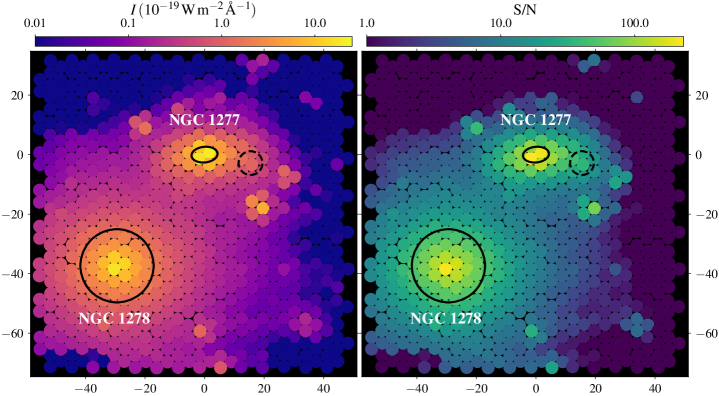
According to the $Λ$CDM cosmology, present-day galaxies with stellar masses $M_\star>10^{11} { m M}_\odot$ should contain a sizable fraction of dark matter within their stellar body. Models indicate that in massive early-type galaxies (ETGs) dark matter should account for $\sim60\%$ of the dynamical mass within five effective radii ($5 R_{ m e}$). Most massive ETGs have been shaped through a two-phase process: the rapid growth of a compact core was followed by the accretion of an extended envelope through mergers. The exceedingly rare galaxies that have avoided the second phase, the so-called relic galaxies, are thought to be the frozen remains of the massive ETG population at $z\gtrsim2$. The best relic galaxy candidate discovered to date is NGC 1277, in the Perseus cluster. We used deep integral field GCMS data to revisit NGC 1277 out to an unprecedented radius of 6 kpc (corresponding to $5 R_{ m e}$). By using Jeans anisotropic modelling we find a negligible dark matter fraction within $5 R_{ m e}$ ($f_{ m DM}(5 R_{ m e})<0.05$; two-sigma confidence level), which is in tension with the expectation. Since the lack of an extended envelope would reduce dynamical friction and prevent the accretion of an envelope, we propose that NGC 1277 lost its dark matter very early or that it was dark matter deficient ab initio. We discuss our discovery in the framework of recent proposals suggesting that some relic galaxies may result from dark matter stripping as they fell in and interacted within galaxy clusters. Alternatively, NGC 1277 might have been born in a high-velocity collision of gas-rich proto-galactic fragments, where dark matter left behind a disc of dissipative baryons. We speculate that the relative velocities of $\approx2000 { m km/s}$ required for the latter process to happen were possible in the progenitors of the present-day rich galaxy clusters.
연구 동기 및 목표
- 깊은 적분장 데이터(depth-integral field data)를 사용하여 NGC 1277의 다섯 개의 유효 반경(5 Re)까지의 암흑 물질 함량을 평가한다.
- 질량이 큰 초기형 은하에 대한 Lambda CDM 기대치와 DM 분율을 비교한다.
- 일반적인 두 단계 외피 성장(envelope growth)을 피한 잔재 은하인지 NGC 1277을 조사한다.
- 관측된 운동학을 설명하는 데 암흑 물질의 얼개가 필요한지 확인하기 위해 역학적 모형을 사용한다.
제안 방법
- George and Cynthia Mitchel Spectrograph (GCMS)로 NGC 1277과 NGC 1278의 깊은 적분장 분광관측을 얻어 대략 ~5 Re까지 항성 운동학을 맵핑한다.
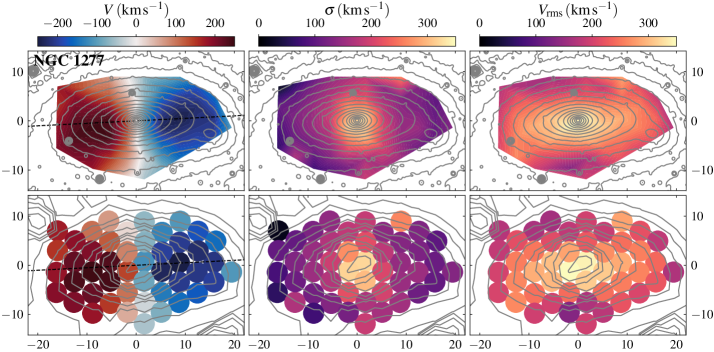
- E-MILES 템플릿을 사용한 pPXF로 항성 운동학을 추출하여 V, sigma, 및 V_rms 맵을 도출한다.
- HST 영상으로 다중 가우시안 확장(MGE)을 이용해 광도 및 질량 모델을 구성하여 바리온 분포를 추적한다.
- Jeans 이방성 모형(JAM)을 적용하여 암흑 물질 해를 포함한 전체 질량을 추론하고 5 Re 내의 DM 분율을 도출한다.
- 고해상도 내부 데이터(NIFS, HST)를 포함시켜 중심 퍼텐셜과 블랙홀 질량을 제약하고 그것이 바깥 영역의 DM에 미치는 영향을 평가한다.
- 물리적 스케일을 위해 평평한 우주론(H0=71 km/s/Mpc, Omega_m0=0.265)과 퍼세우스(distance to Perseus, z=0.017195)를 채택한다.
실험 결과
연구 질문
- RQ1NGC 1277의 다섯 개의 유효 반경 내 DM 분율은 얼마나 되는가?
- RQ2NGC 1277은 큰 반경까지의 항성 운동학을 설명하기 위해 확장된 DM 해가 필요한가?
- RQ3NGC 1277의 DM 함유량은 거대 초기형 은하에 대한 LCDM 기대와 어떻게 비교되는가?
- RQ4잃지 않은 DM 함량(또는 부족함)이 잔재 특성과 어떻게 조화를 이루는가?
- RQ5암흑 물질 분포에 미치는 후생 블랙홀 질량 추정 및 중심 질량 모형의 시사점은 무엇인가?
주요 결과
- f_DM(5 Re) < 0.05 at two-sigma, implying negligible dark matter within 5 Re.
- NGC 1277 shows little to no need for an extended DM halo to reproduce stellar kinematics in the outer parts.
- The observed DM deficit is in tension with LCDM expectations of ~15% DM within 1 Re and ~60% within 5 Re for massive ETGs.
- The relic nature (lack of an extended envelope) could explain reduced dynamical friction and envelope growth, consistent with low DM framing in the inner regions.
- A scenario is proposed where DM is stripped early, or DM was intrinsically deficient, possibly linked to cluster-infall processes or high-velocity formation events.
더 나은 연구,지금 바로 시작하세요
연구 설계부터 논문 작성까지, 연구 시간을 획기적으로 줄여보세요.
카드 등록 없음 · 무료 플랜 제공
이 리뷰는 AI가 만들고, 인간 에디터가 검토했습니다.