
[논문 리뷰] The $γ$-ray emitting region in low synchrotron peak blazars. Testing self-synchrotron Compton and external Compton scenarios
이 연구는 104개의 라디오로 선택된 저형광점피크(LSP) 블라자르에서 테스트한 자기형광컴프턴(SSC) 및 외부형광컴프턴(EC) 모델을 통해 고에너지 감마선 방출의 기원을 조사한다. 연구 결과, 관측된 스펙트럼 에너지 분포(SED)를 설명하기 위해 SSC만으로는 부족하며, 대신 적외선 외부 광자장에 의해 지배되는 EC 시나리오가 유리하다고 밝혀져, 감마선 방출 부위가 블랙홀에서 0.1 pc 이상 떨어져 있음을 시사한다. 이는 빠른 변화를 지탱할 수 있는 좁은 제트 구조와 일치한다.
From the early days in gamma-ray astronomy, locating the origin of GeV emission within the core of an active galactic nucleus (AGN) persisted as an open question; the problem is to discern between near- and far-site scenarios with respect to the distance from the super massive central engine. We investigate this question under the light of a complete sample of low synchrotron peak (LSP) blazars which is fully characterized along many decades in the electromagnetic spectrum, from radio up to tens of GeV. We consider the high-energy emission from bright radio blazars and test for synchrotron self-Compton (SSC) and external Compton (EC) scenarios in the framework of localizing the $γ$-ray emission sites. Given that the inverse Compton (IC) process under the EC regime is driven by the abundance of external seed photons, these photons could be mainly ultraviolet (UV) to X-rays coming from the accretion disk region and the broad-line region (BLR), therefore close to the jet launch base; or infrared (IR) seed photons from the dust torus and molecular cloud spine-sheath, therefore far from jet launch base. We use enhanced SED information from recent works (including new $γ$-ray detections) to refine the study of Syn to IC peak correlations, which points to a particular $γ$-ray emission site. We show that SSC alone is not enough to account for the observed SEDs. Our analysis favors an EC scenario under the Thomson scattering regime, with a dominant IR external photon field. Therefore, the far-site (i.e., far from the jet launch) is probably the most reasonable scenario to account for the population properties of bright LSP blazars in cases modeled with a pure leptonic component. We calculate the photon energy density associated with the external field at the jet comoving frame to be $ m U'_{ext}=1.69 imes 10^{-2}$ erg/cm$^3$, finding good agreement to other correlated works.
연구 동기 및 목표
- 저형광점피크(LSP) 블라자르에서 감마선 방출 영역의 위치를 특정하기 위해, 자기형광컴프턴-근접(SSF)과 외부형광컴프턴-원거리(EC) 시나리오를 구분한다.
- LSP 블라자르의 광역 SED를 라디오에서 GeV 대역까지 설명할 수 있는 자기형광컴프턴-SSC 또는 외부형광컴프턴-EC 메커니즘을 평가한다.
- LSP 블라자르에서 EC 과정을 주도하는 주요 외부 광자장(광폭선 영역의 자외선 또는-dust 토러스의 적외선)을 규명한다.
- 다중파장 SED 모델링을 통해 제트의 물리적 매개변수, 즉 러너지 팩터, 도플러 보정, 외부 광자 에너지 밀도를 제약한다.
- 스펙트럼 매개변수(예: 피크 주파수, 스펙트럼 기울기)와 빛의 세기 간의 상관관계를 탐색하여 제트 물리학의 근본 원리를 추론한다.
제안 방법
- 37 GHz 복사 밀도가 1 Jy 이상인 104개의 LSP 블라자르로 구성된 완전한 샘플을 분석하여, 라디오에서 GeV 감마선까지의 SED를 활용한다.
- 일체형 렙톤 제트 모델을 가정하여, SSC 및 EC 모델을 사용해 광역 SED를 구성하고 적합시킨다.
- 자외선 종자 광자를 광폭선 영역(BLR)에서 온 것으로 가정한 두 가지 EC 시나리오를 테스트한다. 또 다른 시나리오는 먼지 토러스와 분자 구름에서 온 적외선 종자 광자를 사용한다.
- 외부 광자 에너지 밀도의 공동 프레임(comoving-frame)을 계산하여, 외부 필드의 지배 정도를 평가한다.
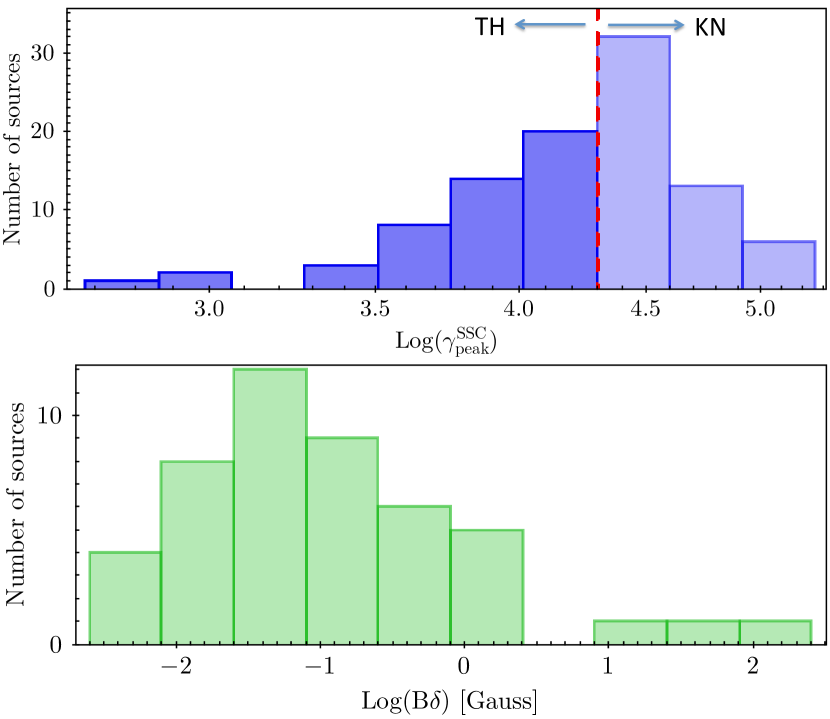
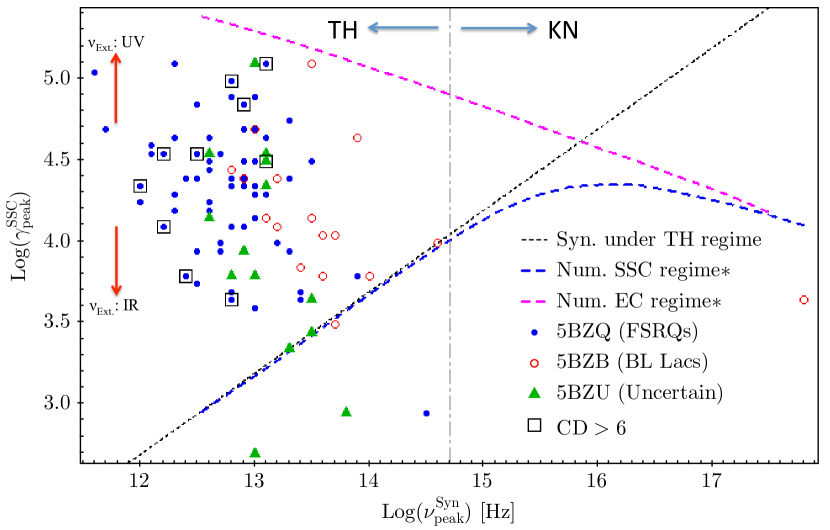
- EC가 SSC보다 유리한 영역을 식별하기 위해 $ \log(\gamma^{\text{EC}}_{\text{peak}}) $ 대 $ \log(\nu^{\text{Syn}}_{\text{peak}}) $ 평면을 매핑한다.
- 일곱 개의 온도 범위에 걸쳐 IC 및 동기복사 빛의 세기 간 상관관계를 연구하기 위해 $ \log(L_{\text{IC}}) $ 대 $ \log(L_{\text{Syn}}) $ 평면을 그린다.
실험 결과
연구 질문
- RQ1저형광점피크(LSP) 블라자르의 관측 SED를 설명하기 위해 자기형광컴프턴-SSC 모델이 충분한가?
- RQ2LSP 블라자르에서 관측된 감마선 방출과 더 일치하는 외부 광자장은 광폭선 영역의 자외선인지, 먼지 토러스의 적외선인지?
- RQ3관측된 SED와 EC 모델에 기반해 중심 블랙홀에서 감마선 방출 부위까지 추정되는 거리는 얼마인가?
- RQ4스펙트럼 매개변수(예: $ \nu^{\text{Syn}}_{\text{peak}} $, $ \nu^{\text{IC}}_{\text{peak}} $, $ \Gamma $)가 빛의 세기와 피크 주파수와 어떻게 상관관계를 가지는가?
- RQ5LSP 블라자르에서 관측된 IC 방출을 생성하기 위해 필요한 공동 프레임 외부 광자 에너지 밀도는 얼마인가?
주요 결과
- 대부분의 소스가 SSC 지배 영역과 일치하지 않는 매개변수 공간 영역에 위치함에 따라, SSC만으로는 LSP 블라자르의 관측 SED를 설명할 수 없다.
- 적외선 외부 광자장에 기반한 외부형광컴프턴(EC) 모델이 SED에 더 잘 맞으며, 이는 감마선 방출 부위가 블랙홀에서 0.1 pc 이상 떨어져 있음을 시사한다.
- 공동 프레임 외부 광자 에너지 밀도는 $ U^{\text{'} }_{\text{ext}} = 1.69 \times 10^{-2} $ erg/cm³로 계산되었으며, 독립된 연구들과 양호한 일치를 보였다.
- 평균값 $ \langle \log(B\delta) \rangle \approx 0.99 $ 및 $ \langle \log(\gamma^{\text{EC}}_{\text{peak}}) \rangle \approx 2.80 $ 는 이전 연구 결과와 일치하며, 고체 러너지 팩터와 강한 도플러 보정을 지닌 제트 구조를 지지한다.
- 일곱 온도 범위에 걸쳐 $ \log(L_{\text{IC}}) $ 대 $ \log(L_{\text{Syn}}) $ 평면에서 기울기가 1보다 略ally 큰 밀도 있는 상관관계를 발견하여, 제트 내에서 입자 가속과 에너지 손실 간의 균형을 시사한다.
- 감마선 스펙트럼 기울기 $ \Gamma $ 는 $ \nu^{\text{Syn}}_{\text{peak}} $ 와 $ \nu^{\text{IC}}_{\text{peak}} $ 가 증가함에 따라 더 딱딱해지며, LSP 블라자르는 0.1–500 GeV 대역에서 기울기가 급격히 기울어져 페르미-LAT로 탐지하기 어려운 편이다.
더 나은 연구,지금 바로 시작하세요
논문 읽기부터 검토까지, 연구 시간을 획기적으로 줄여보세요.
카드 등록 없음 · 무료 플랜 제공
이 리뷰는 AI가 만들고, 인간 에디터가 검토했습니다.