
[논문 리뷰] The Rise of Faint, Red AGN at $z>4$: A Sample of Little Red Dots in the JWST Extragalactic Legacy Fields
논문은 z~2–11에 걸친 341개의 희미하고 붉은 AGN 후보(LRDs)로 구성된 JWST 기반 대규모 샘플을 제시하며, 연속체 기울기, 소형 형태학, 및 가려진 AGN 특성을 상세히 다룬다. 적색편이 분포, 수 밀도, X선 및 NIRSpec 확인 여부를 분석하고 이전 LRD 샘플과 비교한다.
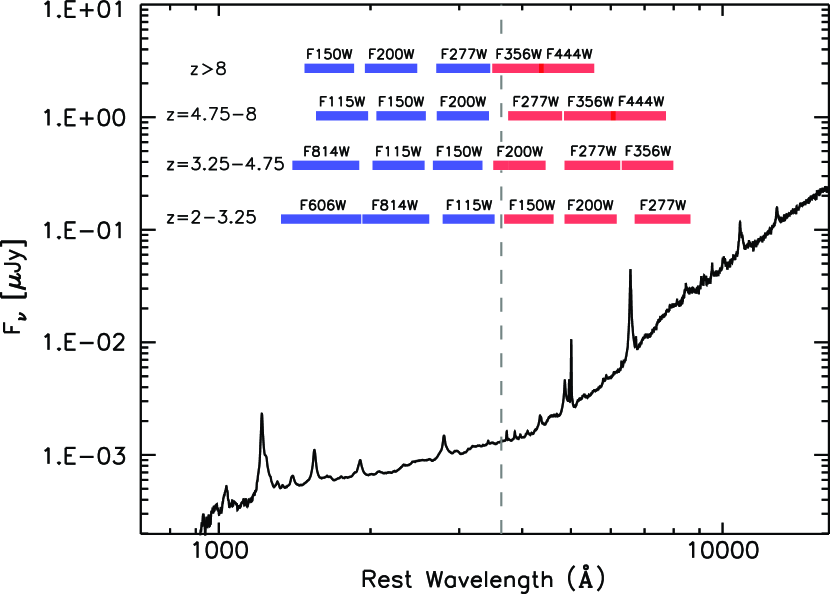
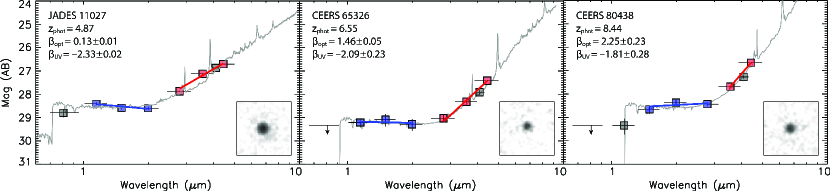
We present a sample of 341 "little red dots" (LRDs) spanning the redshift range $z\sim2-11$ using data from the CEERS, PRIMER, JADES, UNCOVER and NGDEEP surveys. Unlike past use of color indices to identify LRDs, we employ continuum slope fitting using shifting bandpasses to sample the same rest-frame emission blueward and redward of the Balmer break. This enables the detection of LRDs over a wider redshift range and with less contamination from galaxies with strong breaks that otherwise lack a rising red continuum. The redshift distribution of our sample increases at $z<8$ and then undergoes a rapid decline at $z\sim4.5$, which may tie the emergence of these sources to the inside-out growth that galaxies experience during this epoch. We find that LRDs are $\sim1$ dex more numerous than X-ray and UV selected AGN at z~5-7. Within our sample, we have identified the first two X-ray detected LRDs. An X-ray spectral analysis confirms that these AGN are moderately obscured with $\log\,(N_{ m H}/{ m cm}^{2}$) of $23.3^{+0.4}_{-1.3}$ and $22.72^{+0.13}_{-0.16}$. Our analysis reveals that reddened AGN emission dominates their rest-optical light, while the rest-UV originates from their host galaxies. We also present NIRSpec observations from the RUBIES survey of 17 LRDs that show broad emission lines consistent with AGN activity. The confirmed AGN fraction of our sample is 71\% for sources with F444W<26.5. In addition, we find three LRDs with blue-shifted Balmer absorption features in their spectra, suggesting an outflow of high-density, low-ionization gas from near the central engine of these faint, red AGN.
연구 동기 및 목표
- 고적-red-optical/blue-UV 소스의 광촛점으로 묶인 광학적으로 붉은 컴팩트한 소스의 광범위한 인구를 고적출로 식별하여 고적-적색의 AGN 가능성을 탐색한다.
- JWST 심층 필드에서 빨간색 후보의 적색분포, 체적 밀도, 및 밝은 퀴아사와 다른 AGN 선택과의 비교를 정량화한다.
- X선 탐지 및 NIRSpec 분광학을 통해 확인된 AGN 특성을 특징지어, 가려짐과 호스트 은하 기여를 이해한다.
- LRD 발생이 초기 우주 시대의 은하 성장 및 AGN 연료공급에 어떤 영향을 주는지 평가한다.
제안 방법
- 발광단계에서 Balmer 끊기를 기준으로 파장대에 걸친 포토메트릭을 적합시켜 Rest-frame UV 및 광학 연속체 기울기(β_UV 및 β_opt)를 계산한다.
- F444W에서 SNR>12, 양의 β_opt, -2.8에서 -0.37 사이의 β_UV를 갖는 붉은 광학/파란 UV 소스를 선택한다.
- 반광도 반지름 r_h < 1.5 × r_{h,stars}로 확장 오염원을 제거하는 컴팩트 형태학 컷을 적용한다.
- β_UV < -2.8인 잠재 brown dwarfs를 배제하고, β_F277W-F356W 및 β_F277W-F410M 컷으로 강한 선형 방출로 인해 β_opt가 상승했을 가능성을 제거한다.
- χ^2 최소화 및 혼합 모델(은하 + reddened AGN)을 사용한 은하+AGN 구성요소의 SED 적합을 수행하되, 샘플 선택에는 사용하지 않고 시각화를 위한 방법으로만 사용한다.
- 일부(GO-4233)에서 EAZY 포토제닉 적합성 및 NIRSpec RUBIES 분광학으로 적색편이를 검증하고 광범위한 방출선과 가려진 AGN 지표를 식별한다.
실험 결과
연구 질문
- RQ1JWST 심층 필드에서 faint, red AGN(LRDs)의 발생률 및 적색분포를 z~11까지 파악하는가?
- RQ2LRDs의 수밀도가 밝은 퀴사 및 고적자 계통의 X선/UV 선택 AGN과 비교하여 어떤 차이가 있는가?
- RQ3LRDs는 주로 가려진 AGN이며, Rest-frame 광학/UV 빛과 호스트 은하 방출에 어떤 기여를 하는가?
- RQ4LRDs에서 AGN 활동과 피드백을 나타내는 스펙트럼 특징(폭넓은 선, 흡수형 바람 등)은 무엇인가?
- RQ5LRD 인구통계가 초기 블랙홀 성장 및 은하 공동진화 모델에 어떤 정보를 제공하는가?
주요 결과
- LRD의 샘플 341개가 PRIMER-UDS, PRIMER-COSMOS, CEERS, JADES, UNCOVER, NGDEEP에서 z~2–11로 식별된다.
- LRD는 z~5–7에서 밝은 퀴사에 비해 2–3dex 더 많지만, 이 적색에서의 수 밀도는 X-ray 및 UV-selected AGN에 비해 0.6–1 dex만 높다.
- LRD의 최초 X-ray 탐지는 z=3.1 및 z=4.66에서 발견되었으며, 가벼운 가려짐: log(N_H/cm^2) = 23.3^{+0.4}_{-1.3} 및 22.72^{+0.13}_{-0.16}.
- X-ray 스펙트럼 분석은 붉게 보정된 AGN 방출이 Rest-optical 빛을 지배하는 반면 Rest-UV는 주로 호스트 은하 방출임을 보인다.
- 17개의 LRD에 대한 NIRSpec RUBIES 관측은 AGN 활동과 일치하는 폭넓은 방출선을 보여준다.
- 확인된 AGN 비율은 F444W < 26.5 mag인 소스에서 71%이며, 세 개의 LRD에서 바람을 나타내는 좁고 청색 이동된 Balmer 흡수가 관찰되었다.
더 나은 연구,지금 바로 시작하세요
연구 설계부터 논문 작성까지, 연구 시간을 획기적으로 줄여보세요.
카드 등록 없음 · 무료 플랜 제공
이 리뷰는 AI가 만들고, 인간 에디터가 검토했습니다.