
[논문 리뷰] The second data release from the European Pulsar Timing Array: IV. Implications for massive black holes, dark matter and the early Universe
이 논문은 유럽 펄서 타이밍 어레이의 두 번째 데이터 릴리스(DR2)를 분석하여 거대 블랙홀, 암흑물질, 초기 우주의 함의를 탐구한다. DR2가 관련 물리학에 대해 어떻게 제약을 가하는지에 대해 논의한다.
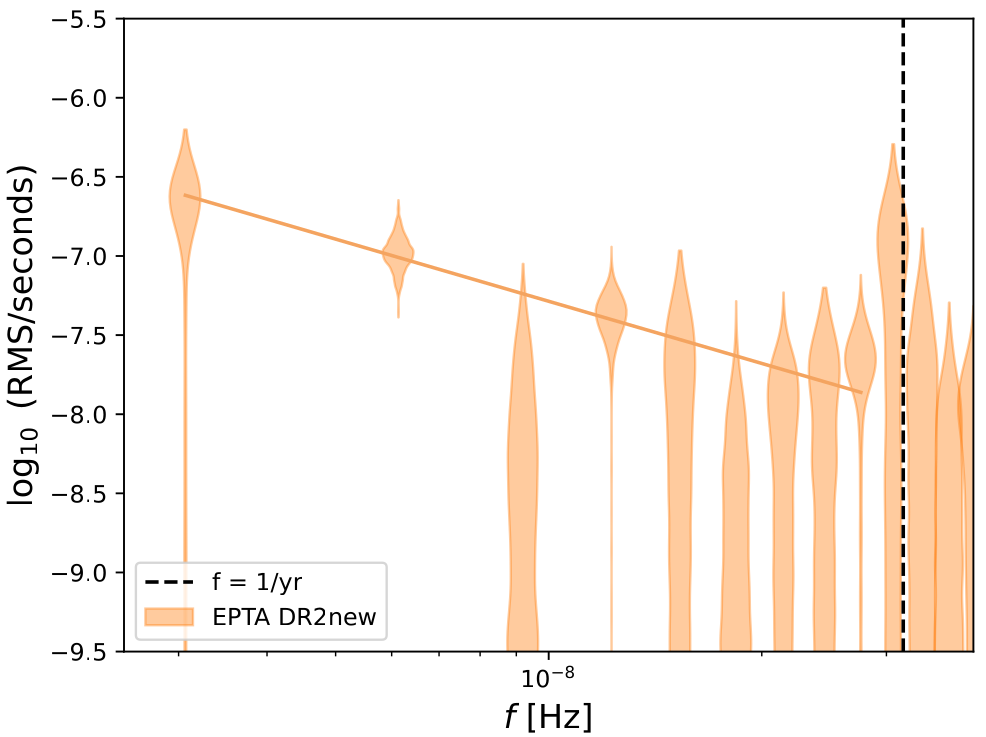
The European Pulsar Timing Array (EPTA) and Indian Pulsar Timing Array (InPTA) collaborations have measured a low-frequency common signal in the combination of their second and first data releases respectively, with the correlation properties of a gravitational wave background (GWB). Such signal may have its origin in a number of physical processes including a cosmic population of inspiralling supermassive black hole binaries (SMBHBs); inflation, phase transitions, cosmic strings and tensor mode generation by non-linear evolution of scalar perturbations in the early Universe; oscillations of the Galactic potential in the presence of ultra-light dark matter (ULDM). At the current stage of emerging evidence, it is impossible to discriminate among the different origins. Therefore, in this paper, we consider each process separately, and investigate the implications of the signal under the hypothesis that it is generated by that specific process. We find that the signal is consistent with a cosmic population of inspiralling SMBHBs, and its relatively high amplitude can be used to place constraints on binary merger timescales and the SMBH-host galaxy scaling relations. If this origin is confirmed, this is the first direct evidence that SMBHBs merge in nature, adding an important observational piece to the puzzle of structure formation and galaxy evolution. As for early Universe processes, the measurement would place tight constraints on the cosmic string tension and on the level of turbulence developed by first-order phase transitions. Other processes would require non-standard scenarios, such as a blue-tilted inflationary spectrum or an excess in the primordial spectrum of scalar perturbations at large wavenumbers. Finally, a ULDM origin of the detected signal is disfavoured, which leads to direct constraints on the abundance of ULDM in our Galaxy.
연구 동기 및 목표
- 유럽 펄서 타이밍 어레이의 두 번째 데이터 릴리스가 거대 블랙홀 이론에 정보를 제공하는 정도를 동기 부여하고 정량화한다.
- 펄서 타이밍 데이터로 접근 가능한 잠재적 암흑물질 시그니처를 평가한다.
- PTA 관측으로 도출된 초기 우주 물리학의 한계를 조사한다.
제안 방법
- European Pulsar Timing Array DR2 데이터셋을 사용하여 타이밍 잔차를 연구한다.
- 크로스-펄서 상관 분석을 적용하여 확률적 배경과 신호 모형을 탐구한다.
- 거대 블랙홀, 암흑물질 효과, 초기 우주 시나리오에 대한 이론적 모형을 PTA 데이터 해석에 통합한다.
실험 결과
연구 질문
- RQ1DR2 데이터셋이 펄서 타이밍 어레이로 탐지 가능한 거대 블랙홀의 집단 및 특성에 대해 어떤 제약을 가하는가?
- RQ2PTA와 관련된 암흑물질 상호작용 또는 분포에 대해 DR2가 제시하는 한계나 시그니처는 무엇인가?
- RQ3DR2가 PTA 관측을 통해 초기 우주 모델에 어떤 정보를 제공하는가?
주요 결과
- DR2는 PTA 주파수 대역에서 거대 블랙홀의 역할에 대한 새로운 통찰을 제공한다.
- 이 데이터는 펄서 타이밍 측정에서 암흑물질 관련 효과에 대해 업데이트된 관점을 제시한다.
- PTA 타이밍 잔차와 확률적 배경의 맥락에서 초기 우주 물리학에 대한 함의가 논의된다.
더 나은 연구,지금 바로 시작하세요
연구 설계부터 논문 작성까지, 연구 시간을 획기적으로 줄여보세요.
카드 등록 없음 · 무료 플랜 제공
이 리뷰는 AI가 만들고, 인간 에디터가 검토했습니다.