
[논문 리뷰] The SN 2023ixf Progenitor in M101: I. Infrared Variability
이 연구는 M101은 은하에 있는 Type II 초신성인 SN 2023ixf의 원형성에 대해 19년간의 Spitzer 및 지상 기반 근적외선 데이터를 사용하여 적외선 변동성을 분석한다. 빛의 곡선에서 1091±71일의 주기성을 확인하였으며, 이는 진동 불안정성에 기인하며 원형성의 광도를 M_K = -11.58±0.31 mag로 유도하였다. 이는 初기 질량 20±4 M☉를 의미하며, 핵붕괴 초신성의 관측된 원형성 중 가장 질량이 큰 편에 속한다.
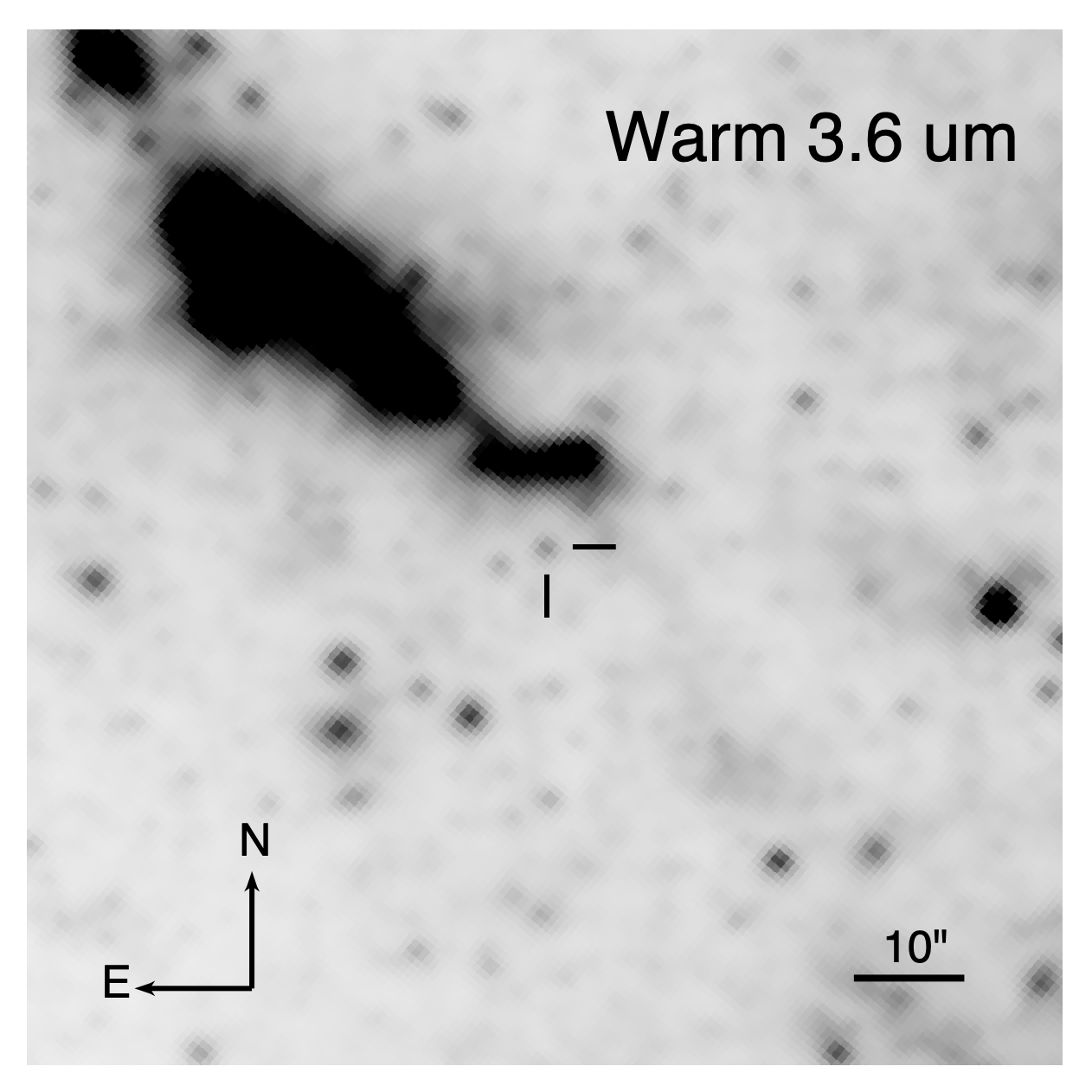
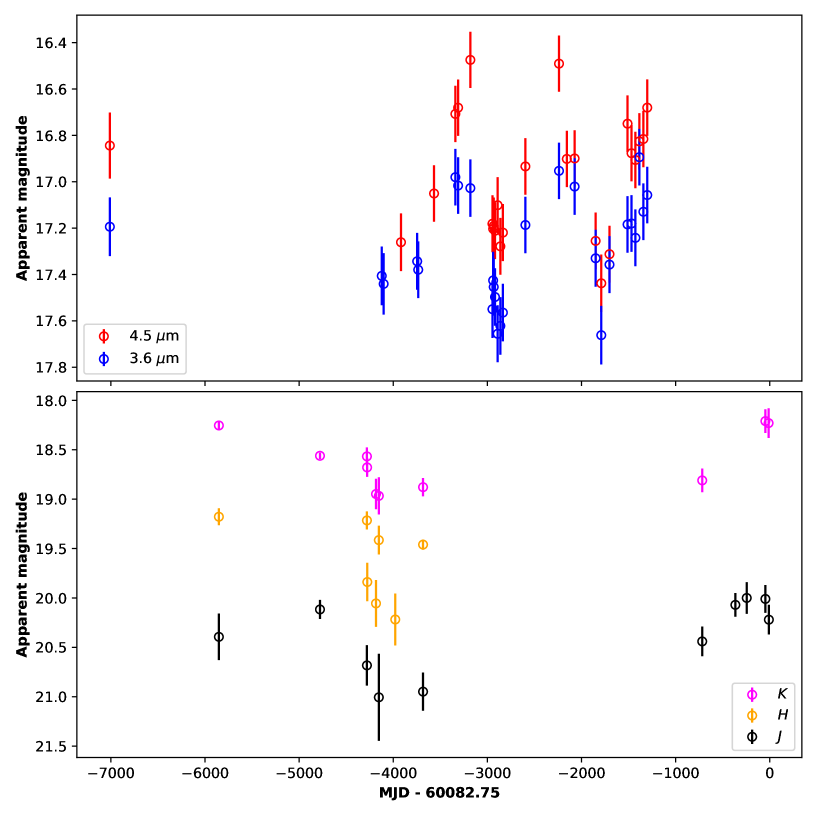
Observational evidence points to a red supergiant (RSG) progenitor for SN 2023ixf. The progenitor candidate has been detected in archival images at wavelengths (>0.6 micron) where RSGs typically emit profusely. This object is distinctly variable in the infrared (IR). We characterize the variability using pre-explosion mid-IR (3.6 and 4.5 micron) Spitzer and ground-based near-IR (JHKs) archival data jointly covering 19 yr. The IR light curves exhibit significant variability with RMS amplitudes in the range of 0.2-0.4 mag, increasing with decreasing wavelength. From a robust period analysis of the more densely sampled Spitzer data, we measure a period of 1091+/-71 days. We demonstrate using Gaussian Process modeling that this periodicity is also present in the near-IR light curves, thus indicating a common physical origin, which is likely pulsational instability. We use a period-luminosity relation for RSGs to derive a value of M_K=-11.58+/-0.31 mag. Assuming a late M spectral type, this corresponds to log(L/L_sun)=5.27+/-0.12 at T_eff=3200 K and to log(L/L_sun)=5.37+/-0.12 at T_eff=3500 K. This gives an independent estimate of the progenitor's luminosity, unaffected by uncertainties in extinction and distance. Assuming the progenitor candidate underwent enhanced dust-driven mass-loss during the time of these archival observations, and using an empirical period-luminosity-based mass-loss prescription, we obtain a mass-loss rate of around (2-4)x10^-4 M_sun/yr. Comparing the above luminosity with stellar evolution models, we infer an initial mass for the progenitor candidate of 20+/-4 M_sun, making this one of the most massive progenitors for a Type II SN detected to-date.
연구 동기 및 목표
- 기록된 Spitzer 및 지상 기반 근적외선 데이터를 사용하여 SN 2023ixf의 원형성의 적외선 변동성을 특성화하기 위해.
- 관측된 변동성의 물리적 기원을 규명하기 위해, 특히 그것이 진동 불안정성에 의해 유도되는지 여부를 확인하기 위해.
- 광도-주기 관계를 사용하여 흡착 및 거리 추정치에 영향을 받지 않는 방식으로 원형성의 광도와 초기 질량을 유도하기 위해.
- 경험적 주기-광도 기반 규정을 사용하여 폭발 이전 단계 동안의 질량 손실률을 추정하기 위해.
- 원형성의 초기 질량에 대해 독립적인 제약 조건을 제공하여 거대 별의 진화 및 초신성 원형성의 특성에 대한 이해를 향상시키기 위해.
제안 방법
- UKIRT, Gemini North, WFCAM에서 확보한 JHKs 근적외선 데이터와 함께 중적외선(3.6 및 4.5 μm) Spitzer 데이터를 19년간 통합하였다.
- 밀도 높은 샘플링을 가진 Spitzer 빛의 곡선에 강력한 주기 분석을 수행하여 1091±71일의 주요 주기성을 확인하였다.
- 근적외선 빛의 곡선에 대해 가우시안 프로세스 모델링을 적용하여 중적외선 주기성과의 일관성을 검증하였으며, 공통된 물리적 기원을 확인하였다.
- 빨간 초거성의 주기-광도 관계를 사용하여 M_K = -11.58±0.31 mag를 유도하였으며, 이는 흡착 및 거리에 영향을 받지 않았다.
- T_eff = 3200–3500 K에서 원형성의 광도를 추정하여 log(L/L☉) = 5.27±0.12에서 5.37±0.12로 유도하였다.
- 주기와 광도에 기반한 경험적 질량 손실 규정을 적용하여 폭발 이전 단계 동안 질량 손실률을 (2–4)×10⁻⁴ M☉ yr⁻¹로 추정하였다.
실험 결과
연구 질문
- RQ1SN 2023ixf의 원형성에서 관측된 적외선 변동성의 성격과 기원은 무엇인가?
- RQ2중적외선 빛의 곡선에서 관측된 주기성이 근적외선에서도 유지되는가? 이는 공통된 물리적 메커니즘을 시사하는가?
- RQ3흡착 및 거리 추정치에 영향을 받지 않는 원형성의 본질적 광도는 무엇인가?
- RQ4그의 진동 주기와 광도에 기반하여 원형성의 초기 질량은 무엇인가?
- RQ5폭발 이전 단계 동안의 질량 손실률은 얼마였으며, 이는 별의 진동 특성과 어떻게 관련되어 있는가?
주요 결과
- SN 2023ixf의 원형성은 파장이 감소함에 따라 증가하는 RMS 진폭 0.2–0.4 mag를 보이며 뚜렷한 적외선 변동성을 나타낸다.
- Spitzer 중적외선 빛의 곡선에서 1091±71일의 주요 주기성이 확인되었으며, 이는 진동 불안정성에 기인함을 시사한다.
- 가우시안 프로세스 모델링을 통해 이 주기성이 근적외선 빛의 곡선에서도 존재하는 것으로 확인되었으며, 공통된 물리적 기원을 지지한다.
- 빨간 초거성의 주기-광도 관계를 사용하여 원형성의 절대 K-대역 magnitude를 M_K = -11.58±0.31 mag로 유도하였다.
- 원형성의 광도는 T_eff = 3200 K일 때 log(L/L☉) = 5.27±0.12, T_eff = 3500 K일 때 log(L/L☉) = 5.37±0.12로 유도되었으며, 이는 흡착 및 거리에 영향을 받지 않았다.
- 은하계 진화 모델에 따르면 초기 질량는 20±4 M☉로 추정되었으며, 이는 현재까지 관측된 Type II 초신성의 원형성 중 가장 질량이 큰 편에 속한다.
더 나은 연구,지금 바로 시작하세요
논문 읽기부터 검토까지, 연구 시간을 획기적으로 줄여보세요.
카드 등록 없음 · 무료 플랜 제공
이 리뷰는 AI가 만들고, 인간 에디터가 검토했습니다.