
[논문 리뷰] The split majoron model confronts the NANOGrav signal and cosmological tensions
본 논문은 split majoron model을 NANOGrav의 중력파 배경 원천으로 재평가하고, 저스케일의 1차 상전이와 SMBHBs가 데이터를 설명할 수 있음을 보이면서 추가 방사선 및 deuterium 제약을 다루고 우주론적 긴장을 완화할 가능성을 제시한다.
In the light of the evidence of a gravitational wave background from the NANOGrav 15yr data set, we reconsider the split majoron model as a new physics extension of the standard model able to generate a needed contribution to solve the current tension between the data and the standard interpretation in terms of inspiraling supermassive black hole massive binaries. In the split majoron model the seesaw right-handed neutrinos acquire Majorana masses from spontaneous symmetry breaking of global $U(1)_{B-L}$ in a strong first order phase transition of a complex scalar field occurring above the electroweak scale. The final vacuum expectation value couples to a second complex scalar field undergoing a low scale phase transition occurring after neutrino decoupling. Such a coupling enhances the strength of this second low scale first order phase transition and can generate a sizeable primordial gravitational wave background contributing to the NANOGrav 15yr signal. Some amount of extra-radiation is generated after neutron-to-proton ration freeze-out but prior to nucleosynthesis. This can be either made compatible with current upper bound from primordial deuterium measurements or even be used to solve a potential deuterium problem. Moreover, the free streaming length of light neutrinos can be suppressed by their interactions with the resulting majoron background and this mildly ameliorates existing cosmological tensions. Thus cosmological observations nicely provide independent motivations for the model.
연구 동기 및 목표
- 15년 데이터 세트를 반영하여 split majoron model을 NANOGrav GW 신호의 원천으로 재평가한다.
- 추가 방사선(Delta Neff) 및 BBN/CMB 관찰로부터의 우주론적 제약을 분석한다.
- GW 스펙트럼에 미치는 고스케일/저스케일 상전이의 영향을 보여준다.
- 중립-주 majoron 상호작용이 Hubble 긴장과 같은 우주론적 긴장을 완화할 수 있는지 탐구한다.
제안 방법
- 자발적 U(1) 대칭 깨짐을 가진 두 스칼라(phi, phi') 및 오른쪽 선형 중성미자 프레임워크를 구성한다.
- relativistic degrees of freedom g_rho와 g_s의 진화, dark-sector 온도 비(r_D) 및 Delta Neff를 계산한다.
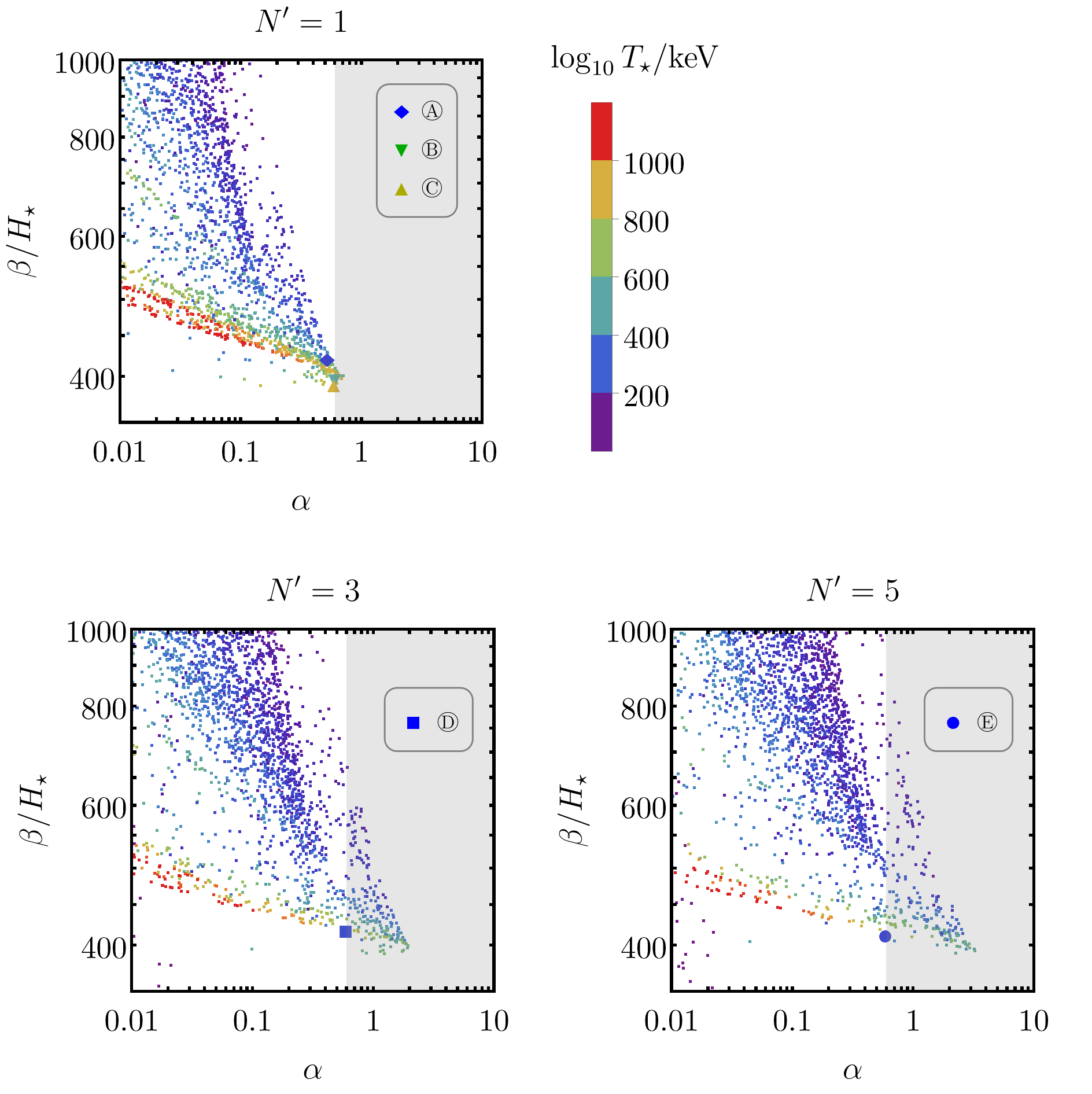
- 저스케일 상전이를 유한온도 유효 포텐셜로 모델링하고 GW 생성에 필요한 alpha와 beta/H_* 파라미터를 도출한다.
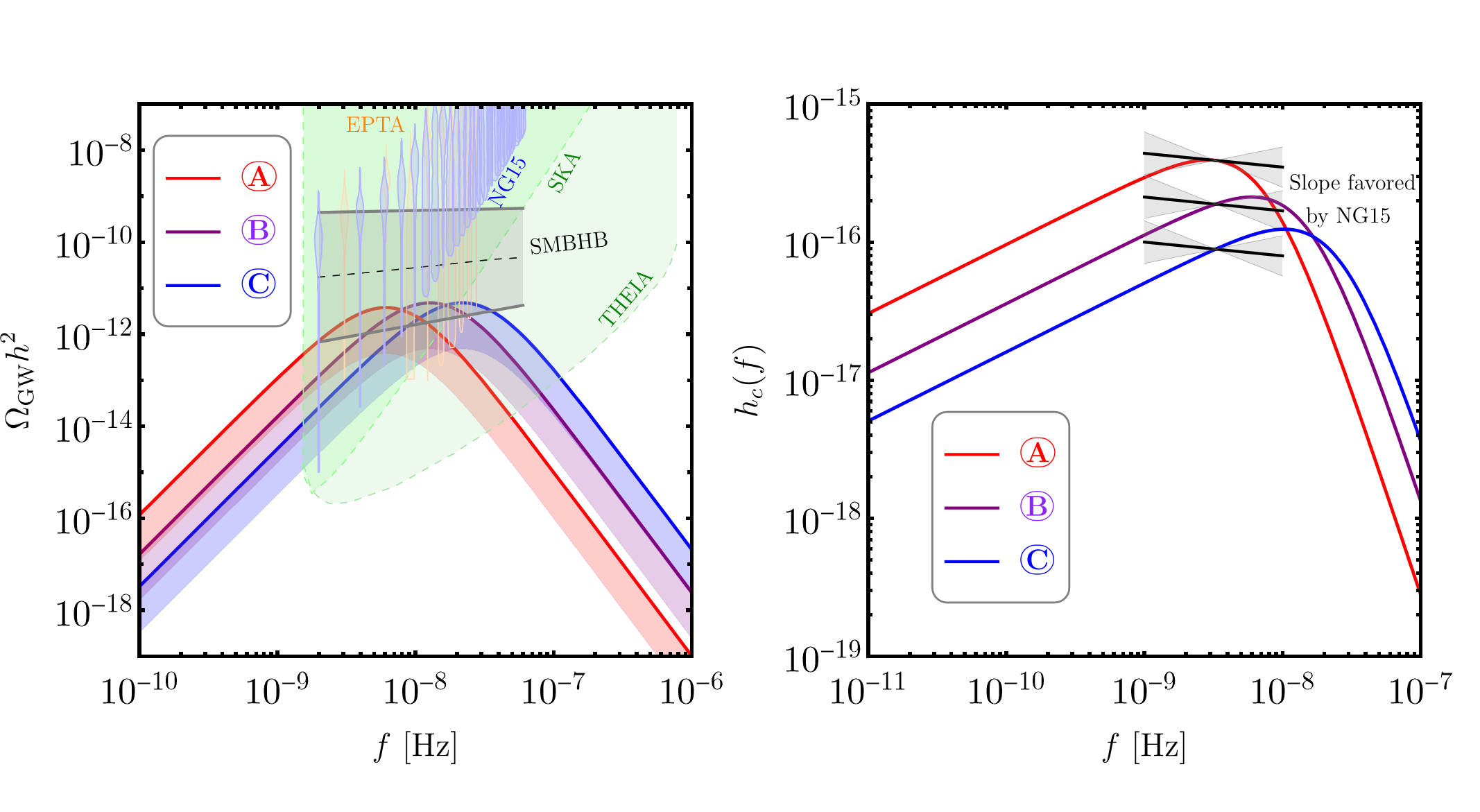
- Jo(u)guet detonation 및 억제 요인을 가지는 음향 파 동주 GW 스펙트럼을 사용해 GW 신호를 예측하고 NANOGrav 15-year 결과와 비교한다.
- BBN 수소-동위원소 측정 및 중성미자 탈커플링으로부터의 우주론적 제약을 포함해 허용 가능한 매개변수 공간을 구분한다.
실험 결과
연구 질문
- RQ1split majoron model이 BBN/CMB 제약을 위반하지 않으면서 NANOGrav 15-year 신호를 설명할 수 있을 만큼 충분한 진폭의 GW 배경을 생성할 수 있는가?
- RQ2NANOGrav 데이터를 맞추는 상전이 매개변수(alpha, beta/H_*, v_w)와 dark-sector 기여의 허용 범위는 무엇인가?
- RQ3추가적인 dark radiation(Delta Neff)과 그것의 온도 진화가 원시 원소 풍부도 및 CMB 측정과의 호환성에 어떤 영향을 미치는가?
- RQ4 neutrino–majoron 상호작용이 중립 자유 스트리밍을 수정하여 우주론적 긴장을 Hubble 긴장과 같은 문제를 완화하는가?
- RQ5암흐로-dark-sector 차수의 증가가 GW 신호와 수소-동위원소 제약 사이의 불일치를 해소하는 데 도움이 되는가?
주요 결과
- 저스케일의 1차 상전이가 SMBHB 기본값과 함께 NANOGrav 15년 신호에 대한 적합도를 향상시킬 수 있다.
- 모델은 약 0.3–0.5의 Delta Neff 수준의 추가 방사를 예측하며, 이는 BBN 및 CMB 제약과 호환되거나 약간의 이점을 제공할 수 있다.
- Dark-sector 차수를 증가시키면 유효한 Delta Neff를 감소시켜 모델과 수소-동위원소 제약의 불일치를 완화할 가능성이 있다.
- 네트리노-majoron 상호작용은 중성미자의 자유 진행을 억제할 수 있어 Hubble 긴장과 같은 기존의 우주론적 긴장을 경미하게 개선할 수 있다.
- 저스케일 상전기에 대한 유한온도 유효 포텐셜로 GW 스펙트럼을 계산하며 alpha_nuD 및 beta/H_*에 대한 정량적 의존성을 가지며 유한 음향파 수명의 억제 요인을 포함한다.
더 나은 연구,지금 바로 시작하세요
연구 설계부터 논문 작성까지, 연구 시간을 획기적으로 줄여보세요.
카드 등록 없음 · 무료 플랜 제공
이 리뷰는 AI가 만들고, 인간 에디터가 검토했습니다.