
[논문 리뷰] The Taurus Boundary of Stellar/Substellar (TBOSS) Survey I: far-IR disk emission measured with Herschel
이 연구는 허셀 패스 애널리시스 시스템(PACS)를 사용하여 토러스 성성 영역의 적외선 원반 방출에 대한 포괄적인 인벤토리 분석을 수행한다. 153개의 M4-L0 물체(은하계/은하계 이하 경계)를 대상으로 분석한 결과, 중심 물체의 복사와의 비율에서 원반 초과가 유의미하게 변화하지 않았으며, 중간값 70 μm 복사가 스펙트럼 유형에 따라 부드럽게 감소하는 경향을 보였다. 또한 24–70 μm 스펙트럼 기울기가 급격한 5개의 새로운 전이 원반 후보를 확인하였다.
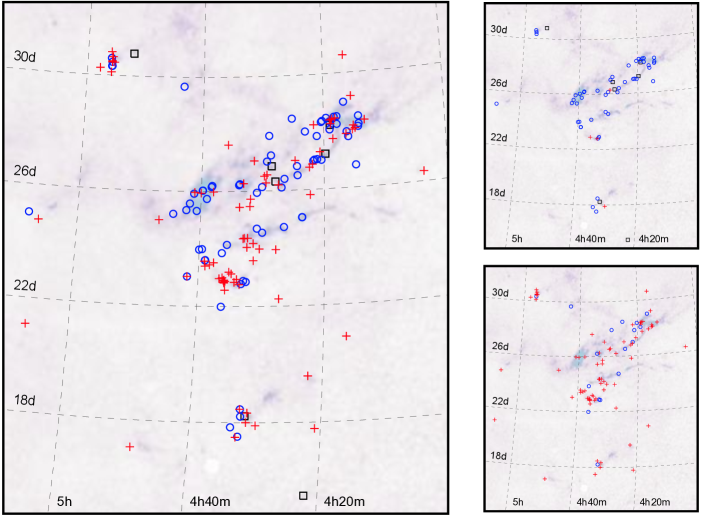
With Herschel/PACS 134 low mass members of the Taurus star-forming region spanning the M4-L0 spectral type range and covering the transition from low mass stars to brown dwarfs were observed. Combining the new Herschel results with other programs, a total of 150 of the 154 M4-L0 Taurus members members have observations with Herschel. Among the 150 targets, 70um flux densities were measured for 7 of the 7 ClassI objects, 48 of the 67 ClassII members, and 3 of the 76 ClassIII targets. For the detected ClassII objects, the median 70um flux density level declines with spectral type, however, the distribution of excess relative to central object flux density does not change across the stellar/substellar boundary in the M4-L0 range. Connecting the 70um TBOSS values with the results from K0-M3 ClassII members results in the first comprehensive census of far-IR emission across the full mass spectrum of the stellar and substellar population of a star-forming region, and the median flux density declines with spectral type in a trend analogous to the flux density decline expected for the central objects. SEDs were constructed for all TBOSS targets covering the optical to far-IR range and extending to the submm/mm for a subset of sources. Based on an initial exploration of the impact of different physical parameters; inclination, scale height and flaring have the largest influence on the PACS flux densities. From the 24um to 70um spectral index of the SEDs, 5 new candidate transition disks were identified. The steep 24um to 70um slope for a subset of 8 TBOSS targets may be an indication of truncated disks in these systems.Two examples of mixed pair systems that include secondaries with disks were measured. Finally, comparing the TBOSS results with a Herschel study of Ophiuchus brown dwarfs reveals a lower fraction of disks around the Taurus substellar population.
연구 동기 및 목표
- 토러스 성성 영역에서 별/은하계 경계를 넘는 원반 빈도와 특성을 조사하기 위해.
- 저질량 별과 브라운 왜소성(스펙트럼 유형 M4–L0) 간에 원반 특성이 다를지 판단하기 위해.
- 젊은 M4–L0 물체의 광학에서 밀리미터 파장까지의 포괄적인 스펙트럼 에너지 분포(SED) 샘플을 구축하기 위해.
- 원거리 적외선 SED 형태를 기반으로 전이 원반을 식별하고 특성화하기 위해.
- 토러스의 원반 특성과 오phiuchus 성성 영역의 특성을 비교하여 환경적 또는 질량 의존적 경향을 평가하기 위해.
제안 방법
- 134개의 저질량 토러스 성원(M4–L0 스펙트럼 유형)에 대해 허셀 패스 애널리시스 시스템(PACS)을 사용해 깊은 원거리 적외선 광도 측정을 수행하였다.
- 허셀 데이터를 기존 설문조사와 융합하여 153개의 물체(150개는 허셀 데이터, 3개는 스피처 데이터)로 구성된 99% 완전한 샘플을 구성하였다.
- 광학에서 밀리미터 파장까지의 SED를 구성하였으며, 가용한 경우 더 긴 파장 데이터를 포함시켰다.
- 24 μm에서 70 μm 사이의 SED 기울기를 분석하여 급격한 스펙트럼 기울기를 보이는 후보 전이 원반을 식별하였다.
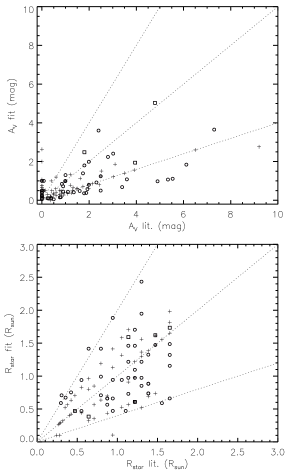
- SED 모델링을 통해 기울기, 척도 높이, 퍼짐 정도가 패스 밴드 복사 밀도에 미치는 영향을 평가하였다.
- 허셀 탐지 결과를 고해상도 동반성 설문조사와 비교하여 이중/다중 시스템에서 원반을 가진 시스템을 식별하였다.
실험 결과
연구 질문
- RQ1M4–L0 스펙트럼 유형 범위에서 별/은하계 경계를 넘어서 원반 빈도나 형태가 유의미하게 변화하는가?
- RQ2M4–L0 범위에서 별의 스펙트럼 유형에 따라 원거리 적외선(70 μm) 복사 밀도가 어떻게 변화하는가?
- RQ3은하계 이하 영역에서 전이 원반은 표준 Class II 원반과 비교해 원거리 적외선 SED 특성이 뚜렷한가?
- RQ4유사한 연령과 질량에서 토러스의 원반 특성은 오phiuchus 성성 영역의 특성과 어떻게 비교되는가?
- RQ5기울기, 퍼짐 정도, 척도 높이 등의 물리적 매개변수 중 관측된 70 μm 복사 밀도에 가장 큰 영향을 미치는 것은 무엇인가?
주요 결과
- 150개의 TBOSS 관측 대상 중 7개의 Class I, 48개의 Class II, 3개의 Class III 물체에서 70 μm 복사 밀도가 측정되었다.
- 중간값 70 μm 복사 밀도는 중심 물체 복사에 따라 예상되는 경향과 유사하게 스펙트럼 유형에 따라 감소하는 경향을 보였으며, 이는 질량 의존적 원반 빛나는 정도의 경향을 시사한다.
- M4–L0 범위에서 별/은하계 경계를 넘어서 중심 물체 복사 대비 원반 초과에 유의미한 변화가 없음을 발견하였다.
- 24–70 μm 스펙트럼 기울기가 급격한 5개의 새로운 전이 원반 후보가 식별되었으며, 외부 원반 SED는 표준 Class II 원반과 구분되지 않았다.
- 8개의 TBOSS 대상 중 일부는 외부 반경이 추가 데이터 없이도 구명되지 않은 채로 24–70 μm 기울기가 급격한 경향을 보이며, 잘린 원반을 시사한다.
- 허셀 데이터에서 원반을 지닌 보조성의 혼합 쌍 2개의 시스템이 탐지되었으며, 이는 이중 시스템에서 원반 생존이 가능함을 확인한다.
- 유사 질량에서 비교했을 때, 토러스의 은하계 물체에서 원반 비율은 오phiuchus 영역보다 낮다.
더 나은 연구,지금 바로 시작하세요
논문 읽기부터 검토까지, 연구 시간을 획기적으로 줄여보세요.
카드 등록 없음 · 무료 플랜 제공
이 리뷰는 AI가 만들고, 인간 에디터가 검토했습니다.