
[논문 리뷰] The $z \gtrsim 9$ galaxy UV luminosity function from the JWST Advanced Deep Extragalactic Survey: insights into early galaxy evolution and reionization
본 논문은 JWST/JADES를 사용하여 z>9에서 rest-frame UV 광도함수를 도출하고, Muv ~ -17에 도달하며, 밝은 끝의 과잉과 가파한 약끝 기울기를 발견하여 초기 은하 진화와 재이온화에 대한 함의를 제시한다.
The high-redshift UV luminosity function provides important insights into the evolution of early galaxies. JWST has revealed an unexpectedly large population of bright ($M_\mathrm{UV} \lesssim -20$) galaxies at $z\gtrsim10$, implying fundamental changes in the star forming properties of galaxies at increasingly early times. However, constraining the fainter population ($M_\mathrm{UV} \gtrsim -18$) has been more challenging. In this work, we present the $z\gtrsim9$ UV luminosity function from the JWST Advanced Deep Extragalactic Survey. We calculate the UV luminosity function from several hundred $z\gtrsim9$ galaxy candidates that reach UV luminosities of $M_\mathrm{UV}\sim-17$ in redshift bins of $z\sim9-12$ (309 candidates) and $z\sim12-16$ (63 candidates). We search for candidates at $z\sim16-22.5$ and find none. We also estimate the $z\sim14-16$ luminosity function from the $z\geq14$ subset of the $z\sim12-16$ sample. Consistent with other measurements, we find an excess of bright galaxies that is in tension with many theoretical models, especially at $z\gtrsim12$. However, we also find high number densities at $-18\lesssim M_\mathrm{UV} \lesssim-17$, suggesting that there is a larger population of faint galaxies than expected, as well as bright ones. From our parametric fits for the luminosity function, we find steep faint end slopes of $-2.5\lesssimα\lesssim-2.3$, suggesting a large population of faint ($M_\mathrm{UV} \gtrsim -17$) galaxies. Combined, the high normalization and steep faint end slope of the luminosity function could imply that the reionization process is appreciably underway as early as $z=10$.
연구 동기 및 목표
- JADES의 JWST/NIRCam 이미징을 사용하여 z>9의 rest-frame UV 광도함수를 제약한다.
- Muv ~ -17까지의 약끝 영역을 조사하여 전체 은하 개체군을 이해한다.
- UV 광도밀도의 진화를 평가하고 우주 재이온화에 대한 시사점을 밝힌다.
- 관측치를 이론적 은하 형성 모델과 비교하여 긴장점과 가능한 설명을 식별한다.
- LF 측정에 근거하여 재이온화 과정이 진행 중인 적색편이 범위를 특징짓는다.
제안 방법
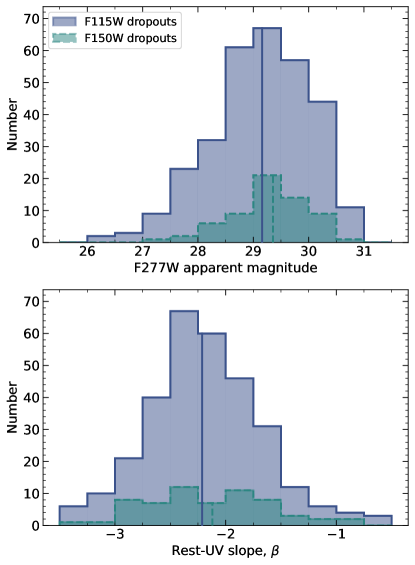
- F115W, F150W, F200W에서 광학적 드랍아웃 선택을 통해 z~9-17 은하 후보를 식별한다.
- BEAGLE SED 피팅을 통해 광학적 적색편향(photometric redshifts)과 확률적 적색편포(posteriors)를 도출한다.
- F090W–F444W의 8개 JWST/NIRCam 필터를 사용하여 rest-frame UV 광측을 구성하고 광도함수를 측정한다.
- z~9-12 및 z~12-16의 적색편이 구간에서 UV 광도함수를 계산하고 z>16에서 상한치를 제시한다.
- 적색편이에 따른 rest-UV 광도밀도 진화를 추정한다.
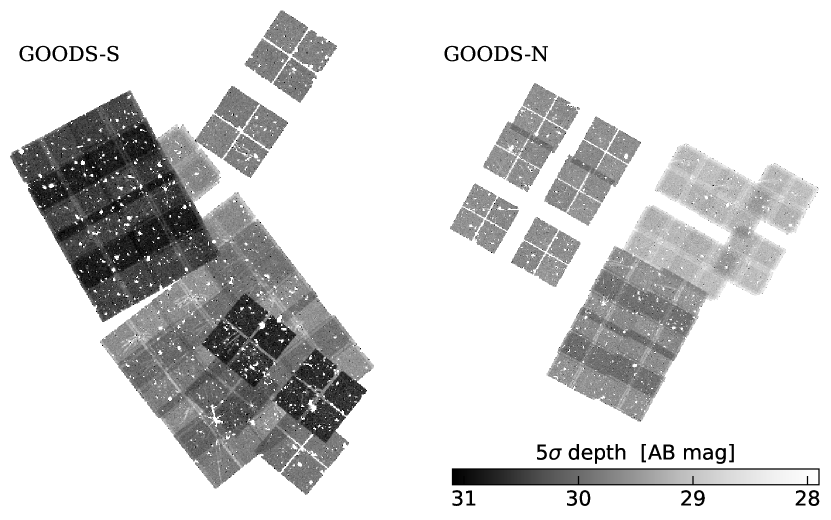
- 깊이와 설문면적의 변화를 반영하여 LF의 약끝을 제약한다.
실험 결과
연구 질문
- RQ1z~9-12와 z~12-16에서 rest-frame UV 광도함수의 형태와 정규화는 무엇인가?
- RQ2이론 모델에 비해 z>12 은하의 밝은 쪽에서 과잉이 있는가, 그리고 이것이 초기 항성 형성에 대해 무엇을 시사하는가?
- RQ3z>9에서 UV LF의 약끝 기울기(alpha)는 무엇이며, 약은 은하가 UV 광도밀도에서 지배적인가?
- RQ4더 높은 적색편으로 갈수록 UV 광도밀도가 어떻게 진화하며, 우주 재이온화의 시간표에 어떤 시사점이 있는가?
주요 결과
- z>12에서 밝은 은하의 과잉이 존재하며 이는 많은 이론 모델과 대립한다.
- -18 ≲ Muv ≲ -17에서 높은 수 밀도를 보이며, 상당한 약은하 개체군을 시사한다.
- 모수적 피팅은 가파른 약끝 기울을 내며: -2.5 ≲ α ≲ -2.3, 이는 많은 약은하(Muv ≳ -17)를 시사한다.
- 높은 정규화와 가파른 약끝 기울기의 결합은 재이온화가 대략 z ≈ 10에서 시작되었을 수 있음을 시사한다.
- z~16-22.5 후보는 발견되지 않았고 이 적색편에서 UV LF의 상한치를 제시한다.
- z>9에서의 결과는 z~13까지 밝은 은하의 느린 진화와 일치하며, 다양한 광도 범위가 UV 광도밀도에 기여함을 시사한다.
더 나은 연구,지금 바로 시작하세요
연구 설계부터 논문 작성까지, 연구 시간을 획기적으로 줄여보세요.
카드 등록 없음 · 무료 플랜 제공
이 리뷰는 AI가 만들고, 인간 에디터가 검토했습니다.