
[논문 리뷰] Thermometry by correlated dephasing of impurities in a 1D Fermi gas
이 논문은 1차원 초냉각 페르미 가스 내에서 정적 불순성 큐비트 두 개의 상관된 디코herence를 이용한 새로운 양자 온도 측정 방법을 제안한다. 기능적 행렬식 방법을 통해 다체 문제를 정확히 해결함으로써, 저자들은 열역학적 상호작용을 통해 유도되는 RKKY 유형의 상호작용이 불순성 간의 상관관계를 유도하며, 독립적인 측정기보다도 온도 측정 민감도를 향상시킴을 보여준다. 특히 저온 및 약한 결합 조건에서 이는 두드러지며, 복잡한 상태 준비 없이 표준 라마지 간섭계를 통해 실현 가능하다.
We theoretically investigate the pure dephasing dynamics of two static impurity qubits embedded within a common environment of ultracold fermionic atoms, which are confined to one spatial dimension. Our goal is to understand how bath-mediated interactions between impurities affect their performance as nonequilibrium quantum thermometers. By solving the dynamics exactly using a functional determinant approach, we show that the impurities become correlated via retarded interactions of the Ruderman-Kittel-Kasuya-Yosida type. Moreover, we demonstrate that these correlations can provide a metrological advantage, enhancing the sensitivity of the two-qubit thermometer beyond that of two independent impurities. This enhancement is most prominent in the limit of low temperature and weak collisional coupling between the impurities and the gas. We show that this precision advantage can be exploited using standard Ramsey interferometry, with no need to prepare correlated initial states nor to individually manipulate or measure the impurities. We also quantitatively assess the impact of ignoring these correlations when constructing a temperature estimate, finding that acceptable precision can still be achieved from a simplified model of independent impurities. Our results demonstrate the rich nonequilibrium physics of impurities dephasing in a common Fermi gas, and may help to provide better temperature estimates at ultralow temperatures.
연구 동기 및 목표
- 1D 페르미 가스 내에서 두 불순성 큐비트 간의 열역학적 상호작용이 비평형 양자 온도 측정기로서의 성능에 미치는 영향을 조사하는 것.
- 공통의 페르미성 열역학적 환경에 의해 유도된 상관관계가 온도 추정에서 메트로로지적 이점을 제공할 수 있는지 확인하는 것.
- 엔트로피 상태가 필요하거나 개별 큐비트 제어가 없는 표준 라마지 간섭계를 통해 이러한 상관관계를 활용할 수 있는지의 가능성 평가.
- 독립적인 불순성 모델을 단순화하여 무시할 경우 발생하는 오차를 정량화하는 것.
제안 방법
- 1D 페르미 가스에 결합된 두 정적 불순성 큐비트의 다체 문제를 다루기 위해 기능적 행렬식 방법을 사용한 디코herence 동역학의 정확한 해법.
- 비마르코프 및 장시간 행동을 포함한 모든 스핀 구성 채널에 대한 디코herence 함수 유도.
- 약한 결합 및 저온 영역에서의 디코herence 분석을 위한 누적량 전개 사용.
- 불순성 간의 지연된 상호작용을 매개하는 루더먼–킬트–카스야–요시다(Ruderman–Kittel–Kasuya–Yosida, RKKY) 메커니즘을 통한 열역학적 상호작용 분석.
- 상관관계의 정량화를 위해 상호정보량과 양자 디스코어를 사용하며, 초월함수를 통한 디스코어의 해석적 계산.
- 양자 피셔 정보를 이용한 온도 측정 정밀도 평가 및 상관관계가 있는 불순성 모델과 독립적인 불순성 모델 간 비교.

실험 결과
연구 질문
- RQ11D 페르미 가스 내에서 두 불순성 큐비트 간의 열역학적 상호작용이 양자 온도 측정에서 메트로로지적 이점을 가져올 수 있는가?
- RQ2RKKY 유형의 상관관계가 불순성의 디코herence 동역학과 온도 민감도에 미치는 영향는 어떠한가?
- RQ3엔트로피 상태나 개별 큐비트 제어 없이도 표준 라마지 간섭계가 상관관계가 있는 불순성에서 향상된 정밀도를 추출할 수 있는 정도는 어느 정도인가?
- RQ4독립적인 불순성 모델을 단순화하여 사용할 경우 열역학적 상호작용에 의해 유도된 상관관계를 忽略할 경우 온도 추정에 미치는 영향은 어떠한가?
- RQ5상관관계가 있는 디코herence 조건에서 온도 측정 정밀도가 온도, 결합 강도 및 불순성 간 거리에 따라 어떻게 변화하는가?
주요 결과
- RKKY에 의해 매개되는 상관관계가 있는 디코herence는 독립적인 불순성 큐비트의 표준 양자 한계를 초월하는 온도 측정 민감도를 향상시킨다. 특히 저온 및 약한 결합 영역에서 두드러진다.
- 정밀도 향상은 저온 및 작은 불순성 간 거리에서 가장 두드러지며, 이는 RKKY 상호작용이 가장 강하고 진동하는 특성을 보일 때 발생한다.
- 이 민감도 향상은 엔트로피 상태나 개별 큐비트 제어 없이도 표준 라마지 간섭계를 통해 실현 가능하다.
- 두 불순성 시스템은 항상 분리 가능하며, 이는 메트로로지적 이점의 근본 원인이 양자 얽힘은 아니지만, 양자 디스코어와 고전적 상관관계가 정보 획득에 기여함을 시사한다.
- 열역학적 상관관계를 忽略할 경우 일부 매개변수 영역에서는 수용 가능한 정밀도를 유지할 수 있으나, RKKY 상호작용이 강할 경우 상관관계 모델이 훨씬 더 정확한 정밀도를 제공한다.
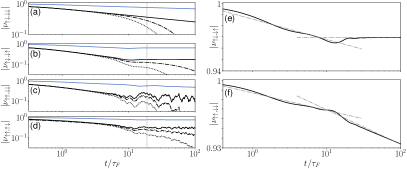
- $\nu_{\uparrow\uparrow,\uparrow\downarrow}$ 채널의 디코herence 함수는 저온에서 저주파수 진동수에 의한 결합으로 인해 느려지는 경향을 보이며, 이는 슈퍼 디코herence 효과를 나타낸다.
더 나은 연구,지금 바로 시작하세요
논문 읽기부터 검토까지, 연구 시간을 획기적으로 줄여보세요.
카드 등록 없음 · 무료 플랜 제공
이 리뷰는 AI가 만들고, 인간 에디터가 검토했습니다.