
[논문 리뷰] Towards a Modular Architecture for Science Factories
이 논문은 재구성 가능한 하드웨어 모듈, 조작기, 소프트웨어 워크플로우를 사용하여 인공지능과 고성능 컴퓨팅(HPC)이 통합된 자율적이고 AI 기반의 실험실인 과학 공장에 대한 모듈러 아키텍처를 제안한다. 이 시스템은 다양한 분야에서 확장 가능하고 재사용 가능하며 조합 가능한 과학적 실험을 가능하게 하며, 생물학 및 재료 과학 분야에서 15대의 로봇 시스템과 디지털 트윈 통합을 통해 다섯 가지 실제 응용 사례로 검증되었다.
Advances in robotic automation, high-performance computing (HPC), and artificial intelligence (AI) encourage us to conceive of science factories: large, general-purpose computation- and AI-enabled self-driving laboratories (SDLs) with the generality and scale needed both to tackle large discovery problems and to support thousands of scientists. Science factories require modular hardware and software that can be replicated for scale and (re)configured to support many applications. To this end, we propose a prototype modular science factory architecture in which reconfigurable modules encapsulating scientific instruments are linked with manipulators to form workcells, that can themselves be combined to form larger assemblages, and linked with distributed computing for simulation, AI model training and inference, and related tasks. Workflows that perform sets of actions on modules can be specified, and various applications, comprising workflows plus associated computational and data manipulation steps, can be run concurrently. We report on our experiences prototyping this architecture and applying it in experiments involving 15 different robotic apparatus, five applications (one in education, two in biology, two in materials), and a variety of workflows, across four laboratories. We describe the reuse of modules, workcells, and workflows in different applications, the migration of applications between workcells, and the use of digital twins, and suggest directions for future work aimed at yet more generality and scalability. Code and data are available at https://ad-sdl.github.io/wei2023 and in the Supplementary Information
연구 동기 및 목표
- 자율적 과학적 발견을 위한 일반적인 목적, 확장 가능하고 재구성 가능한 플랫폼의 부족을 보완하기 위해.
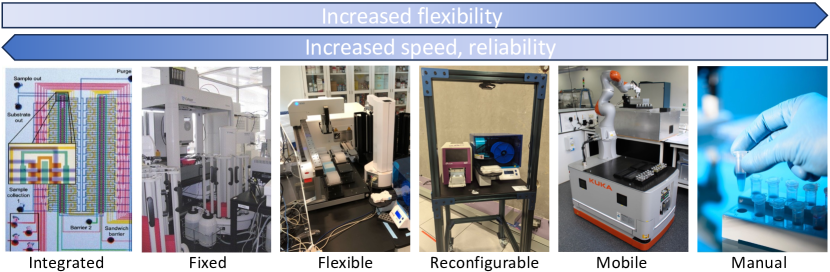
- 현재 자율 실험실이 일반적으로 유연하지 않고 이동성이 없으며 쉽게 확장되지 않는 한계를 극복하기 위해.
- 다양한 실험 분야에 걸쳐 대규모, 병렬적이고 프로그래밍 가능한 과학 워크플로우를 가능하게 하기 위해.
- 표준화된 인터페이스를 통해 물리적 모듈, 계산 자원, AI/ML 파ip라인 간의 상호운용성을 지원하기 위해.
- 다양한 실험실 구성에서 워크플로우의 재사용, 이관, 디지털 트윈 기반 시뮬레이션을 촉진하기 위해.
제안 방법
- 모듈러 과학 기기 간의 하드웨어-소프트웨어 상호작용을 표준화하기 위해 6기능 프로그래밍 인터페이스를 설계하기 위해.
- 모듈의 기계적 및 전기적 통합을 표준화하기 위해 '카트'라는 물리적 형상 요소를 도입하기 위해.
- 모듈과 조작기를 조합한 워크셀을 정의하여 모듈러이고 재구성 가능한 실험 단위를 가능하게 하기 위해.
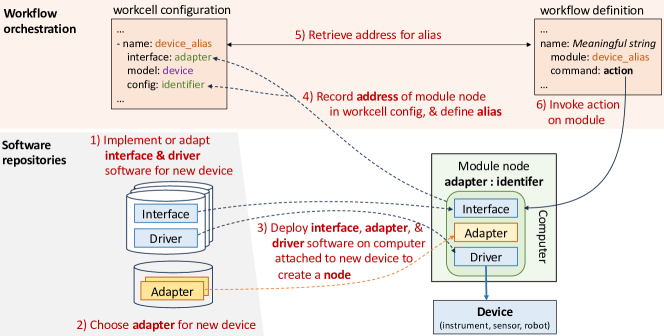
- 모듈 및 워크셀 구성 정보를 기록하기 위한 표기 체계를 개발하여 재현성과 조합 가능성을 보장하기 위해.
- 다양한 모듈 간 동작 시퀀스를 조율하기 위한 워크플로우 엔진을 구현하며, 동시 실행을 지원하기 위해.
- 물리적 실행 이전에 워크플로우를 시뮬레이션하고 검증하기 위해 디지털 트윈을 통합하여 신뢰성 향상과 시행착오 감소를 위해.
실험 결과
연구 질문
- RQ1모듈러 아키텍처는 다양한 과학 분야에서 자율적 과학 실험실의 확장 가능하고 재사용 가능한 구현을 어떻게 가능하게 하는가?
- RQ2표준화된 인터페이스와 형상 요소는 이질적인 로봇 기기의 상호운용성과 재구성 가능성을 어느 정도 지원할 수 있는가?
- RQ3통합적이고 조합 가능한 워크플로우 시스템 내에서 AI, 시뮬레이션, 물리적 실험의 통합은 얼마나 효과적인가?
- RQ4디지털 트윈과 워크셀 간 워크플로우 이관은 실험 효율성 향상과 개발 시간 단축에 어떤 영향을 미치는가?
- RQ5다양한 실험실과 응용 분야에 모듈러 과학 공장을 구현할 때의 실질적 과제와 이점은 무엇인가?
주요 결과
- 모듈러 아키텍처는 네 개의 실험실에서 두 개의 생물학, 두 개의 재료 과학, 그리고 한 개의 교육 분야에 걸쳐 다섯 가지의 별도된 과학 응용 사례를 성공적으로 지원하였다.
- 15종의 다양한 로봇 장치가 시스템에 통합되어 하드웨어 호환성과 재구성 가능성의 광범위한 범위를 입증하였다.
- 워크플로우와 응용 프로그램이 서로 다른 워크셀 간에 성공적으로 재사용되고 이관되었으며, 아키텍처의 조합 가능성을 검증하였다.
- 디지털 트윈을 통해 물리적 실행 이전에 워크플로우를 시뮬레이션하고 검증할 수 있었으며, 실험 리스크와 반복 시간을 감소시켰다.
- 시스템은 다수의 응용 프로그램을 동시에 실행하는 것을 보여주었으며, AI 모델 학습, 추론, HPC 기반 시뮬레이션의 완전한 통합을 달성하였다.
- 공개된 코드 및 데이터 저장소가 구축되었으며, 재현 가능성을 위해 태그된 릴리스를 포함하고 있으며, 핵심 워크플로우 실행 소프트웨어는 https://github.com/AD-SDL/rpl_wei 에서 이용 가능하다.
더 나은 연구,지금 바로 시작하세요
논문 읽기부터 검토까지, 연구 시간을 획기적으로 줄여보세요.
카드 등록 없음 · 무료 플랜 제공
이 리뷰는 AI가 만들고, 인간 에디터가 검토했습니다.