
[논문 리뷰] Towards quantum-enabled cell-centric therapeutics
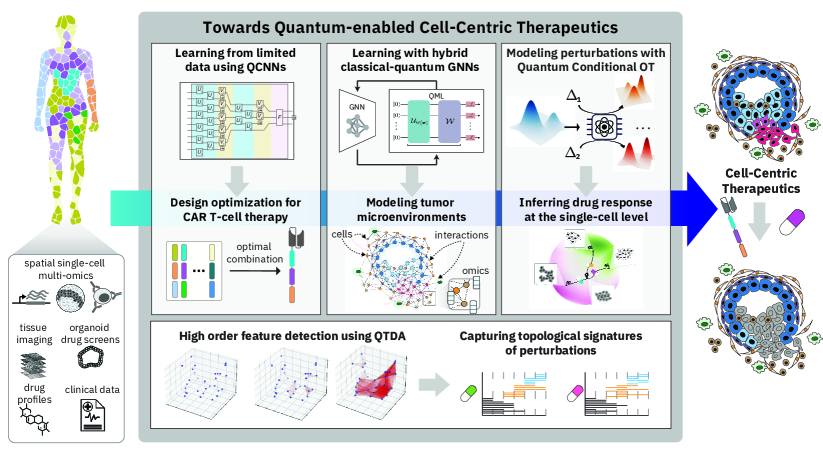
본 논문은 양자 컴퓨팅을 활용해, 양자 기계학습 및 최적화를 포함하여, 건강 관리 및 생명 과학 분야의 세포 중심 치료를 발전시킬 것을 구상하고 있으며, HCLS에서 양자 기반 연구의 잠재적 영역, 도구, 해결해야 할 문제들을 개략적으로 제시한다.
In recent years, there has been tremendous progress in the development of quantum computing hardware, algorithms and services leading to the expectation that in the near future quantum computers will be capable of performing simulations for natural science applications, operations research, and machine learning at scales mostly inaccessible to classical computers. Whereas the impact of quantum computing has already started to be recognized in fields such as cryptanalysis, natural science simulations, and optimization among others, very little is known about the full potential of quantum computing simulations and machine learning in the realm of healthcare and life science (HCLS). Herein, we discuss the transformational changes we expect from the use of quantum computation for HCLS research, more specifically in the field of cell-centric therapeutics. Moreover, we identify and elaborate open problems in cell engineering, tissue modeling, perturbation modeling, and bio-topology while discussing candidate quantum algorithms for research on these topics and their potential advantages over classical computational approaches.
연구 동기 및 목표
- 암호학과 화학을 넘어 HCLS에서 양자 컴퓨팅의 잠재력을 고무한다.
- 양자 방법이 고전적 접근법보다 이점을 제공할 수 있는 세포 중심 치료 분야를 식별한다.
- HCLS 응용에 관련된 현재의 양자 하드웨어, 소프트웨어 도구, 알고리즘을 조사한다.
- 단일 세포 및 공간-오믹스 데이터와 양자 기반 워크플로를 통합하여 치료를 설계하는 비전을 제안한다.
- 양자 응용을 위한 세포 공학, 조직 모델링, 섭동 모델링 및 생물 토폴로지의 해결되지 않은 문제를 강조한다.
제안 방법
- 양자 하드웨어(퀘비트, 오차 완화, 회로 분할)의 최근 발전과 이것이 HCLS 워크플로에 주는 시사점을 논의한다.
- 양자 도구 모음 및 서비스(예: Qiskit Runtime) 개요와 이들이 HCLS 작업을 위한 클라우드 기반 양자 계산을 어떻게 가능하게 하는지 설명한다.
- HCLS와 관련된 양자 알고리즘을 검토한다. 여기에는 양자 시뮬레이션(VQE, QSE, qEOM), 양자 최적화(QAOA, quantum Monte Carlo), 양자 기계 학습(QSVM, QNNs)이 포함된다.
- 양자 데이터 과학 기법을 예로 들어 양자 토폴로지 데이터 분석, 누적량 계산, 양자 네트워크 의학을 세포 중심 치료 패러다임의 구성 요소로 설명한다.
- 단일 세포 및 공간 기술을 활용해 세포 대사와 역학을 지도화하여 치료 설계를 위한 양자 기반 세포 중심 치료의 개념적 프레임워크를 제안한다.
- 근시점의 양자 컴퓨팅과 내결함 양자 컴퓨팅의 고려사항 및 대규모에서 타당한 문제를 식별하기 위한 도메인 전문가의 협력 필요성을 논의한다.
![Figure 1: Quantum computing state-of-the-art. A : Reproduced with permission from [ 63 ] . Different levels of metrics to express the quality of quantum hardware. Along with number of qubits, quantum gate quality is an important quality metric. This is typically expressed in terms of Quantum Volume](https://ar5iv.labs.arxiv.org/html/2307.05734/assets/x1.png)
실험 결과
연구 질문
- RQ1세포 중심 치료 설계에 가장 유망한 양자 기반 접근법은 무엇인가?
- RQ2양자 기계학습과 최적화가 치료 발견을 위한 단일 세포 및 공간 오믹스 데이터 분석을 어떻게 향상시킬 수 있는가?
- RQ3양자 알고리즘으로 다룰 수 있는 세포 공학, 조직 모델링, 섭동 모델링, 생물 토폴로지의 열린 문제는 무엇인가?
- RQ4HCLS 응용에서 실용적인 양자 이점을 실현하기 위해 필요한 하드웨어/소프트웨어 개발은 무엇인가?
- RQ5양자 네트워크 의학 개념을 세포 중심 치료 워크플로에 어떻게 통합할 수 있는가?
주요 결과
- 양자 하드웨어 및 소프트웨어의 발전은 HCLS 작업을 위한 의미 있는 양자 계산 실행의 가능성을 확장하고 있다.
- 오류 완화 및 회로 분할이 적용된 근시점 양자 장치는 초기 장치보다 더 큰 문제를 다룰 수 있어, 의료 맥락에서 조기 양자 기반 실험을 가능하게 한다.
- 양자 알고리즘(시뮬레이션, 최적화, ML)과 도구 모음(예: Qiskit Runtime)은 약물 설계, 생물표지자 발견, 조직 모델링에서 고전적 접근을 보완하기 위한 위치에 있다.
- 양자 TDA, 누적량, 재설명, 네트워크 의학과 같은 양자 데이터 과학 개념은 복잡한 다중 오믹스 데이터에서 패턴을 추출하는 새로운 방법을 제공한다.
- 본 논문은 양자 기반 세포 중심 치료의 비전과 로드맵을 제시하며, 생물학에서 영감을 받은 양자 알고리즘을 공동 창출하기 위해 양자 연구자와 HCLS 연구자 간의 협력을 촉구한다.
더 나은 연구,지금 바로 시작하세요
연구 설계부터 논문 작성까지, 연구 시간을 획기적으로 줄여보세요.
카드 등록 없음 · 무료 플랜 제공
이 리뷰는 AI가 만들고, 인간 에디터가 검토했습니다.