
[논문 리뷰] Traveling Waves Encode the Recent Past and Enhance Sequence Learning
논문은 Wave-RNN (wRNN)을 소개하며, 숨겨진 상태가 최근 과거를 인코딩하는 traveling waves를 지원하는 최소한의 RNN 모델로서 wave-free RNN들보다 더 빠른 학습과 긴 시퀀스 작업에서 더 나은 성능을 제공하며 LSTMs/GRUs와도 경쟁력이 있음을 보여준다. 합성 메모리 작업과 순차 이미지 분류 벤치마크에서 wave의 이점을 검증한다.
Traveling waves of neural activity have been observed throughout the brain at a diversity of regions and scales; however, their precise computational role is still debated. One physically inspired hypothesis suggests that the cortical sheet may act like a wave-propagating system capable of invertibly storing a short-term memory of sequential stimuli through induced waves traveling across the cortical surface, and indeed many experimental results from neuroscience correlate wave activity with memory tasks. To date, however, the computational implications of this idea have remained hypothetical due to the lack of a simple recurrent neural network architecture capable of exhibiting such waves. In this work, we introduce a model to fill this gap, which we denote the Wave-RNN (wRNN), and demonstrate how such an architecture indeed efficiently encodes the recent past through a suite of synthetic memory tasks where wRNNs learn faster and reach significantly lower error than wave-free counterparts. We further explore the implications of this memory storage system on more complex sequence modeling tasks such as sequential image classification and find that wave-based models not only again outperform comparable wave-free RNNs while using significantly fewer parameters, but additionally perform comparably to more complex gated architectures such as LSTMs and GRUs.
연구 동기 및 목표
- travelling waves가 wave-field memory에서 최근 연속 정보를 저장할 수 있다는 가설을 동기화하고 검증한다.
- 숨겨진 상태에서 traveling waves를 자연스럽게 나타내는 최소한의 RNN 아키텍처를 개발한다.
- 합성 태스크 및 표준 긴 시퀀스 벤치마크에서 wave dynamics의 기억 및 시퀀스 학습 이점을 Demonstrate한다.
제안 방법
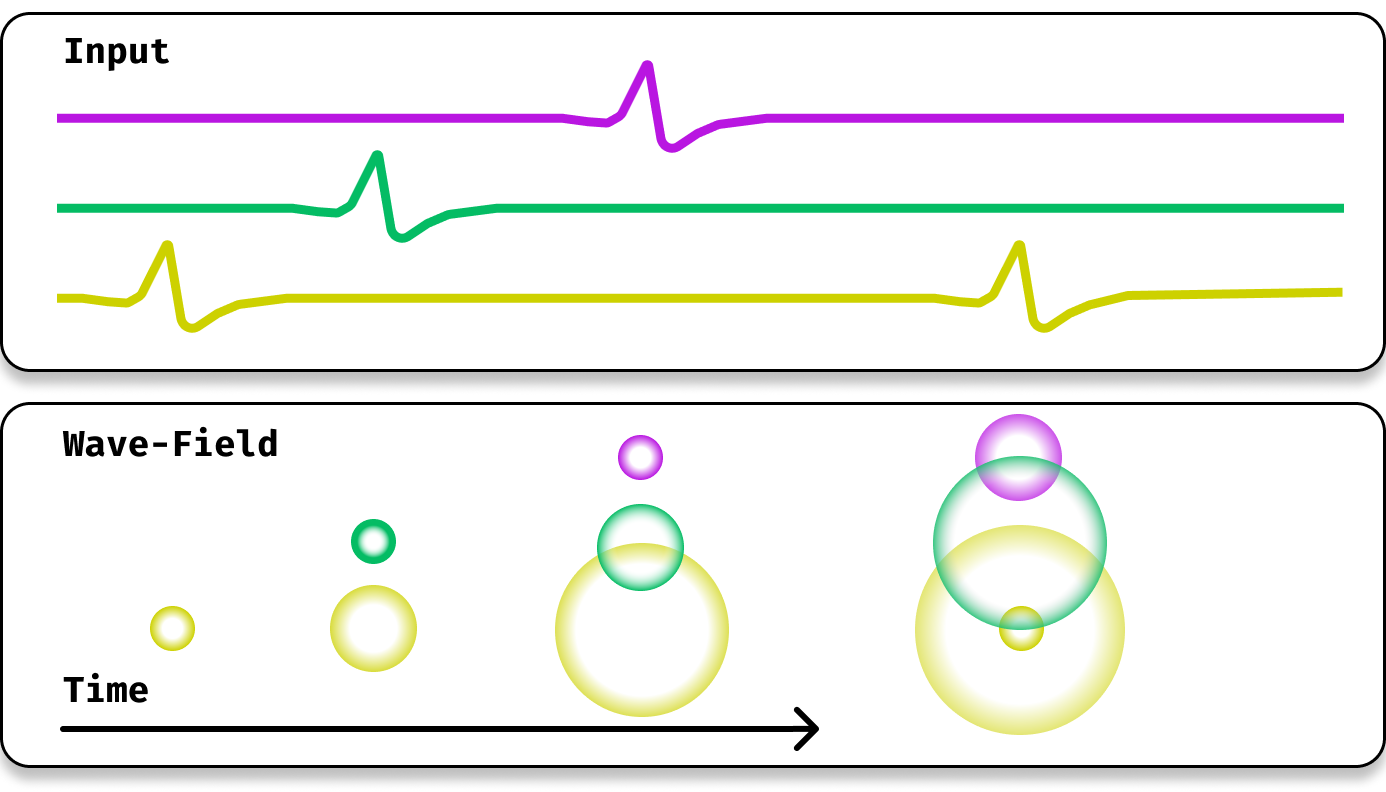
- Wave-RNN (wRNN)을 원형 숨겨진 상태 배치를 이용한 1차원 이산 wave 방정식으로 recurrence를 정의한다.
- 숨겨진 채널들 사이에서 traveling waves를 생성하기 위해 shift(Sigma)을 모방하는 합성 합성 연산자 (u)를 사용한다.
- ReLU 활성화, 채널화된 숨겨진 상태, 그리고 구체적인 초기화: u-shift를 Toeplitz/shift 정렬과 V의 희소 항등 초기화를 통해 wave-driven memory를 가능하게 한다.
- traveling waves의 효과를 고립시키기 위해 최소한의 wave dynamics를 가진 iRNN 기준선과 비교한다.
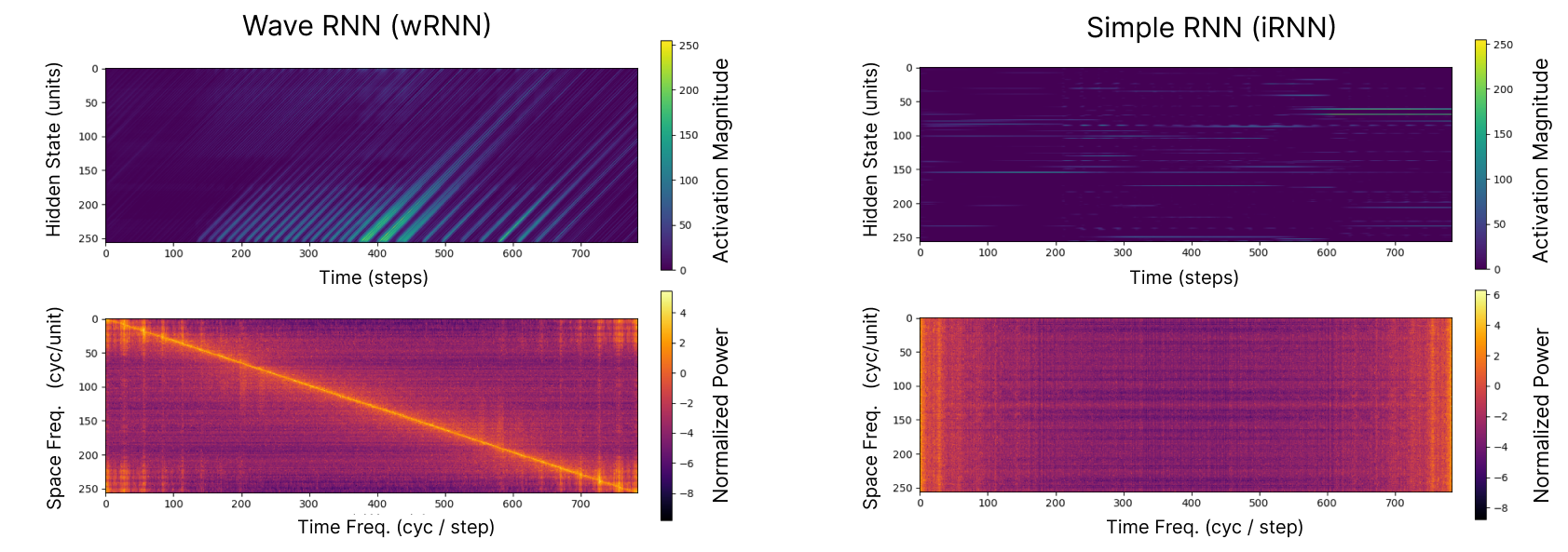
- 숨겨진 활성화의 2D 푸리에 변환을 통해 traveling-wave 구조를 검증하고 wave의 등장 여부를 분석한다.
실험 결과
연구 질문
- RQ1최소한의 RNN에서 traveling-wave dynamics가 wave-free 순환 구조보다 최근 과거를 더 효과적으로 인코딩할 수 있는가?
- RQ2wave 기반 모델이 합성 메모리 테스트보다 더 긴 시퀀스와 더 복잡한 작업으로 일반화하는가?
- RQ3Wave-RNN은 긴 시퀀스 벤치마크에서 표준 게이트 아키텍처(LSTM/GRU)와 어떻게 비교되는가?
- RQ4강건한 파동 전파를 가능하게 하는 필수 아키텍처 구성요소(합성 순환, 초기화)는 무엇인가?
주요 결과
- Wave-RNNs는 Copy 과제에서 시퀀스 길이 T에서 매칭된 wave-free 기준선보다 손실을 5개 이상 줄이는 경향을 보인다(예: {0,30,80}에서).
- Long Sequence Addition 과제에서 wRNN은 수렴 속도가 빠르고 iRNN보다 더 긴 시퀀스(최대 1000 단계)를 해결한다.
- 순차 이미지 작업(sMNIST, psMNIST, nsCIFAR10)에서 wRNN은 학습 속도가 빠르고 wave-free 모델보다 우수하며 LSTM/GRU 및 다른 게이트 아키텍처에 대해 경쟁력 있거나 우수한 정확도를 보인다.
- U-Shift 초기화가 장거리 파동 기억을 가능하게 하는 데 가장 큰 영향을 미치고, V 초기화는 주로 수렴 속도를 높인다.
- 시각화 결과는 wRNN의 숨겨진 상태에서 traveling-wave 패턴이 확인되며 iRNN 기준선에서는 발견되지 않는다.
더 나은 연구,지금 바로 시작하세요
연구 설계부터 논문 작성까지, 연구 시간을 획기적으로 줄여보세요.
카드 등록 없음 · 무료 플랜 제공
이 리뷰는 AI가 만들고, 인간 에디터가 검토했습니다.