
[논문 리뷰] TuRMoiL of Survival: A Unified Survival Criterion for Cloud-Wind Interactions
이 논문은 뜨거운 초음속 바람 속의 클라우드에 대한 새로운 통합 생존 기준을 제안한다. 이 기준은 뜨거운 바람 유체 요소가 클라우드를 횡단하는 데 걸리는 난류 시간스케일과 혼합 기체의 최대 냉각 시간스케일을 비교하여 기반을 두고 있다. 이 기준은 물리적으로 일관된 시간스케일을 사용함으로써 이전 모델에서 오랫동안 지속된 모순을 해결하며, 고풍/클라우드 밀도 대비가 큰 유체역학 시뮬레이션에서 클라우드 생존을 정확히 예측한다.
Cloud-wind interactions play an important role in long-lived multiphase flows in many astrophysical contexts. When this interaction is primarily mediated by hydrodynamics and radiative cooling, the survival of clouds can be phrased in terms of the comparison between a timescale that dictates the evolution of the cloud-wind interaction, (the dynamical time-scale $τ_{ m dyn}$) and the relevant cooling timescale $τ_{ m cool}$. Previously proposed survival criteria, which can disagree by large factors about the size of the smallest surviving clouds, differ in both their choice of $τ_{ m cool}$ and (to a lesser extent) $τ_{ m dyn}$. Here we present a new criterion which agrees with a previously proposed empirical formulae but is based on simple physical principles. The key insight is that clouds can grow if they are able to mix and cool gas from the hot wind faster than it advects by the cloud. Whereas prior criteria associate $τ_{ m dyn}$ with the cloud crushing timescale, our new criterion links it to the characteristic cloud-crossing timescale of a hot-phase fluid element, making it more physically consistent with shear-layer studies. We develop this insight into a predictive expression and validate it with hydrodynamic ENZO-E simulations of ${\sim}10^4\, { m K}$, pressure-confined clouds in hot supersonic winds, exploring, in particular, high wind/cloud density contrasts, where disagreements are most pronounced. Finally, we illustrate how discrepancies among previous criteria primarily emerged due to different choices of simulation conditions and cooling properties, and discuss how they can be reconciled.
연구 동기 및 목표
- 압력으로 둘러싸인 클라우드가 뜨거운 초음속 바람에서 생존 기준에 오랫동안 지속된 논란을 해결하기 위해.
- 클라우드-바람 상호작용에 대한 물리적으로 타당한 동역학적 시간스케일을 규명하여 이전에 사용된 클라우드 압축 시간스케일 대신 클라우드 횡단 시간스케일을 도입하기 위해.
- turbulent 방사 혼합층(TRML)의 유입과 계면에 따른 상별 냉각에 물리적으로 일관된 냉각 시간스케일을 정의하기 위해.
- 고밀도 대비 조건에서 enzo-e 유체역학 시뮬레이션을 대상으로 새로운 기준을 검증하기 위해.
- 기존 기준 간의 모순을 시뮬레이션 조건과 냉각 규정의 차이로 추적하여 이를 해소하기 위해.
제안 방법
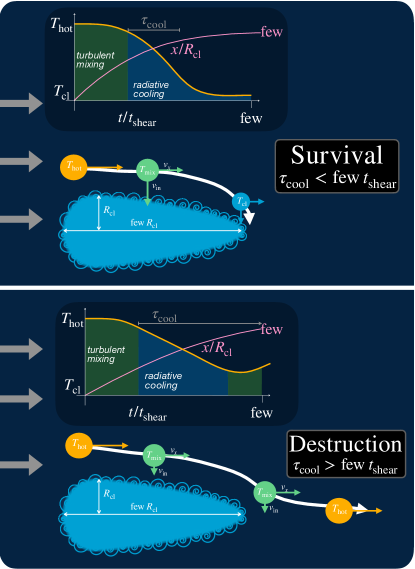
- 뜨거운 바람 유체 요소가 클라우드를 횡단하는 데 걸리는 시간스케일인 $ t_{\rm shear} $와 혼합 기체의 최대 냉각 시간스케일 $ t_{\rm cool,max} $를 비교하여 새로운 생존 기준을 제안한다.
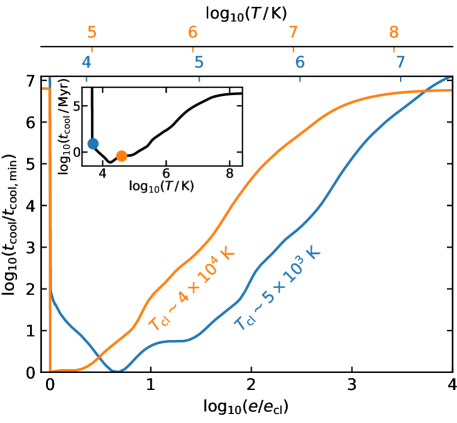
- $ t_{\rm cool,max} $를 클라우드 온도 $ T_{\rm cl} $와 혼합층에서 도달하는 최소 온도 $ T_{\rm min,cool} $ 사이의 냉각 시간스케일의 최댓값으로 정의한다.
- 이전 연구에서 사용된 클라우드 압축 시간스케일 대신, 난류층 동역학에서 유도된 물리적으로 타당한 $ \tau_{\rm dyn} $ 를 사용한다.
- 밀도 대비 $ \chi \sim 10^4 $ 인 $ \sim 10^4 \, \text{K} $ 정도의 압력으로 둘러싸인 클라우드에 대해 고해상도 enzo-e 시뮬레이션을 사용하여 기준을 검증한다.
- 혼합층에서의 현실적인 냉각을 모의하기 위해 $ T_{\rm min,cool} = \max(T_{\rm cl}, \, 10^{4.25} \, \text{K}) $ 에서 최소값을 가지는 상별 냉각 함수를 적용한다.
- 새로운 기준을 이전의 경험적 및 이론적 생존 기준과 비교하여, 관측된 시뮬레이션 결과와의 일치를 보이며 기존의 모순을 해결한다.
실험 결과
연구 질문
- RQ1난류 방사 혼합층에서 클라우드-바람 상호작용에 대한 물리적으로 타당한 동역학적 시간스케일은 무엇인가?
- RQ2다상 유동에서 클라우드 생존을 정확히 예측하기 위해 냉각 시간스케일은 어떻게 정의되어야 하는가?
- RQ3왜 이전의 생존 기준들이 최소 생존 클라우드 크기에 대해 예측에서 크게 다름을 보이는가?
- RQ4단일의 물리적으로 타당한 기준이 경험적으로 校정된 생존 기준의 정확성과 동일하게 재현할 수 있는가?
- RQ5시뮬레이션 설정과 냉각 규정의 차이가 기존 생존 기준 간의 모순을 어떻게 설명하는가?
주요 결과
- 새로운 기준, 즉 $ t_{\rm shear} \gtrsim t_{\rm cool,max} $ 를 기반으로, 고풍/클라우드 밀도 대비($ \chi \sim 10^4 $) 조건에서 enzo-e 시뮬레이션에서 클라우드 생존을 정확히 예측한다.
- 기존 연구 간의 모순은 물리적 차이가 아니라 $ \tau_{\rm dyn} $ 와 $ \tau_{\rm cool} $ 의 일관되지 않은 선택에서 비롯됨을 보여주며, 이 기준이 이를 해결한다.
- 뜨거운 상 유체 요소의 횡단에 기반한 난류 시간스케일 $ t_{\rm shear} $ 는 클라우드 압축 시간스케일보다 난류층 연구와 더 물리적으로 일관된다.
- $ T_{\rm cl} $ 와 $ T_{\rm min,cool} $ 사이에서 평가된 최대 냉각 시간스케일 $ t_{\rm cool,max} $ 는 강력하고 물리적으로 타당한 냉각 시간스케일을 제공한다.
- 이 기준은 $ T_{\rm cl} \gtrsim 10^4 \, \text{K} $ 와 같은 극한 조건에서도 잘 작동하며, 이전 기준이 실패하거나 물리적으로 비현실적인 클라우드 크기를 요구하는 영역에서도 성능이 뛰어나다.
- Farber & Gronke (2022)의 냉각 클라우드($ \sim 10^3 \, \text{K} $) 연구 결과와도 일치하므로, 은하폭발 유출에서의 냉각 상에 대한 광범위한 적용 가능성을 시사한다.
더 나은 연구,지금 바로 시작하세요
논문 읽기부터 검토까지, 연구 시간을 획기적으로 줄여보세요.
카드 등록 없음 · 무료 플랜 제공
이 리뷰는 AI가 만들고, 인간 에디터가 검토했습니다.