
[논문 리뷰] Ultrashort dissipative Raman solitons in Kerr resonators driven with phase-coherent optical pulses
이 논문은 표준 통신 섬유 킬러 공진기에서 위상일관성 있는 펄스 주입을 통해 초단파 소산성 라만 솔리톤을 결정론적으로 생성함으로써, 100 fs 이내의 펄스 지속시간을 달성한다. 퓌즈 실리카 내 임베디드된 라만 증폭을 활용하고 정밀한 분산 제어를 통해 저잡음, 고성능의 솔리톤 생성을 실현하였으며, 반복 주파수는 GHz 이하로 유지하면서도 기록적인 짧은 펄스를 확보하였다. 이는 확장 가능하고 칩 친화적인 주파수 콤을 실현하며, 라인 간격을 사용자 정의할 수 있다.
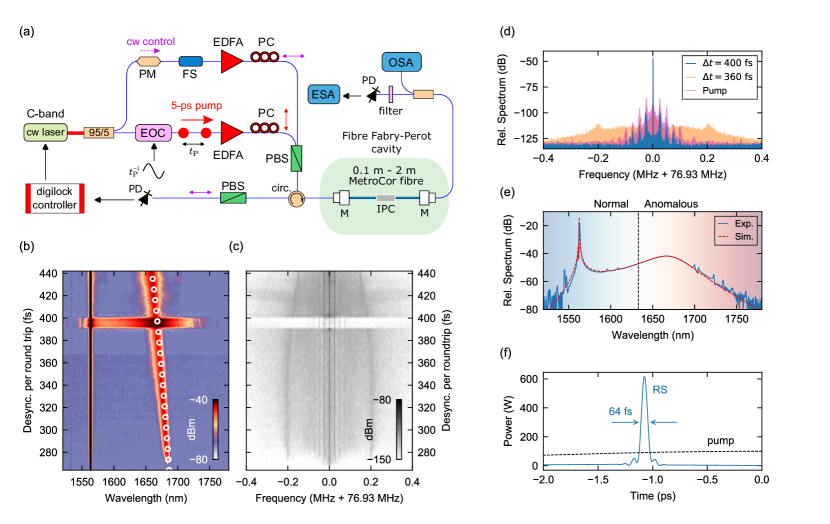
External driving of passive, nonlinear optical resonators has emerged over the past decade as a novel route for the generation of ultrashort optical pulses and corresponding broadband frequency combs. Whilst the pulse formation dynamics in such systems differ dramatically from those manifesting themselves in conventional mode-locked lasers, the demarcation between the two traditionally distinct paradigms has recently begun to blur, with demonstrations of hybrid systems incorporating both external driving and active media shown to offer specific advantages. Here we explore a new pathway for ultrashort pulse generation at the interface of externally-driven passive resonators and lasers. By leveraging the nonlinear Raman gain inherent to fused silica, we achieve deterministic generation of low-noise dissipative solitons with durations well below 100 fs via phase-coherent pulsed driving of resonators made of standard, commercially-available optical fibre. We explore and explain the physics of the new dissipative Raman soliton states, identifying scaling laws that govern the pulses' characteristics and that allow output repetition rates to be scaled at will without influencing the soliton duration. The scheme explored in our work enables the shortest ever pulses generated in resonators (active or passive) made from a single commercially-available optical fibre, and it has the potential to be transferred into a chip-scale format by using existing dispersion-engineered silica microresonators.
연구 동기 및 목표
- 수동 킬러 공진기에서 초단파 펄스 지속시간과 저반복 주파수 사이의 근본적 상충관계를 극복하기 위해.
- 융합 실리카 내 임베디드된 라만 증폭을 활용하여 외부 증폭 매체 없이 결정론적, 저잡음 솔리톤 형성을 가능하게 하기 위해.
- 스케일링 법칙을 통해 솔리톤 지속시간이 반복 주파수와 분리됨을 보여주어 융통성 있는 주파수 콤 설계를 가능하게 하기 위해.
- 분산 설계된 실리카 마이크로공진기를 활용한 칩 수준 통합의 길을 마련하기 위해.
- 외부 주입 수동 공진기와 전통적인 모드-록킹 레이저 사이의 격차를 메우기 위해 하이브리드 라만-소산성 솔리톤 메커니즘을 도입하기 위해.
제안 방법
- 표준 단모드 섬유 공진기의 라운드트립 시간에 맞춰 위상일관성 있는 펄스 주입을 사용하여 소산성 솔리톤을 자극하였다.
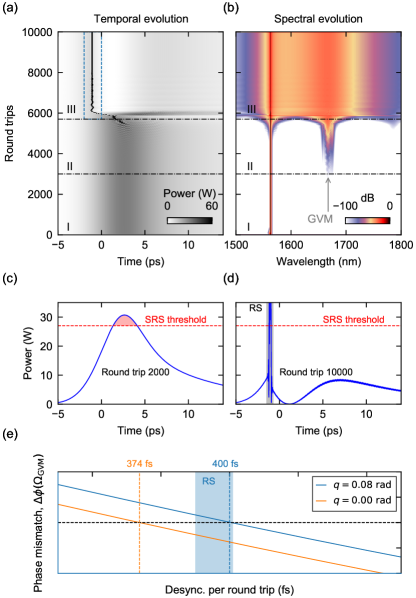
- 외부 증폭 매체 없이도 비선형 증폭을 가능하게 하는 융합 실리카 내 내재된 강력한 라만 스토킹 산란(SRS) 증폭을 활용하였다.
- 공진기의 분산을 설계하여 군속도 일치를 달성하고 안정적인 위상일관성 솔리톤 작동을 가능하게 하였다.
- 솔리톤 동역학을 모델링하기 위해 차원 없는 형태의 일반화된 루지아토-레프레버 방정식(GLE)을 사용하였으며, 주요 매개변수로는 탈조화도 $d_1$, 정규화된 시간 스케일 $ au_s$, 그리고 삼차 분산 $d_3$ 가 포함되었다.
- 수치 시뮬레이션을 통해 솔리톤 특성은 주로 $ au_s$ 와 $ au_R$ (라만 응답 시간 스케일)에 의존하며, 탈조화도나 주입 진폭에는 영향을 받지 않는다는 것을 확인하였다.
- 실험 결과를 시뮬레이션과 비교하여 결정론적 솔리톤 형성과 펄스 지속시간의 스케일링을 확인하였다.
실험 결과
연구 질문
- RQ1융합 실리카 내 내재된 라만 증폭이 외부 증폭 매체 없이도 표준 섬유 공진기에서 초단파 소산성 솔리톤을 생성하는 데 기여할 수 있는가?
- RQ2기존의 동기화 주입 라만 오실레이터와 비교해 위상일관성 있는 펄스 주입이 솔리톤의 위상 일관성과 지속시간에 어떤 영향을 미치는가?
- RQ3분산 제어와 주입 타이밍 제어를 통해 솔리톤 지속시간을 반복 주파수에서 얼마나 분리시킬 수 있는가?
- RQ4이 시스템에서 라만 솔리톤의 펄스 지속시간과 안정성에 영향을 주는 스케일링 법칙은 무엇인가?
- RQ5이 메커니즘은 분산 설계된 칩형 마이크로공진기로 이식되어 통합 주파수 콤 응용에 활용될 수 있는가?
주요 결과
- 저자들은 표준 통신 섬유 공진기에서 전고도 반폭(FWHM) 펄스 지속시간이 100 fs 이내인 소산성 라만 솔리톤을 달성하였으며, 이는 이러한 시스템에서 기록적으로 가장 짧은 펄스 지속시간이다.
- 반복 주파수와 독립적인 펄스 지속시간이 입증되었으며, 스케일링 법칙을 통해 솔리톤 특성은 $ au_s$ 와 $ au_R$ 에만 의존함을 보여주어 반복 주파수를 자유롭게 조절하면서도 펄스 폭을 유지할 수 있다.
- 위상일관성 주입과 군속도 일치 덕분에 결정론적, 고정밀도 솔리톤 형성이 이루어졌으며, 이는 이전의 라만 오실레이터 설계에서 흔히 볼 수 있었던 저위상 일관성과 넓은 펄스 지속시간 문제를 해결하였다.
- 시뮬레이션 결과, 라만 응답 함수 $ ilde{ au}_R$ 과 정규화된 시간 스케일 $ au_s$ 가 솔리톤 폭과 안정성에 가장 큰 영향을 미치는 주요 매개변수임을 확인하였다.
- 기본 물리 법칙과 스케일링 법칙이 분산 설계된 통합 플랫폼과 호환되므로, 이 방법은 칩 수준의 실리카 마이크로공진기로도 확장 가능하다.
- 이 방법은 서브-GHz 수준의 미세한 라인 간격을 가진 넓은 대역 주파수 콤을 생성할 수 있으며, 双-콤 분광학 등 응용에 적합할 뿐 아니라 초단파 펄스 특성도 유지한다.
더 나은 연구,지금 바로 시작하세요
논문 읽기부터 검토까지, 연구 시간을 획기적으로 줄여보세요.
카드 등록 없음 · 무료 플랜 제공
이 리뷰는 AI가 만들고, 인간 에디터가 검토했습니다.