
[논문 리뷰] Ultraviolet Compactness of High-Redshift Galaxies as a Tracer of Early-Stage Gas Infall, Bursty Star Formation, and Offset from the Fundamental Metallicity Relation
본 연구는 JWST NIRSpec/NIRCam 데이터를 이용해 컴팩트함이 로컬 FMR에서의 금속오프셋과 어떤 관계가 있는지 z>3 은하에서 조사하고, 약간의 FMR 진화를 발견하며 컴팩트함과 금속 결핍 사이의 연결고리가 확률적이고 내부-밖으로의 초기별 형성을 뒷받침한다.
The empirical anti-correlation between gas-phase metallicity and star formation rate (SFR) at a fixed stellar mass, known as the fundamental metallicity relation (FMR), is commonly interpreted as an equilibrium state in the interplay between gas infall, enrichment, and gas removal. JWST/NIRSpec spectroscopy has shown a $z>3$ deviation from the local-universe FMR calibrations, suggesting that these galaxies are potentially caught out of equilibrium. To investigate this, we inferred the stellar population, nebular, and morphological properties of 427 galaxies at $310^9M_{\odot}$ galaxies exhibit negligible redshift evolution. We also confirm the redshift evolution of the FMR: $z>3$ galaxies appear metal-deficient compared to expectations for their stellar mass and SFR according to the local-universe FMR. This offset grows with redshift. Metal deficiency is correlated with compactness: galaxies most offset from the average mass-size relation are also the most metal-poor for their stellar mass and SFR. We interpret this as a product of bursty star formation: compact galaxies exhibit elevated SFR surface densities, indicating that they are observed during burst episodes triggered by gas infall. While accretion of metal-poor gas has reduced their gas-phase metallicity by diluting the interstellar medium, they are observed prior to chemical yield release by newly formed massive stars. Simply, they are chemically out of equilibrium compared to the equilibrium state known as the FMR.
연구 동기 및 목표
- z≈3를 넘는 적색편이에서 질량-금속성 관계의 진화를 설명하고 고적색에서 기본 금속성 관계(FMR)의 적용 가능성을 검증한다.
- 더 컴팩트한 고적색 은하가 금속 결핍이 더 크고 로컬 FMR 기준점에서 벗어나 있는지 조사한다.
- rest-UV 크기를 측정하고 z>4 은하의 질량-크기 관계를 측정하며 적색편이에 따른 진화를 평가한다.
- 컴팩트함이 FMR 오프셋과 상관관계가 있는지 평가하여 초기 단계의 가스 흡입 및 확률적(무작위) 별형성 모드를 추론한다.
제안 방법
- 공개 프로그램에서 334개 + JADES에서 93개를 포함하여 NIRSpec 프리즘 분광 및 NIRCam 광도 측정을 모두 갖춘 427개 z>3 은하의 샘플을 구성한다.
- 샘플 간 일관성을 보장하기 위해 WebbPSF PSF를 사용한 galight로 rest-UV 크기를 측정한다.
- SED 적합(prospector/FSPS) 및 발광선 분석(pPXF with MILES library)을 통해 스텔러 질량, SFR, 금속성도를 추정한다.
- EW(Hβ)를 ISM 이온화의 프록시로 삼아 R23와 O32 진단을 사용하여 가스상 금속성을 도출하고 금속성 중복 문제를 해소한다.
- Andrews & Martini (2013)의 보정을 Chabrier IMF으로 번역한 것을 사용하여 Nakajima et al. 2023를 통해 예측된 금속성으로 질량과 SFR에서 FMR의 적색편진화를 평가한다.
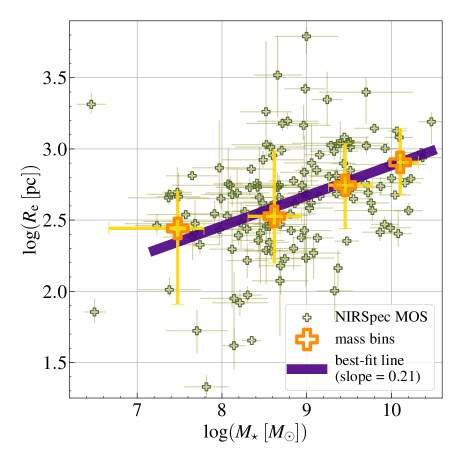
- κ log(M*) − log(Re)로 은하의 컴팩트함을 정량화하며, 발견된 질량-크기 기울기(0.21)로 κ를 고정한다.
실험 결과
연구 질문
- RQ1z>4에서 기본 금속성 관계가 약하게 진화하는가, 그리고 고적색의 금속성은 FMR 예측과 어떻게 비교되는가?
- RQ2z>3에서 은하의 컴팩트함과 가스상 금속성도 사이에 견고한 음의 상관이 있는가, 초기 단계의 가스 흡입을 시사하는가?
- RQ3z=4–10 은하에 대한 질량-크기 관계의 적색편이 진화는 어떠하며 이 진화는 어떤 질량에 의존하는가?
- RQ4컴팩트하고 저금속성의 고SFR 시스템은 가장 이른 은하들에 대해 내부-에서 밖으로 진행되는 확률적 star-formation 시나리오를 지지하는가?
주요 결과
- 로컬 FMR 보정을 사용할 때 z>3 은하의 기본 금속성 관계 오프셋에 약한 적색편이 진화가 있다.
- z=4–10에서 질량-크기 관계의 최적 적합 거듭제곱 법칙 기울기는 0.21 ± 0.04이다.
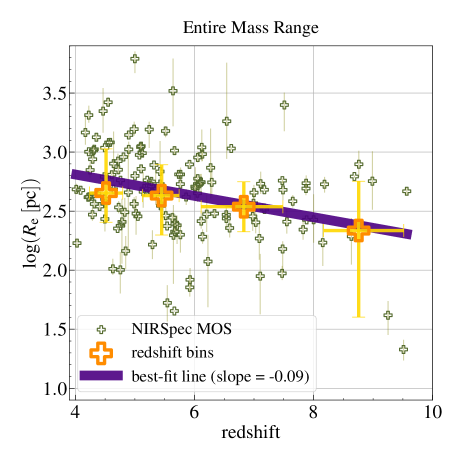
- 고정된 질량에서 은하들은 더 높은 적색편에서 더 컴팩트해지며, 크기-적색편 관계 기울기는 −0.090 ± 0.02이다.
- 고정된 질량에서 더 컴팩트한 은하일수록 금속결핍이 크고 로컬 FMR 보정에서 더 벗어나며, FMR-오프셋 대 컴팩트함의 직선 경향을 보이며 기울기 −0.35 ± 0.11, 절편 −0.56 ± 0.09.
- 분석은 초기 은하들에 대해 내부-에서 시작해 버스트형 별생성으로 중심으로의 빠른 축적이 컴팩트하고 저금속 코어를 유도하는 내부-밖으로의 버스트형 star-formation 관점을 지지한다.
더 나은 연구,지금 바로 시작하세요
연구 설계부터 논문 작성까지, 연구 시간을 획기적으로 줄여보세요.
카드 등록 없음 · 무료 플랜 제공
이 리뷰는 AI가 만들고, 인간 에디터가 검토했습니다.