
[논문 리뷰] Unraveling a cavity induced molecular polarization mechanism from collective vibrational strong coupling
이 논문은 집단 진동 강결합이 열역학적 분자 집합에서 자체 일관된 cavity-Hartree 상호작용을 통해 상당한 국소 전자 극화를 유도할 수 있으며, 이는 극화 글래스와 같은 국소 구조와 핫스팟으로 이어진다.
We demonstrate that collective vibrational strong coupling of molecules in thermal equilibrium can give rise to significant local electronic polarizations in the thermodynamic limit. We do so by first showing that the full non-relativistic Pauli-Fierz problem of an ensemble of strongly-coupled molecules in the dilute-gas limit reduces in the cavity Born-Oppenheimer approximation to a cavity-Hartree equation for the electronic structure. Consequently, each individual molecule experiences a self-consistent coupling to the dipoles of all other molecules, which amount to non-negligible values in the thermodynamic limit (large ensembles). Thus collective vibrational strong coupling can alter individual molecules strongly for localized "hotspots" within the ensemble. Moreover, the discovered cavity-induced polarization pattern possesses a zero net polarization, which resembles a continuous form of a spin glass (or better polarization glass). Our findings suggest that the thorough understanding of polaritonic chemistry, requires a self-consistent treatment of dressed electronic structure, which can give rise to numerous, so far overlooked, physical mechanisms.
연구 동기 및 목표
- 열역학적 조건에서 집단 진동 강결합이 개별 분자 특성을 어떻게 수정하는지 이해하는 데 동기를 부여한다.
- cavity 내 다분자 상호작용을 기술하기 위한 자기일관적이고 ab-initio 가능한 프레임워크를 개발한다.
- 거대 극한에서도 순수한 거시적 분극이 0이어도 국소 극화 효과가 지속된다는 것을 입증한다.
- 이론적 예측을 cavity 유도 레드 시프트 및 극화 효과의 실험 관찰과 연결한다.
제안 방법
- 희박가스 한계에서 강하게 결합된 분자들의 집합에 대한 전체 비상대론적 파울리-피에르 문제를 형식화한다.
- cavity Born-Oppenheimer 근사 (cBOA)를 통해 cavity-Hartree 방정식 집합으로 환원한다.
- 국소 분자 바닥상태 간 중첩이 무시될 수 있다고 가정하는 평균장 가정으로 집합의 전자 상태를 다룬다.
- N(N−1)로 스케일링되는 자체일관적 분자 간 쌍극-쌍극 에너지 항을 포함한다.
- 핵 및 변위장(displacement fields)에 대한 고전 Langevin 역동을 전개하여 극 polarization-장착된 기저 상태 포텐셜 에너면을 얻는다.
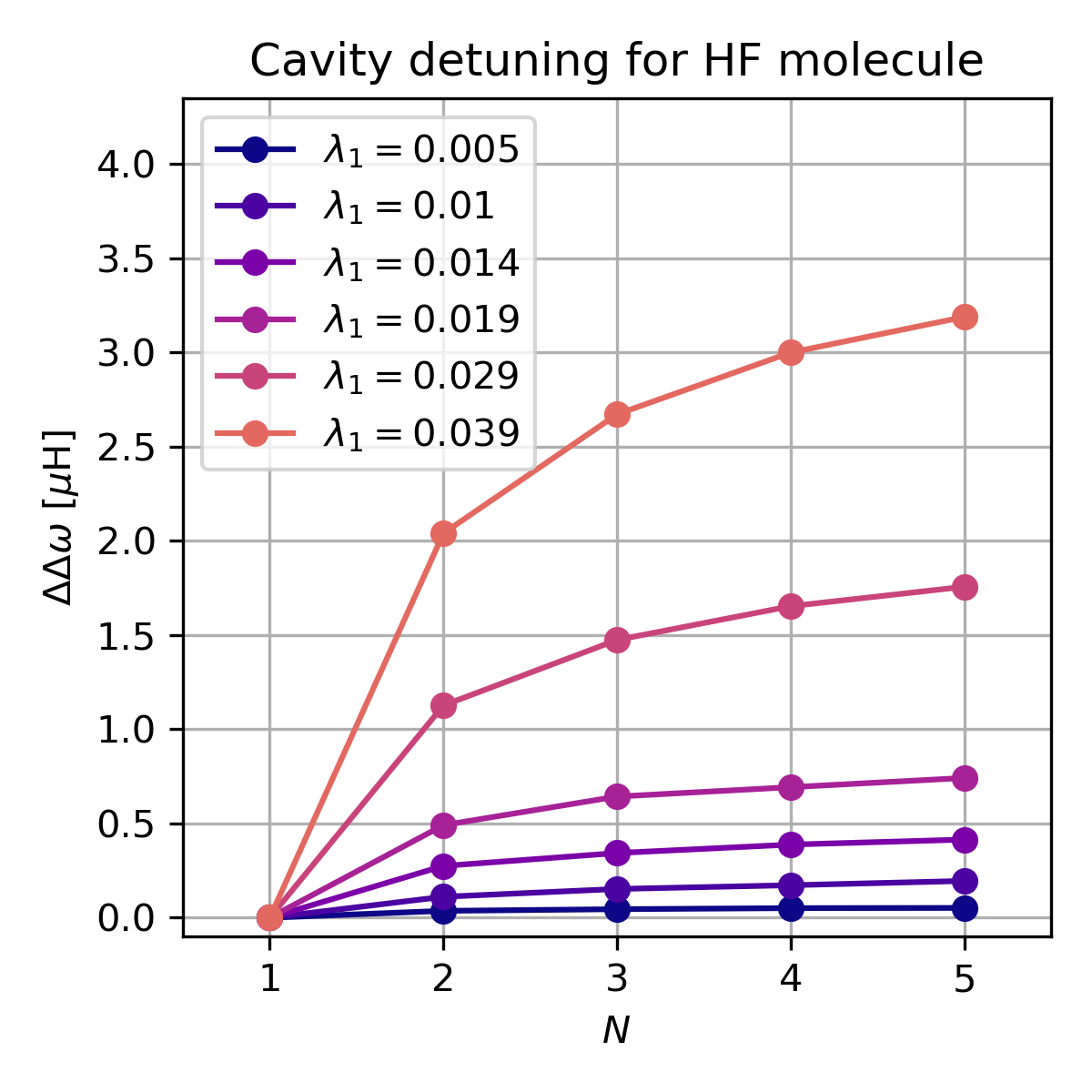
- 자기일관 해 및 Langevin 궤적으로부터 국소 쌍극 진동과 cavity detuning 같은 관측치를 계산한다.

실험 결과
연구 질문
- RQ1집단 진동 강결합이 열역학적 한계에서 개별 분자의 비제로 국소 극화를 유도하는가?
- RQ2cavity 유도 극화의 자기일관적 처리는 cavity 주파수(detuning) 및 관찰된 폴리트로닉 특징에 어떤 영향을 미치는가?
- RQ30의 순맥적 거시화에서도 국소 극화 패턴이 발생할 수 있으며 그것의 화학적 의의는 무엇인가?
- RQ4진동-폴리트로닉 커플링 하에서 분자 집합과 원자 집합의 국소 극화 효과가 질적으로 다른가?
주요 결과
- 자기일관적 cavity-Hartree 처리는 대규모 N 극한에서도 0이 아닌 cavity 유도 국소 극화를 지속시킴을 보여준다.
- 집합의 전체 전자 극화는 0으로 남아 있지만, 개별 분자는 국소 극화 변화(핫스팟)를 보인다.
- 자기일관된 극화장으로 인한 cavity의 레드 시프트(detuning) 현상이 관측과 일치한다.
- 국소 극화 패턴은 단일 균일한 값이 아닌 국소 극화를 분포시키는 연속적 극화 글래스 상태를 닮아 있다.
- 원자 집합의 경우 유사 조건에서도 국소 극화 메커니즘이 존재하지 않아 분자 특유의 물리가 강조된다.
- 결과는 극자-화학(polarto-l bit) 연구가 변위장-만으로의 모델을 넘어서 자기일관적 극화 처리를 필요로 함을 시사한다.
더 나은 연구,지금 바로 시작하세요
연구 설계부터 논문 작성까지, 연구 시간을 획기적으로 줄여보세요.
카드 등록 없음 · 무료 플랜 제공
이 리뷰는 AI가 만들고, 인간 에디터가 검토했습니다.