
[논문 리뷰] Updating the $^{56}$Ni Problem in Core-collapse Supernova Explosion
이 연구는 빛등불 근사법을 통한 중성미자 가열을 고려한 1D 라그랑주 유체역학을 사용하여 핵붕괴 초신성에서의 56Ni 문제를 조사한다. 연구 결과, 56Ni 합성 범위는 폭발 에너지 증가율($\dot{E}_{\text{expl}}$)에 민감하지 않지만, 56Ni의 탈출 물질 질량은 내부 물질이 탈출하는지 여부에 크게 의존하며, 이는 느린 폭발($\dot{E}_{\text{expl}} \lesssim 1$ 베스 펄스⁻¹)이 표면이 벗겨진 초신성에서 관측된 56Ni 질량을 재현하기에 부족함을 보여준다. 표면이 벗겨진 초신성에서 관측된 56Ni 질량을 재현하려면 초기 단계에서 더 빠른 폭발($\dot{E}_{\text{expl}} \gtrsim 2$ 베스 펄스⁻¹)이 필요하다.
Details of the core-collapse supernova (CCSN) explosion mechanism still need to be fully understood. There is an increasing number of successful examples of reproducing explosions in multidimensional hydrodynamic simulations, but subsequent studies pointed out that the growth rates of the explosion energy $\dot{E}_\mathrm{expl}$ of these simulations are insufficient to produce enough $^{56}$Ni to match observations. This issue is known as the `$^{56}$Ni problem' in CCSNe. Recently, however, some studies have suggested that this $^{56}$Ni problem is derived from the simplicity of the explosion model. In response, we investigate the effect of the explosion energy growth rate $\dot{E}_\mathrm{expl}$ on the behavior of nucleosynthesis in CCSNe in a more realistic model. We employ the 1D Lagrangian hydrodynamic code, in which we take neutrino heating and cooling terms into account with the light-bulb approximation. We reiterate that, consistent with previous rebuttal studies, there is the $^{56}$Ni problem: Although $^{56}$Ni is synthesized to almost the same mass coordinate independent of $\dot{E}_\mathrm{expl}$, some of the innermost material in the low-$\dot{E}_\mathrm{expl}$ model failed to escape, leading to a shift in the innermost mass coordinate of the ejecta to the outer positions. Comparing our results with observations, we find that while modern slow explosions can, in principle, reproduce observations of standard Type II SNe, this is not possible with stripped-envelope SNe. Our finding places a strong constraint on the explosion mechanism. There are significant differences in the progenitor structures and the explosion mechanism between Type II and stripped-envelope SNe.
연구 동기 및 목표
- 느린 폭발 에너지 증가율을 가진 시뮬레이션에서 관측된 56Ni 질량을 재현하지 못하는 핵붕괴 초신성에서 오랫동안 지속된 56Ni 문제를 해결하기 위해.
- 1D 유체역학 모델에서 중성미자 가열을 고려할 때 폭발 에너지 증가율($\dot{E}_{\text{expl}}$)이 핵합성과 탈출 물질 질량에 미치는 영향을 조사하기 위해.
- 현대의 느린 폭발 모델이 타입 II와 표면이 벗겨진 초신성의 관측 결과와 얼마나 타당한지 비교하기 위해.
- 56Ni 문제의 원인이 모델 단순화에 기인하는지 아니면 폭발 역학의 근본적 제약 때문인지 판단하기 위해.
- 타입 II와 표면이 벗겨진 초신성 간의 56Ni 수확량 격차를 설명하는 데 있어 원형성의 구조적 차이 또는 폭발 메커니즘의 다양성이 어떤 영향을 미치는지 평가하기 위해.
제안 방법
- 빛등불 근사법을 사용해 중성미자 가열 및 냉각 항목을 모델링한 1D 라그랑주 유체역학 코드.
- 초기 폭발 에너지 증가율($\dot{E}_{\text{expl}}$)을 0.1에서 5 베스 펄스⁻¹까지 다양하게 설정하여 자기 일관성 있는 폭발 모델링.
- 640종의 이sov종 핵반응 네트워크를 사용해 후처리 방식으로 56Ni 수확량을 계산.
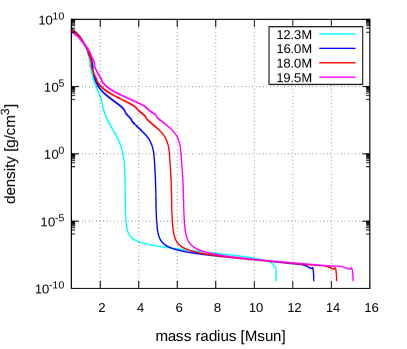
- ZAMS 시점에서 질량이 12.3, 16.0, 18.0, 19.5 M$_\odot$인 원형성의 별을 대상으로 시뮬레이션을 수행하였으며, 밀도 구조와 중성미자 빛나는 강도를 다양하게 설정.
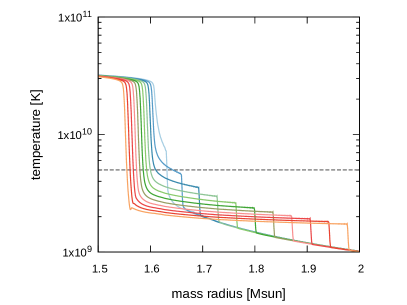
- 폭발 후 충격면, PNS, 56Ni가 풍부한 영역의 질량 좌표를 추적하여 탈출 조건과 탈출 물질 조성 평가.
- 시뮬레이션된 56Ni 질량을 타입 II와 표면이 벗겨진 초신성의 빛의 곡선에서 관측된 값과 비교.
실험 결과
연구 질문
- RQ1자기 일관성 있는 유체역학 모델에서 중성미자 가열을 고려할 때, 핵붕괴 초신성에서의 56Ni 수확량은 폭발 에너지 증가율($\dot{E}_{\text{expl}}$)에 따라 달라지는가?
- RQ2왜 현대의 느린 폭발 시뮬레이션($\dot{E}_{\text{expl}} \lesssim 1$ 베스 펄스⁻¹)은 표면이 벗겨진 초신성에서 관측된 56Ni 질량을 재현하지 못하는가?
- RQ356Ni 수확량과 $\dot{E}_{\text{expl}}$ 간의 반비례 관계가 이전 모델에서 초기 붕괴를 고려하지 못해 발생한 수치적 오류인가?
- RQ4느린 폭발은 표준 타입 II 초신성에서 관측된 56Ni 질량을 재현할 수 있는가, 아니면 더 빠른 폭발 단계가 필요한가?
- RQ5표면이 벗겨진 초신성에서 타입 II 초신성보다 더 높은 56Ni 질량을 유도하는 데 있어 원형성의 구조적 차이 또는 폭발 메커니즘의 다양성은 어떤 물리적 차이를 초래하는가?
주요 결과
- 56Ni 합성 범위(질량 좌표까지)는 $\dot{E}_{\text{expl}}$에 거의 영향을 받지 않으며, 이는 핵합성이 폭발 속도에 민감하지 않음을 시사한다.
- 낮은 $\dot{E}_{\text{expl}}$ 모델에서는 내부 물질이 탈출하지 못해 탈출 물질 질량 좌표가 외부로 이동하며, 전체 56Ni 질량이 감소한다.
- 유사한 56Ni 합성 조건에서도 탈출 물질의 56Ni 질량은 내부 PNS 표면 영역이 탈출 속도에 도달하는지 여부에 매우 민감하게 의존한다.
- 현대의 느린 폭발($\dot{E}_{\text{expl}} \lesssim 1$ 베스 펄스⁻¹)은 표준 타입 II 초신성에서 관측된 56Ni 질량($M_{\text{Ni}} \approx 0.03 M_\odot$)을 재현할 수 있다.
- 그러나 이러한 모델은 더 높은 56Ni 질량($M_{\text{Ni}} \approx 0.07 M_\odot$)을 보이는 표면이 벗겨진 초신성에서는 실패하며, 이는 $\dot{E}_{\text{expl}} \gtrsim 2$ 베스 펄스⁻¹이 필요함을 시사한다.
- 결과적으로 타입 II와 표면이 벗겨진 초신성 간의 원형성의 구조나 폭발 메커니즘에 중대한 차이가 있으며, 후자는 초기 단계에서 더 빠른 폭발을 선호함을 의미한다.
더 나은 연구,지금 바로 시작하세요
논문 읽기부터 검토까지, 연구 시간을 획기적으로 줄여보세요.
카드 등록 없음 · 무료 플랜 제공
이 리뷰는 AI가 만들고, 인간 에디터가 검토했습니다.