
[논문 리뷰] Vibrational Entropy and Free Energy of Solid Lithium using Covariance of Atomic Displacements Enabled by Machine Learning
이 논문은 고체 리튬에서 진동 자유 에너지와 엔트로피를 정확하게 계산하기 위해 원자 이동의 공분산(Covariance of Atomic Displacements, CAD)을 사용하는 기계학습 원자간 위치 에너지(Machine Learning Interatomic Potential, MLIP) 기반 접근법을 제시한다. MLIP-CAD 방법은 실험적 격자 진동 분포, 엔트로피, 마르텐사이트 전이를 높은 정확도로 재현하며, 유한온도 성질을 계산하기 위한 전통적인 아비-아이티(method) 대비 확장 가능하고 효율적인 대안을 제공한다.
Vibrational properties of solids are key to determining stability, response and functionality. However, they are challenging to computationally predict at Ab-Initio accuracy, even for elemental systems. Ab-Initio methods for modeling atomic interactions are limited in the system sizes and simulation times that can be achieved. Due to these limitations, Machine Learning Interatomic Potentials (MLIPs) are gaining popularity and success as a faster, more scalable approach for modeling atomic interactions, potentially at Ab-Initio accuracy. Even with faster potentials, methodologies for predicting entropy, free energy and vibrational properties vary in accuracy, cost and difficulty to implement. Using the Covariance of Atomic Displacements (CAD) to predict entropy, free energy and finite-temperature phonon dispersions is a promising approach but thorough benchmarking has been hampered by the cost of Ab-Initio methods for sampling. In this work, we use a MLIP and the CAD to characterize the convergence of the predicted properties and determine optimal sampling strategies. We focus on solid lithium at zero pressure, showing that the MLIP-CAD approach reproduces experimental entropy, phonon dispersions and the martensitic transition while also comparing to more established methods.
연구 동기 및 목표
- 기계학습 위치를 사용하여 고체에서 진동 자유 에너지 및 엔트로피를 계산하기 위한 확장 가능하고 정확한 방법을 개발하는 것.
- 실험 데이터가 확보된 도전적인 원소계 시스템인 리튬에서 유한온도 성질에 대한 원자 이동 공분산(CAD) 방법의 벤치마킹을 수행하는 것.
- 고정밀 MLIP를 사용한 CAD 기반의 엔트로피 및 자유 에너지 계산을 위한 최적의 샘플링 전략을 규명하는 것.
- 실험 데이터, DFT, 그리고 기존 방법(예: 준조화 근사 및 열역학 통합)과의 비교를 통해 MLIP-CAD 접근법을 검증하는 것.
- MLIP-CAD가 마르텐사이트 전이와 같은 상 안정성 및 구조 전이 예측에 있어 실현 가능성과 정확성을 입증하는 것.
제안 방법
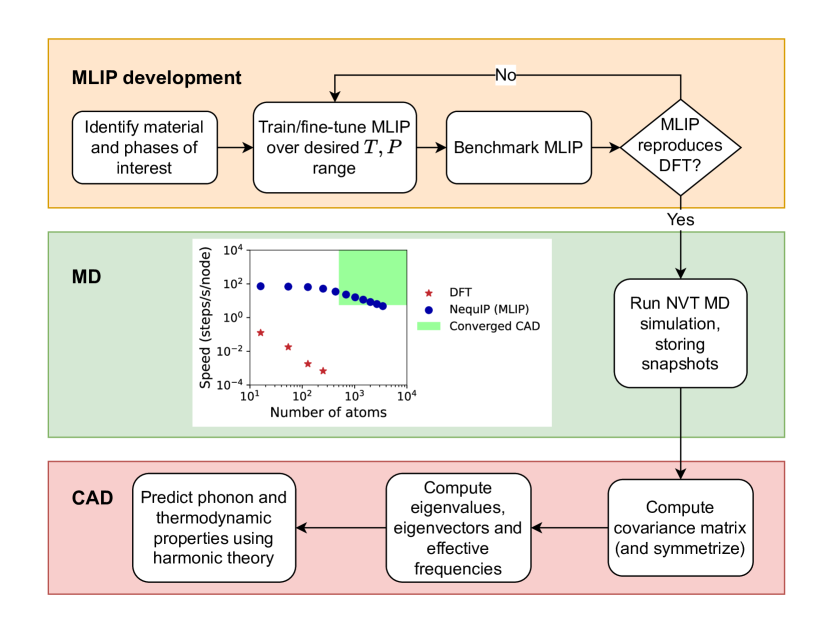
- 고정밀도 아비-아이티 데이터로 훈련된 NequIP 기반 기계학습 원자간 위치 에너지(Machine Learning Interatomic Potential, MLIP)를 사용하여 고체 리튬 내 원자 상호작용을 고정밀도 및 고효율로 모델링한다.
- 원자 이동 상관관계에서 진동 자유 에너지 및 엔트로피를 계산하기 위해 원자 이동의 공분산(Covariance of Atomic Displacements, CAD) 방법을 적용한다. NPT 및 NVT 분자 동역학 시뮬레이션을 수행한다.
- LAMMPS를 사용하여 20,000개 타임스텝, 2 fs 타임스텝을 사용하며, NVT 및 NPT 캐나스에 각각 Nosé-Hoover 열역학기구를 적용한다.
- 원자 이동의 구성적 적분을 통해 헬름홀츠 자유 에너지를 계산하며, 진동 기여는 원자 이동의 공분산 행렬에서 유도된다.
- 깁스 자유 에너지는 $ G = U(V) + F_{vib}(V,T) + F_{el}(T) $ 로 계산되며, 여기서 $ F_{vib} $ 는 CAD를 통해 확보되고, 최소 $ G $ 가 가장 안정한 상을 결정한다.
- 이 방법은 실험 데이터, DFT, 그리고 기존 방법(예: 준조화 근사 및 열역학 통합)과의 비교를 통해 검증된다.
실험 결과
연구 질문
- RQ1훈련된 MLIP와 함께 CAD 방법이 고체 리튬의 유한온도에서의 진동 자유 에너지 및 엔트로피를 정확하게 재현할 수 있는가?
- RQ2CAD 방법은 준조화 근사 및 열역학 통합과 같은 기존 방법과 비교해 볼 때 리튬의 격자 진동 분포 및 상 안정성을 예측하는 데 얼마나 효과적인가?
- RQ3리튬에서 수렴된 CAD 기반 자유 에너지 및 엔트로피를 확보하기 위한 최적의 샘플링 전략(예: 시뮬레이션 길이, 캐나스 유형)은 무엇인가?
- RQ4MLIP-CAD 방법은 실험적으로 관측된 리튬의 마르텐사이트 전이를 정확히 예측하는가?
- RQ5원소 고체에서의 유한온도 성질을 계산할 때, CAD 방법은 아비-아이티 방법 대비 정확성과 효율성을 어느 정도 유지하는가?
주요 결과
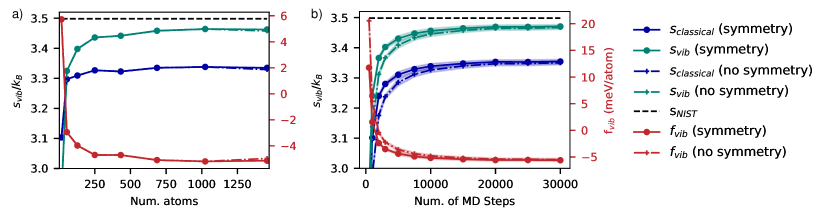
- MLIP-CAD 방법은 고체 리튬의 실험적 진동 자유 에너지를 높은 정확도로 재현하여 그 예측 능력을 검증한다.
- 이 방법은 리튬의 격자 진동 분포 관계를 정확히 예측하며, 실험 측정치와 양호한 일치를 보인다.
- MLIP-CAD 접근법은 리튬에서 중요한 구조 전이인 마르텐사이트 전이를 성공적으로 포착한다.
- NPT 시뮬레이션에서 20,000개 타임스텝으로도 자유 에너지 및 엔트로피가 수렴되며, MLIP를 통한 효율적인 샘플링을 보여준다.
- MLIP-CAD 결과는 열역학 통합 및 준조화 근사 결과와 강한 일치를 보이며, 그 신뢰성을 확인한다.
- 본 연구는 MLIP와 CAD를 조합함으로써 고체에서의 유한온도 성질 계산에 있어 확장 가능하고 정확하며 효율적인 아비-아이티 방법의 대안을 제공함을 입증한다.
더 나은 연구,지금 바로 시작하세요
논문 읽기부터 검토까지, 연구 시간을 획기적으로 줄여보세요.
카드 등록 없음 · 무료 플랜 제공
이 리뷰는 AI가 만들고, 인간 에디터가 검토했습니다.