
[논문 리뷰] Viewpoint-aware Progressive Clustering for Unsupervised Vehicle Re-identification
이 논문은 시점에 민감한 점진적 군집화(VAPC)를 제안하며, 예측된 시점에 따라 특징 공간을 분할하고 점진적 군집화를 적용하여 내부 클래스 변동을 감소시키는 새로운 비지도 차량 재식별 방법이다. 이 방법은 VeRi 및 VeRi-Wild 벤치마크에서 최신 기술 수준의 성능을 달성하였으며, 비지도 설정에서 VeRi-776에서 76.2%의 Rank-1 정확도를 기록했고, 잘못된 시점 예측이 있을 경우에도 성능이 유지된다.
Vehicle re-identification (Re-ID) is an active task due to its importance in large-scale intelligent monitoring in smart cities. Despite the rapid progress in recent years, most existing methods handle vehicle Re-ID task in a supervised manner, which is both time and labor-consuming and limits their application to real-life scenarios. Recently, unsupervised person Re-ID methods achieve impressive performance by exploring domain adaption or clustering-based techniques. However, one cannot directly generalize these methods to vehicle Re-ID since vehicle images present huge appearance variations in different viewpoints. To handle this problem, we propose a novel viewpoint-aware clustering algorithm for unsupervised vehicle Re-ID. In particular, we first divide the entire feature space into different subspaces according to the predicted viewpoints and then perform a progressive clustering to mine the accurate relationship among samples. Comprehensive experiments against the state-of-the-art methods on two multi-viewpoint benchmark datasets VeRi and VeRi-Wild validate the promising performance of the proposed method in both with and without domain adaption scenarios while handling unsupervised vehicle Re-ID.
연구 동기 및 목표
- 극단적인 시점 변화로 인해 발생하는 차량 Re-ID에서의 큰 내부 클래스 차이와 외부 클래스 유사성 문제를 해결한다.
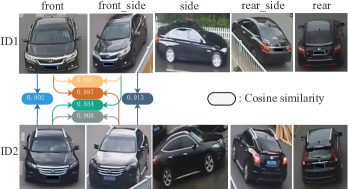
- 사람 Re-ID 군집화 방법을 차량에 직접 적용할 경우 발생하는 '유사도 딜레마' 문제를 해결한다. 이는 유사한 시점에서 찍힌 다른 차량이 서로 더 유사하게 보이며, 같은 차량이 다른 시점에서 찍힐 경우 더 유사도가 낮아지는 현상이다.
- 라벨이 부여된 소스 도메인 데이터가 필요 없는 타겟 전용 비지도 학습 프레임워크를 개발하여, 고비용 애너테이션을 수반하는 도메인 적응에 의존하지 않는다.
- 시점 인식 특징 분할과 다양한 시점 간의 점진적 군집 병합을 통해 비지도 차량 Re-ID의 군집 정확도를 향상시킨다.
제안 방법
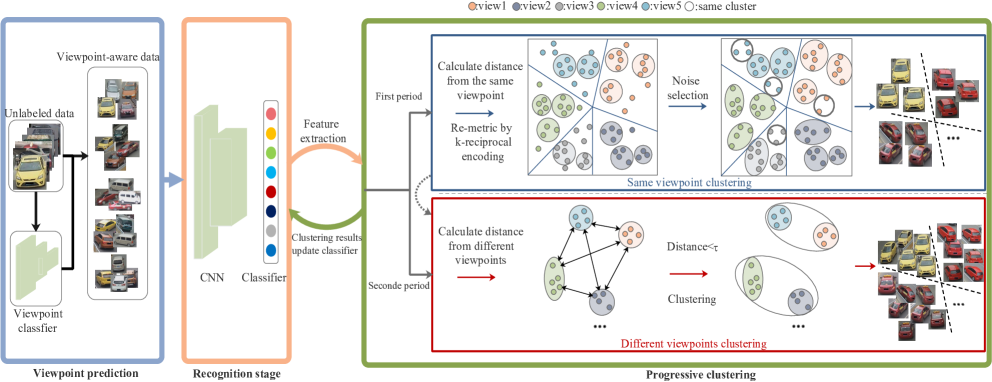
- 사전 학습된 시점 애너테이션을 사용하여 차량 이미지의 시점을 예측하는 시점 인식 네트워크를 제안하며, 이는 특징 공간을 분할하는 사전 정보로 기능한다.
- 예측된 시점에 기반해 특징 공간을 부분 공간으로 나누어, 각 시점 그룹 내에서 군집화를 수행함으로써 시점 간 변동을 줄이고 군집화 작업을 단순화한다.
- 유사도에 기반해 점진적으로 군집을 병합하는 전략을 구현하며, 동일 시점 군집에서 시작하여 점차 높은 시점 간 유사도를 가진 군집을 병합한다.
- 임계값 파rameter $\tilde{k}$를 사용해 클러스터링 중에 노이즈 샘플을 식별하고 분리하는 노이즈 선택 메커니즘을 도입하여, 잘못된 분류에 대한 강건성을 향상시킨다.
- t_i-번째 근접 이웃 쌍에서 유도된 거리 임계값 $\tau$를 사용해 시점 간 군집 병합을 제어하며, 군집의 밀집도와 정확도 사이의 균형을 유지한다.
- 가짜 레이블이 부여된 군집을 반복적으로 재학습하여 특징를 개선하고, 점진적 단계를 거쳐 군집 품질을 향상시킨다.
실험 결과
연구 질문
- RQ1시점 변화로 인한 내부 클래스 변동을 줄이기 위해 시점 인식 군집화가 비지도 차량 Re-ID 성능을 크게 향상시킬 수 있는가?
- RQ2단일 단계 군집화에 비해 다양한 시점 간의 점진적 군집 병합 전략은 차량 Re-ID에서 군집 정확도를 어떻게 향상시키는가?
- RQ3시점 예측 정확도가 낮을 경우 제안된 방법의 성능는 얼마나 떨어지며, 낮은 정확도의 시점 분류기 조건에서도 강건성을 유지할 수 있는가?
- RQ4실세계 환경에서 노이즈 샘플의 영향을 줄이기 위해 제안된 노이즈 선택 전략은 군집 품질에 얼마나 효과적인가?
주요 결과
- 제안된 VAPC 방법은 비지도 설정에서 VeRi-776 벤치마크에서 76.2%의 Rank-1 정확도를 달성하여 기존 최신 기술 수준의 비지도 방법을 능가한다.
- 시점 분류기 정확도가 0.5에 불과한 경우에도 70%의 Rank-1 정확도를 유지하여, 잘못된 또는 노이즈가 많은 시점 예측에 대해 강건함을 입증한다.
- 점진적 군집화 전략은 조정된 상호정보량(AMI) 측정 기준으로 군집 품질 향상에 기여하며, 반복적인 군집화 단계에서 성능이 점진적으로 향상된다.
- 파라미터 분석 결과, $t_i = 1200$ 및 $\tilde{k} = 2$가 최적의 성능을 내며, 특히 VeRi-Wild와 같이 내부 클래스 간 차이가 작은 데이터셋에서 군집 병합 정확도와 노이즈 제어의 균형을 잘 유지한다.
- VeRi-776 및 VeRi-Wild 양쪽 모두에서 뛰어난 성능을 기록하여, 소스 도메인 애너테이션 없이도 다양한 실세계 다중 시점 환경에서의 효과성을 입증한다.
- 노이즈 선택 전략은 노이즈 샘플의 부정적 영향을 효과적으로 줄이며, 반복적 군집화 과정에서 성능 붕괴를 방지하고 안정성을 향상시킨다.
더 나은 연구,지금 바로 시작하세요
논문 읽기부터 검토까지, 연구 시간을 획기적으로 줄여보세요.
카드 등록 없음 · 무료 플랜 제공
이 리뷰는 AI가 만들고, 인간 에디터가 검토했습니다.