
[논문 리뷰] Wave function network description and Kolmogorov complexity of quantum many-body systems
논문은 양자 다체 스냅샷을 설명하기 위해 파동함수 네트워크를 도입하고, 이를 이용해 Kolmogorov 복잡성을 추정하며, Rydberg 양자 시뮬레이터에서 스케일-프리 네트워크와 교차 플랫폼 인증을 시연한다.
Programmable quantum devices are now able to probe wave functions at unprecedented levels. This is based on the ability to project the many-body state of atom and qubit arrays onto a measurement basis which produces snapshots of the system wave function. Extracting and processing information from such observations remains, however, an open quest. One often resorts to analyzing low-order correlation functions - i.e., discarding most of the available information content. Here, we introduce wave function networks - a mathematical framework to describe wave function snapshots based on network theory. For many-body systems, these networks can become scale free - a mathematical structure that has found tremendous success in a broad set of fields, ranging from biology to epidemics to internet science. We demonstrate the potential of applying these techniques to quantum science by introducing protocols to extract the Kolmogorov complexity corresponding to the output of a quantum simulator, and implementing tools for fully scalable cross-platform certification based on similarity tests between networks. We demonstrate the emergence of scale-free networks analyzing data from Rydberg quantum simulators manipulating up to 100 atoms. We illustrate how, upon crossing a phase transition, the system complexity decreases while correlation length increases - a direct signature of build up of universal behavior in data space. Comparing experiments with numerical simulations, we achieve cross-certification at the wave-function level up to timescales of 4 $μ$ s with a confidence level of 90%, and determine experimental calibration intervals with unprecedented accuracy. Our framework is generically applicable to the output of quantum computers and simulators with in situ access to the system wave function, and requires probing accuracy and repetition rates accessible to most currently available platforms.
연구 동기 및 목표
- 저차의 상관관계를 넘어서는 다체 파동함수 스냡샷에 대한 구조화되고 정보가 풍부한 설명을 제시한다.
- 스핀, 보손, 페르미온 시스템에 대해 전체 정보 내용을 보존하는 네트워크 표현(파동함수 네트워크)을 개발한다.
- 생성된 네트워크가 스케일-프리일 수 있음을 보여주고 이 구조를 사용해 Kolmogorov 복잡성을 추출한다.
- 네트워크 기반의 유사도 테스트를 이용한 양자 시뮬레이터의 플랫폼 간 인증을 시연한다.
제안 방법
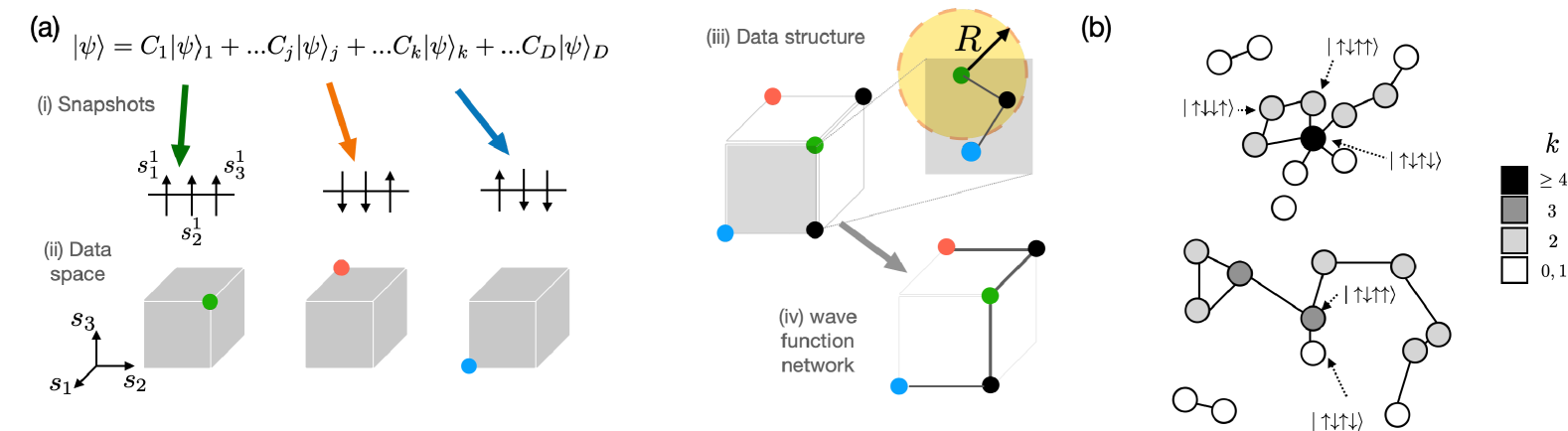
- 스냅샷 모음집을 네트워크로 매핑하되 각 스냅샷은 노드이고 구성 간 해밍 거리가 컷오프 R 미만인 경우 링크를 그린다.
- 컷오프 R을 평균 이웃 거리로 정의하여 네트워크 희소성을 안정화한다.
- 구성 간의 짧은 거리와 긴 거리를 모두 포착하기 위해 해밍 거리를 사용한다.
- 2-NN(두 개의 가장 근접한 이웃) 고유 차원 방법을 통해 파동함수 스냅샷의 Kolmogorov 복잡성을 추정한다.
- Epps-Singleton 검정을 적용하여 플랫폼 간 네트워크를 비교하고 교차 검증이 성립하는 시간 스케일을 식별한다.
실험 결과
연구 질문
- RQ1파동함수 스냅샷이 기반 상관관계와 임계 거동을 드러내는 네트워크로 충실하게 표현될 수 있는가?
- RQ2파동함수 네트워크가 양자 위상 전이 근처에서 스케일-프리 특성을 보이며, 이 특성이 실공간 상의 상관관계와 어떻게 관련되는가?
- RQ3네트워크 기반 Kolmogorov 복잡성이 양자 시뮬레이터의 정보 내용과 그 진화를 정량화할 수 있는가?
- RQ4네트워크 기반 교차 플랫폼 인증이 실험 데이터와 수치 데이터 간 체계적 불일치를 식별하는 데 얼마나 효과적인가?
주요 결과
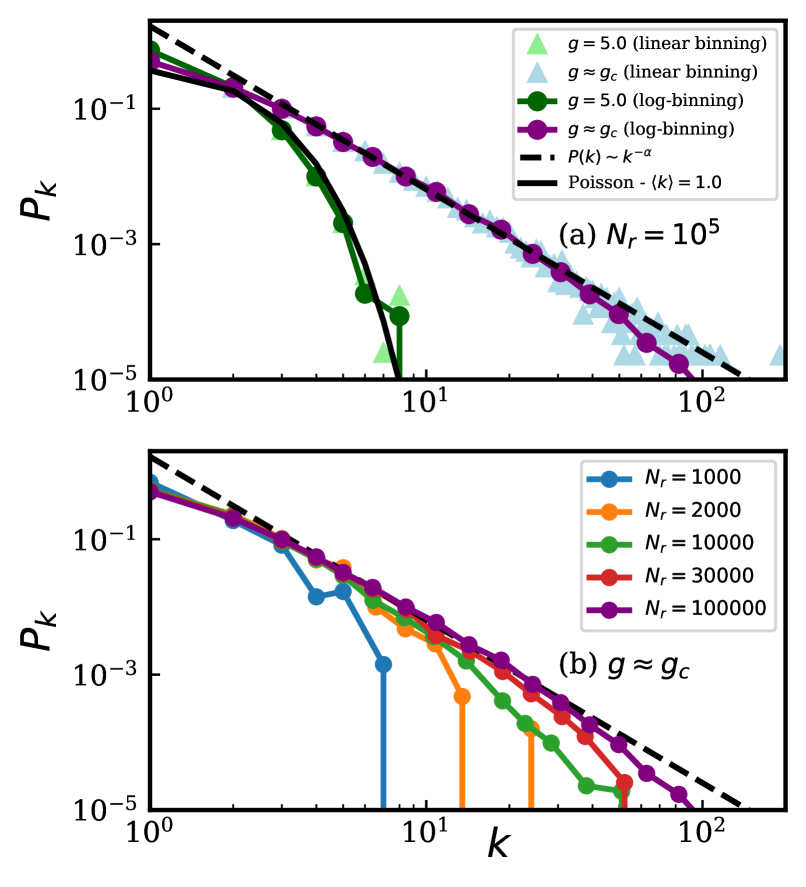
- 상관된 영역 근처에서 파동함수 네트워크는 스케일-프리로 변할 수 있는 반면, 파라모나믹(ER-유사) 구역은 Erdos-Renyi 네트워크에 가깝다.
- 2D 양자 이징 모델에서 차수 분포 Pk는 준자성 구간에서 포아송 분포를 보이고 임계점 근처에서 지수 α ≈ 2.4의 멱법칙을 따른다.
- 실험은 루이드 양자 시뮬레이터를 통해 Pk가 짧은 시간에는 지수적 감소에서 나중에는 강건한 멱꼴 꼬리(α < 2)로 진화한다.
- 배열에 약 3% 결함을 포함해도 스케일-프리 구조가 파괴되지 않아 네트워크 시그니처의 강건성을 시사한다.
- 네트워크 기반의 교차 플랫폼 검증은 파동함수 수준의 거동을 약 4 μs까지 약 90% 신뢰도로 인증할 수 있다.
- 파동함수 스냅샷의 Kolmogorov 복잡도는 2-NN 고유 차원 접근법으로 추정할 수 있으며, 보편적 거동이 구축되면서 단순성이 드러난다.
더 나은 연구,지금 바로 시작하세요
연구 설계부터 논문 작성까지, 연구 시간을 획기적으로 줄여보세요.
카드 등록 없음 · 무료 플랜 제공
이 리뷰는 AI가 만들고, 인간 에디터가 검토했습니다.